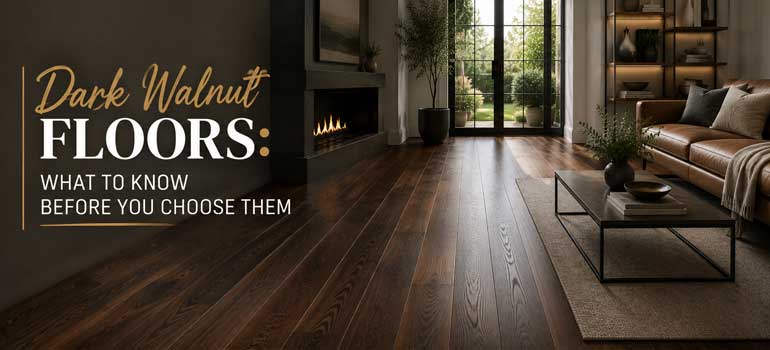
Walnut has a genuine appeal that's hard to argue with: deep, rich colour, natural grain variation between boards, and a character that few other species match. Before committing to it, though, it's worth being clear-eyed about a few things the marketing around walnut often glosses over, starting with cost.
Is walnut still on trend, or has the market moved on?
It's worth updating the picture here. Darker wood tones did have a real moment over recent years, but current flooring trends have shifted toward warmer honey and caramel mid-tones rather than the darkest, most dramatic extremes.
- Walnut hasn't fallen out of favour, but it's no longer the dominant direction the wider market is moving in
- It remains a genuinely strong choice for a deliberate, dramatic statement, particularly in a formal living room, study or dining room
- If you want current warmth without walnut's full darkness, a mid-tone oak stain is worth considering as an alternative
Our guide to how wood floor colour changes the mood of a room covers how different tones affect a space if you're still deciding on colour more broadly.
Where does dark walnut actually work best?
It's not accurate to say walnut suits absolutely any room equally well, and it's worth being honest about where it's a stronger fit.
- Walnut is genuinely softer than oak on the Janka hardness scale, so it shows dents and scratches a little more readily under heavy daily use
- Lower-traffic, more formal rooms are where walnut performs best: living rooms, studies, dining rooms and bedrooms
- Busy hallways, kitchens and high-traffic family rooms are better suited to a harder species like oak or maple, where walnut's softness becomes a more noticeable practical trade-off
- Commercial spaces with heavy footfall generally do better with a harder species too, reserving walnut for lower-traffic areas like a reception or boardroom
Is dark walnut actually budget-friendly?
This needs a direct correction: walnut typically costs more than oak, not less. Walnut trees grow more slowly and yield less usable timber per tree, and its colour and grain variation are genuinely sought after, all of which push its price above oak rather than below it.
That said, there are real ways to manage the cost if walnut's look is what you want:
- Engineered walnut gives you the same genuine walnut surface over a more efficient, stable core, stretching the material further than solid walnut would
- Choosing a lower or more character-rich grade with visible knots and grain variation, rather than a premium clear grade, can bring the price down while keeping walnut's distinctive look
- Using walnut as a feature rather than throughout, in one room or as an accent area, limits the overall material cost while still getting the visual impact
Our oak vs walnut guide covers the cost and hardness comparison between the two species in full detail.
Protecting the colour over time
Every wood floor changes colour somewhat with age and light exposure, walnut included, though the degree varies by product and light exposure rather than following a simple rule about dark woods always fading more dramatically.
- A UV-protective finish, applied at the factory or added after installation, slows colour change considerably compared with an untreated surface
- Rugs and furniture left in the same position for years can create uneven fading patches, so rotating them occasionally helps keep the colour even
- Direct, sustained sunlight through large windows is where UV protection matters most, since that's where colour change happens fastest
If dark walnut sounds right for your project, our parquet floor fitting team can advise on solid versus engineered options, grade and finish to help manage the cost realistically. Get in touch for a free quote whenever you're ready.
Frequently asked questions
Is walnut too soft for a family home with kids and pets? Not necessarily, but it's worth going in with realistic expectations. It will show dents and scratches a little more readily than oak under heavy daily use, so it suits a lower-traffic room in a family home better than the main living or hallway space.
Can I get the look of walnut without paying walnut prices? Staining a harder, more affordable species like oak to a darker, walnut-like tone is one option, giving you similar colour and better durability at a lower cost, though without walnut's natural grain variation between boards. Engineered walnut is the other route if genuine walnut matters to you.
Does dark walnut make a small room feel smaller? Colour plays a smaller role in this than pattern direction and lighting do, so it's not a simple yes or no. A well-lit room with walnut laid to draw the eye down its longest dimension can still feel open despite the dark tone.
How often does a walnut floor need refinishing compared with oak? Refinishing frequency depends more on finish type and traffic than species, so a walnut floor with the same finish and traffic level as an oak floor needs attention at roughly the same intervals. Walnut's softer surface may show the need for it a little sooner in a busy room.
Is engineered walnut as good-looking as solid walnut? Yes, since the visible surface is the same genuine walnut veneer either way, the appearance is identical once fitted and finished. The difference is entirely in the construction underneath, not what you see and feel underfoot.