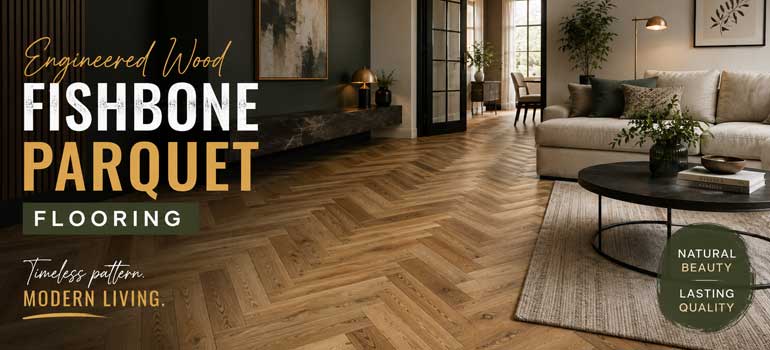
We fit both solid and engineered wood fishbone parquet across London homes and commercial spaces, and it's one of the patterns clients ask for most. Fishbone, also called herringbone, is the oldest and most recognised parquet pattern still in regular use, and engineered wood has made it far more practical to specify than it used to be. This guide covers what the pattern actually is, how engineered boards differ from traditional solid parquet blocks, and what to weigh up before choosing oak or walnut for your own floor.
What is fishbone (herringbone) parquet?
Fishbone and herringbone are two names for the same pattern. Rectangular boards are laid at right angles to each other so each row zigzags down the room, named for its resemblance to the bones of a fish skeleton. It's easy to confuse with chevron, a related pattern where the board ends are mitred at an angle so the rows form one continuous straight line instead of a staggered zigzag. Fishbone stays the more common choice because the square-cut ends are simpler and cheaper to produce than chevron's angled cuts, and the pattern reads as slightly less formal.
The design isn't new. Herringbone brickwork goes back to Roman road construction, but its use as a flooring pattern dates to 16th-century France, with one of the earliest wooden examples laid at the Château de Fontainebleau in 1539. It became a fixture of French aristocratic interiors through the 1600s and has stayed one of the most requested wood floor patterns ever since.
How is engineered fishbone parquet different from solid wood parquet?
Solid parquet blocks are cut from a single piece of hardwood, while engineered boards are built from several cross-layered plies topped with a hardwood veneer. That layered core is the whole point: it holds its shape far better than solid wood when humidity or temperature shifts, so you get less of the cupping, gapping and loose blocks that older solid parquet floors are prone to over time. Once fitted and finished, engineered and solid fishbone parquet look identical. The difference is entirely in what's underneath.
This construction also opens up rooms where solid parquet isn't a safe bet, including kitchens, bathrooms with good ventilation and floors laid over underfloor heating. If underfloor heating is part of the project, engineered wood is the only sensible option; solid wood parquet shouldn't go anywhere near it. Even with engineered boards, the glue-down fitting method is generally recommended over underfloor heating, since it limits movement between the board and the subfloor as temperatures change.
Oak or walnut: which fishbone parquet should you choose?
Both are supplied as engineered boards with a UV-lacquered finish, and the choice mostly comes down to colour and budget rather than performance.
| Engineered oak fishbone | Engineered walnut fishbone | |
|---|---|---|
| Look | Warm, light to mid-tone, classic | Darker, richer brown tones |
| Cost | More budget-friendly | Sits at a higher price point |
| Finish | Can be supplied unfinished if you want to choose your own finishing product | Typically UV-lacquered, hard-wearing and fade-resistant under sunlight |
| Best suited to | Most rooms, DIY-friendly supply, versatile styling | Statement rooms, darker interior schemes |
Oak is the more forgiving, all-purpose choice and works with almost any interior style. Walnut gives a room more visual weight and reads as a deliberate design statement, which suits a living room or study more than it suits a hallway that needs to blend in.
Can you fit engineered fishbone parquet yourself?
You can, but it's worth being realistic about the skill involved before you commit to a DIY fit. Herringbone and fishbone patterns are consistently rated as one of the more advanced flooring layouts to get right, because every row depends on the accuracy of the one before it. A small error in your starting line compounds as you work across the room, and by the far wall it can throw the whole pattern visibly off-square. Engineered boards make the job more manageable than working with loose solid parquet blocks, since they arrive pre-finished and dimensionally consistent, but the setting-out and cutting still call for a steady hand and the right tools.
For a floor that's going to be walked on every day for the next few decades, most clients find it's worth having it fitted the first time properly. Our parquet floor fitting team handles the setting-out, acclimatisation and cutting that a DIY fit often gets wrong, and we also cover commercial parquet floor fitting for offices, restaurants and retail spaces where downtime matters.
Choosing your finish
Engineered fishbone boards generally come two ways: pre-finished with a UV lacquer straight from the factory, or supplied with an unfinished top layer so you can choose your own lacquer or oil once fitted. A factory lacquer is the lower-maintenance route and tends to be more resistant to fading from direct sunlight. An oiled or site-applied finish gives you more control over the final sheen and colour, and it's easier to spot-repair small areas later without refinishing the whole floor. Either way, the finish sits on top of a real hardwood wear layer, so it can be sanded and refinished again down the line, just like solid wood.
If you're weighing up your options for a specific room, our engineered wood flooring range covers the full spread of species and finishes we work with, and we're happy to talk through what suits your subfloor and traffic levels before you order anything. You can get a free, no-obligation quote for your project, and if solid wood parquet blocks are more your style, our parquet flooring blocks are also worth a look for comparison.
Frequently asked questions
Is engineered fishbone parquet as durable as solid wood? In most cases, it holds up better. The cross-layered core resists warping and gap formation from humidity changes more effectively than solid wood, and the hardwood wear layer can still be sanded and refinished multiple times over the floor's life, so you're not trading away long-term durability for stability.
How much of the floor is real wood? The visible wear layer is genuine hardwood, whichever species you choose. It's the core underneath, made from cross-layered plies, that's engineered rather than solid, which is what gives the board its added stability.
Does fishbone parquet make a small room look smaller? No, if anything it tends to do the opposite. The diagonal lines draw the eye across the room rather than straight down it, which is why the pattern is popular in hallways and smaller rooms as well as larger open-plan spaces.
Can engineered fishbone parquet be laid over an existing floor? Often yes, depending on what's currently down and its condition. Engineered boards can generally go over concrete, plywood, and some existing hard floors, though the subfloor needs to be flat, dry and stable first. It's best to have this checked before ordering materials.
Does the direction of the pattern matter? Yes. The angle you start the fishbone pattern at changes how the light catches the boards and how the room reads visually, which is one of the setting-out decisions worth getting right before the first board goes down rather than after.