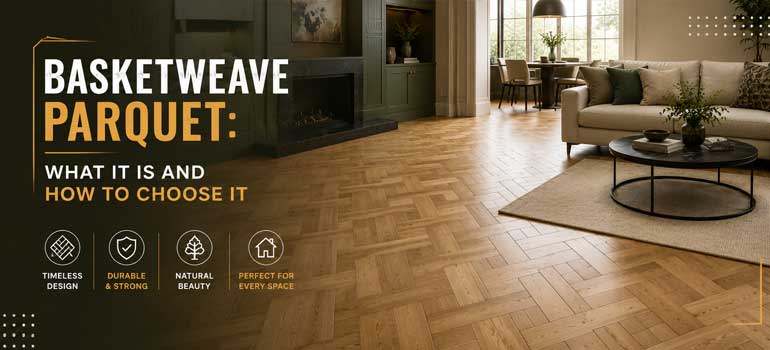
Basketweave is one of parquetry's calmer, more understated patterns, and it's worth explaining properly since the name alone doesn't tell you much. Rather than the strong directional zigzag of herringbone or chevron, basketweave arranges groups of parallel wood blocks at alternating right angles to each other, creating an interlocking, over-under effect that genuinely resembles a woven basket. It's been a popular choice since parquetry first took hold in French interiors centuries ago, and it's had a particular resurgence in mid-century and retro-inspired homes more recently.
What makes basketweave distinctive
Because the pattern doesn't pull the eye in one strong direction the way herringbone does, basketweave reads as calmer and more subtle in a room. That makes it a good fit for smaller spaces and entryways, where you want geometric texture and interest without a pattern that dominates the space. It also takes well to contrasting wood tones: traditionally basketweave uses a fairly uniform, often lighter wood, but mixing in a darker contrasting shade for alternating groups of blocks gives it a bolder, more graphic look if that's the effect you're after.
Why does basketweave cost more than simpler patterns?
The interlocking structure is more involved to produce and lay than a straight-plank or brick bond floor, which is the main reason it sits at a higher price point. Traditionally, achieving a genuinely hand-laid basketweave floor called for a skilled, experienced fitter working block by block, and specialists capable of that level of work aren't easy to find or inexpensive to hire. Ready-constructed basketweave panels are a more practical middle ground for most projects, giving you close to the same visual effect at a lower cost and with a much more straightforward installation than fully bespoke, hand-laid parquetry.
Solid or engineered wood for basketweave?
This comes down to where the floor is going and what conditions it needs to cope with. Engineered wood is generally the better choice for busy areas and rooms with bigger swings in temperature or humidity, such as kitchens, hallways and basements, since its layered construction resists warping and gapping far better than solid wood over time. Bathrooms are a case worth being careful with specifically: engineered wood can work there, but only with good ventilation, a lacquered rather than oiled finish, and by keeping the floor away from direct splash zones like right beside a bath or shower, since even engineered wood is water-resistant rather than waterproof. If a bathroom gets heavy daily use with limited ventilation, it's worth discussing that specific room with a fitter before committing to wood at all.
If you'd like to see how basketweave compares with the other common parquet patterns before deciding, our guide to wood flooring patterns covers herringbone, chevron, brick bond and Versailles alongside it. Basketweave's calm, understated character also makes it a strong option for hallways specifically, if you're weighing it up for that kind of high-traffic entry space. Our parquet floor fitting team fits basketweave in both solid and engineered wood across London, and can advise on which suits your room before you order material. Get in touch for a free quote whenever you're ready.
Frequently asked questions
Is basketweave harder to maintain than other parquet patterns? Not particularly, day to day. It's cleaned and cared for the same way as any other wood floor. The extra cost and effort with basketweave comes at the installation stage rather than in ongoing maintenance.
Does basketweave suit a small room? Yes, generally better than bolder patterns like herringbone laid diagonally or a full Versailles panel design, since it doesn't have a strong directional pull that can feel overwhelming in a compact space.
Can basketweave be laid with underfloor heating? It can, provided you're using engineered wood fitted with the glue-down method, following the same guidance that applies to underfloor heating with any wood floor pattern. Solid wood isn't recommended over underfloor heating regardless of the pattern.
What's the difference between basketweave and square basket? They're closely related. Standard basketweave typically pairs or groups blocks in a woven arrangement, while square basket variants often introduce a small contrasting block, sometimes called a fillet, in the gaps between the woven groups for extra detail.
Is ready-made basketweave as durable as hand-laid parquet? Yes, a quality ready-constructed panel is just as durable as hand-laid blocks, since the difference is in how it's produced and installed, not the wood itself. The wood species, construction and finish are what determine durability, not whether it was hand-fitted piece by piece.