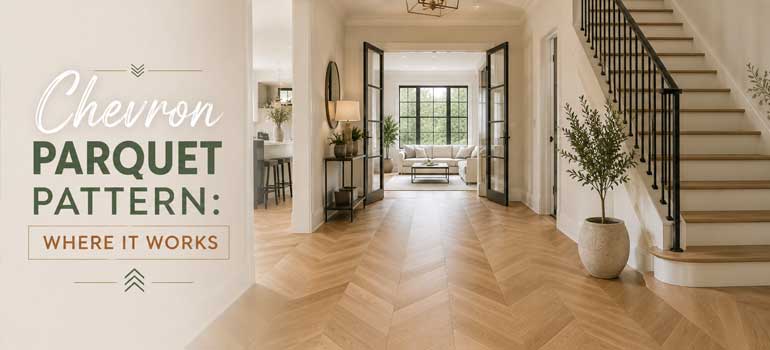
Chevron is one of the most requested parquet patterns for good reason: its continuous, unbroken "V" reads as sharp and deliberate in a way few other layouts manage. Before deciding where to use it, though, it's worth getting the history and the room-suitability advice right, since a couple of common claims about chevron need a closer look.
What actually distinguishes chevron
Chevron pieces are mitred at an angle, meeting edge to edge to form one continuous line down the room, which is what separates it from herringbone's staggered, square-cut zigzag. Both patterns get produced in solid hardwood and engineered wood, cut and arranged into precise, symmetrical points. Our dedicated guide to why we love chevron patterned parquetry covers the construction and cost differences from herringbone in more depth.
Getting the history right
Parquet flooring did not originate at Versailles. The pattern known as Parquet de Versailles is a specific design dating to 1684, but parquetry as a general technique was already established in France well before that, with one of the earliest documented examples laid at the Château de Fontainebleau back in 1539. It was introduced as a lighter, more practical alternative to the marble floors common in grand homes at the time, which were difficult to maintain and damaging to the joists beneath them. Versailles gave one particular elaborate pattern its name; it wasn't where parquet flooring began.
Room size: direction matters more than the pattern itself
It's often claimed that chevron automatically makes small rooms feel more spacious, and that claim needs a closer look, especially since it's sometimes followed immediately by a warning that the same pattern can make a room feel cluttered. Both things can be true depending on how the pattern is used, which is exactly the point worth clarifying: it's the direction chevron is laid in, not some inherent property of the pattern itself, that determines the effect.
- Laid diagonally across a room, chevron can help a narrower space feel wider
- Laid down the length of a room, it emphasises depth rather than width
- A larger-scale chevron in a small room is more likely to feel busy or cluttered than a finer, tighter pattern would in the same space
- Colour and lighting do real work too, so pattern choice alone rarely makes or breaks how spacious a room feels
Where chevron actually suits each room
This is worth being more precise about than a blanket "it looks great anywhere" claim.
- Living rooms, bedrooms, hallways and dining rooms suit both solid hardwood and engineered chevron well, since these rooms don't face extreme humidity or temperature swings
- Kitchens are a much tougher environment, and engineered wood is the sensible choice here given the moisture and temperature changes a kitchen produces, though it's still worth pairing it with a durable, well-maintained finish
- Conservatories need real care regardless of construction, given the extreme daily temperature swings and direct sun exposure these rooms see. Engineered wood with a UV-protective finish is the safer route, and our guide to wood flooring for a conservatory goes into this in full
- Bathrooms are the room worth being most cautious about. Even engineered wood is water-resistant rather than waterproof, so it only makes sense there with good ventilation, a lacquered finish, and kept well away from direct splash zones like beside a bath or shower. It's not accurate to call this a "perfect" choice without those conditions attached
If you're considering chevron for a specific room and want honest advice on whether wood actually suits it, our parquet floor fitting team can talk it through. Get in touch for a free quote whenever you're ready.
Frequently asked questions
Is chevron a safe choice for a small hallway? Yes, particularly laid down the length of the hallway to emphasise depth, or with a finer, smaller-scale pattern to avoid feeling busy in a tight space. It's a popular choice for exactly this kind of room.
Does engineered wood chevron look different from solid wood once fitted? No, they look identical once installed and finished. The difference is entirely in the construction underneath, which affects stability and room suitability rather than appearance.
Is a bathroom ever truly off-limits for wood chevron flooring? Not entirely off-limits, but it's worth a properly honest conversation with a flooring professional about your specific bathroom's ventilation and daily use before committing to it. A poorly ventilated, heavily used bathroom is a much harder case to make wood work in than a well-ventilated one.
Why do people confuse chevron's origin with Versailles so often? Versailles is the most famous single example of parquet flooring in history, so it's an easy shorthand to reach for, even though the specific Versailles pattern came about a century and a half after parquetry itself was already established in France. The association is understandable, just not accurate as an origin story.
Does chevron cost more in a conservatory or bathroom than in a standard room? Not because of the room itself, but engineered wood with a UV-protective or lacquered finish, which these rooms actually need, does typically cost more than a standard finish. It's worth factoring that into your budget rather than assuming the price is the same as a straightforward living room installation.