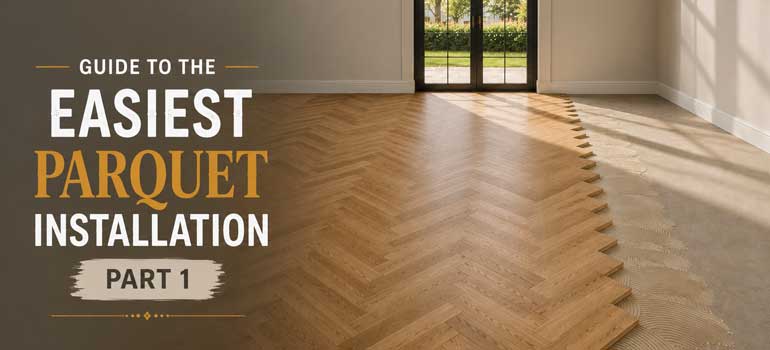
Laying parquet is genuinely one of the more demanding flooring jobs out there, which is why professional fitting is usually the recommended route. That said, some people are working to a tighter budget, and others are simply confident, experienced DIYers who want to take it on themselves. Either way, the planning and preparation stage covered here matters just as much as the actual fitting, whether you're doing the work yourself or checking that a hired team is doing it properly.
Planning before you buy anything
Parquet is a genuine investment, so it's worth researching properly before committing to materials. Be wary of unusually cheap pricing, since it's rarely a sign of good value with a product this dependent on quality timber and construction. Ask for recommendations from people who've had parquet fitted before, and get a clear sense of whether it's genuinely the right choice for your specific room before ordering anything.
If your property is newly built, timing matters more than people expect. Parquet installation should be the last major job in the room, after all plastering and concrete work has fully dried out, since moisture from ongoing building work is exactly the kind of thing that causes problems for wood flooring later.
How long does acclimatisation actually take?
This is worth getting right rather than working to a rough rule of thumb. Solid wood generally needs longer to acclimatise than engineered wood, but the exact timeframe varies considerably by manufacturer, species and how different your storage conditions were from the room it's going into.
- Manufacturer guidance for solid wood commonly ranges from around a week up to two weeks or more, particularly if there's a significant gap between how the wood was stored and the conditions in your home
- Engineered wood typically needs far less, often as little as 24 to 72 hours, thanks to its more stable, cross-layered construction
- The most reliable approach isn't a fixed number of days at all, but checking the wood's moisture content against the subfloor with a moisture meter, since acclimatisation is genuinely complete once those readings stop drifting and match the room's actual conditions
- Keep flooring boxed but opened along the seams during this period, and avoid stacking it directly on cold concrete or against an exterior wall
Getting this step right matters because all wood flooring naturally expands and contracts with humidity. Our guide to why wood floors expand and contract with the seasons covers why this movement happens and how to manage it once the floor's fitted, but proper acclimatisation before that point is what prevents the more serious version of the same problem.
Getting the room ready
If your concrete subfloor can't be brought within the standard dryness range, a moisture-blocking underlayment is worth the investment rather than risking the floor above it. This preparation stage is also the right time to decide on any extras you want built in, soundproofing insulation or an underfloor heating system, since both are far easier to fit before the flooring goes down than to retrofit afterward.
One detail worth remembering: skirting boards should go in after the flooring, not before. They're what covers the expansion gap left around the room's perimeter during fitting, so installing them too early leaves you working around finished trim rather than simply covering the gap once everything else is done.
Which subfloors actually work for parquet?
Parquet can go over more subfloor types than people often assume, though not every surface is suitable without extra preparation.
| Subfloor type | Suitable for parquet? |
|---|---|
| Concrete | Yes, provided it's tested for moisture, dry, level and clean |
| Plywood | Yes, a common and reliable base |
| Existing solid wood flooring | Generally not for glued solid blocks directly; engineered parquet with the right preparation and fitting method can sometimes work instead |
| Uneven or unlevelled surfaces | No, not without levelling work first, regardless of the subfloor material |
Whatever the base, it needs to be completely flat and level, dry and clean before anything is fitted on top. Skipping this step is one of the more common reasons a parquet installation runs into problems later, however good the materials themselves are.
Part two of this series covers the actual installation method for parquet flooring. If you'd rather have the whole process, planning included, handled by someone experienced, our parquet floor fitting team covers it from start to finish, and our guide to what to look for in a flooring contractor is worth a read if you're hiring rather than doing it yourself. Get in touch for a free quote whenever you're ready.
Frequently asked questions
Can I speed up acclimatisation if I'm on a tight schedule? Not really, since rushing this step is exactly what causes problems once the floor is fitted. If timing is a genuine constraint, engineered wood's shorter acclimatisation window is worth considering over solid wood for that reason alone.
Do I need a moisture meter, or can I just estimate acclimatisation by eye? A moisture meter is genuinely the more reliable method, since you can't tell by looking or touching whether the wood's moisture content has actually stabilised to match the room. It's a worthwhile investment even for a single DIY project, or your fitter should have one as standard equipment.
Is it ever worth skipping acclimatisation entirely? No, this is one step not worth cutting corners on regardless of how confident you feel about the wood's condition. Skipping it risks gaps, cupping or buckling appearing after installation, which are far more costly and disruptive to fix than the wait itself.
What if my subfloor fails the moisture test? A moisture-blocking underlayment is the standard solution rather than proceeding anyway, since fitting over a subfloor that's too damp risks serious problems for the flooring above it. It's worth having this tested properly before ordering materials, not after they've arrived.
Can I fit parquet over tile? It depends on the tile's condition and levelness rather than being a simple yes or no, so it's worth having it assessed specifically. A sound, flat, well-adhered tile surface can sometimes work as a base, but a professional opinion is worth getting before assuming it will.