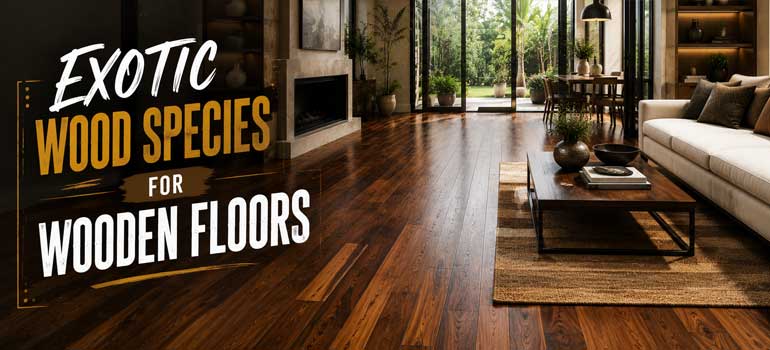
Oak, walnut and maple cover most flooring conversations, but they're far from the only options if you want something genuinely distinctive underfoot. A handful of less common species bring colours, grain patterns and hardness ratings that domestic timber simply doesn't offer. Here's a look at six worth knowing about, including two where the usual claims about them online need correcting.
Jatoba
Also known as Brazilian cherry, Jatoba shares cherry's warm reddish tone but is considerably harder, with a Janka rating of roughly 2,350, around 80% harder than red oak. That combination of familiar colour and genuine toughness makes it a strong option for anyone who likes cherry's look but wants a floor that stands up to serious daily traffic. Its colour also deepens further with age and light exposure, similar to how domestic cherry behaves, but starting from an already richer base tone.
Tigerwood
Tigerwood, native to South America, gets its name from the bold, irregular striping running through its grain, alternating between golden and dark brown streaks in a way no two boards look quite alike. With a Janka rating around 2,160, it's a genuinely durable choice as well as a striking one, well suited to a room where you want the floor itself to be the focal point rather than a backdrop.
Sucupira
This is one worth correcting directly. Sucupira, sometimes called Brazilian wild walnut, is often described online as a softer wood unsuited to high-traffic areas, but that's backwards. With a Janka rating around 2,700, it's actually one of the harder species covered here, comfortably outperforming oak and most domestic hardwoods on durability. Its rich, earthy brown tones bring genuine warmth to a room, and its hardness means it holds up well even in busy family or commercial spaces, not just the quieter rooms it's sometimes recommended for.
Sapele
Sapele grows in West and Central Africa and has a fine, sometimes interlocked grain that produces a distinctive ribbon-like figure when quarter-sawn. It's another species that gets its hardness understated: with a Janka rating around 1,510, sapele is genuinely harder than red oak, not softer, and its natural colour, a rich reddish-brown that deepens with age, does a good job of disguising the odd scratch or scuff along the way. It's a solid choice for a room that sees regular use, not just a decorative one.
Kempas
Kempas comes from Southeast Asia, particularly Malaysia and Indonesia, rather than South Asia more broadly. Its light, orange-toned colour and tight, uniform grain give it a clean, contemporary look, and with a Janka rating around 1,710, it's a genuinely hard-wearing option alongside its distinctive colour.
Acacia
Sometimes marketed as Asian walnut despite no botanical relation to true walnut, acacia brings a dramatic, varied grain and genuine hardness to match, typically rated well above American black walnut on the Janka scale. It's a good option for anyone after walnut's rich character without walnut's comparatively softer surface underfoot.
Hardness compared
| Species | Approximate Janka rating | Native region |
|---|---|---|
| Sucupira | ~2,700 | South America |
| Jatoba | ~2,350 | South America |
| Acacia | ~2,200–2,300 | Asia |
| Tigerwood | ~2,160 | South America |
| Kempas | ~1,710 | Southeast Asia |
| Sapele | ~1,510 | Africa |
| Oak (red, for comparison) | ~1,290 | North America |
As with any species, ratings vary between suppliers and specific samples, so treat this as a guide for comparison rather than an exact figure for a particular board.
If any of these species catch your eye, they're generally available as engineered wood as well as solid, which stretches a less common, often pricier timber further while keeping the same striking surface. Our broader wood species glossary covers a few more options, including cumaru, in similar depth. Our parquet floor fitting team can advise on sourcing and suitability for your specific project, and we're happy to put together a free quote once you've got a shortlist in mind.
Frequently asked questions
Are these exotic species more expensive than oak or walnut? Generally yes, given their more limited supply, longer shipping distances and, in some cases, greater difficulty to work with during manufacturing. Choosing engineered construction over solid is one practical way to make a more exotic species affordable.
Are exotic hardwoods sustainably sourced? It depends entirely on the supplier, so look for FSC certification or another credible chain-of-custody standard before buying. This matters more for these species than for oak or walnut, given the international demand some tropical timbers face.
Can these species be refinished the same way as oak? Yes, though their greater hardness can make sanding more demanding and time-consuming, so it's worth having an experienced technician handle it rather than treating it as a first DIY refinishing project.
Why do some of these species get described inconsistently online? Trade names and popular descriptions don't always keep up with accurate testing data, which is exactly how a genuinely hard wood like sucupira or sapele ends up described as soft in some places. It's worth checking a specific Janka rating rather than relying on general reputation alone.
Is a harder exotic species always the better choice? Not necessarily, since hardness is only one factor. Colour, grain character, cost and how well a species suits your room's style all matter alongside durability, so it's worth weighing the full picture rather than choosing on hardness alone.