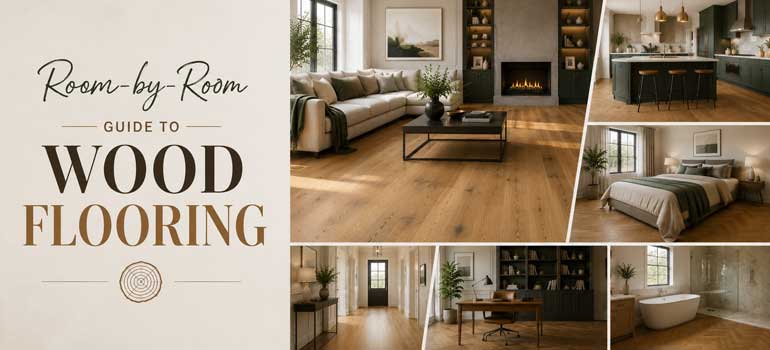
Wood flooring works in almost any room, but "works" and "is the best fit" aren't quite the same thing. Each room in a home puts different demands on a floor, humidity, temperature swings, footfall, moisture, and it's worth matching the wood and construction to those demands rather than choosing purely on looks. Here's a proper room-by-room breakdown, including bathrooms, which get promised in most guides like this and then quietly left out.
Living room
This is genuinely the most flexible room in the house for wood flooring, since it doesn't face the extreme conditions that a kitchen or bathroom does. Style and personal taste can lead here more than any practical constraint.
- Light-coloured wood and wider planks are worth considering in a smaller living room, since both help the space read as more open
- Pattern and plank direction matter more than people expect. Laying boards to draw the eye down the room's longest dimension, or diagonally to widen a narrower one, does more for the sense of space than colour alone
- Warm undertones suit a cosy, comfortable feel, while cooler, paler tones lean more contemporary and airy
Our guide to how wood floor colour changes the mood of a room covers this in more depth if you're still deciding on direction.
Hallway
Hallways see genuine heavy footfall, often combined with grit and moisture tracked in from outside, so durability matters more here than in most rooms. Engineered wood is generally the better recommendation over laminate for a hallway that's meant to last, given the temperature and humidity swings a front door brings, and its added stability holds up better than laminate over the years even though laminate has a lower upfront cost. Lighter tones do help a hallway feel more spacious, and a durable, hard-wearing finish is worth prioritising given the traffic. Our guide to parquet flooring for hallways goes into pattern and species choice for this specific room in full.
Kitchen
Kitchens genuinely present one of the toughest environments in the home for flooring: regular humidity and temperature changes, spills, and heavy daily use all at once. Engineered wood is the more sensible real-wood choice here, since its construction resists the moisture and temperature swings a kitchen produces far better than solid wood would. A lacquered finish adds a genuinely useful extra layer of protection against spills specifically, on top of whichever species and construction you choose. Laminate remains a lower-cost, moisture-tolerant alternative if budget is the deciding factor, though it doesn't offer the same longevity, or the ability to be sanded and refinished, that real wood does.
Bedroom
Comfort and warmth are the priorities in a bedroom rather than heavy-duty performance, since bedrooms typically see far less traffic than a hallway or kitchen. Both solid and engineered wood work well here, opening up a genuinely wide range of species, colours and finishes without the practical constraints that shape choices elsewhere in the house.
Bathroom
This is the room most guides like this promise and then skip, so it's worth covering properly. Bathrooms are the most demanding room in the house for wood flooring, and it's worth going in with realistic expectations rather than assuming any wood floor will do.
- Engineered wood is the only wood option worth considering here, and even then, only with good ventilation, a lacquered rather than oiled finish, and kept away from direct splash zones like right beside a bath or shower
- Solid wood should be avoided in a bathroom altogether, given how poorly it copes with sustained humidity and occasional standing water
- Even engineered wood is water-resistant, not waterproof, so a bathroom with limited ventilation or very heavy daily use is genuinely worth discussing with a flooring professional before committing to wood at all
If you're planning flooring for a specific room and want advice tailored to how it's actually used, our parquet floor fitting team can talk it through with you. Get in touch for a free quote whenever you're ready.
Frequently asked questions
Is engineered wood always the safer choice over solid wood? Not always, since solid wood performs perfectly well in stable, lower-humidity rooms like living rooms and bedrooms. It's specifically in rooms with genuine temperature and moisture swings, hallways, kitchens and bathrooms, where engineered wood's added stability really earns its keep.
Why does the original room-by-room advice so often skip bathrooms? Wood genuinely isn't the easiest material to recommend confidently for a bathroom, given how much moisture the room deals with, so it's easier to leave out than to explain properly. It's still a legitimate option with the right construction and precautions, just one that needs more caveats than most other rooms.
Should every room in a house use the same wood species for consistency? It's a reasonable approach for a cohesive look, but it's not essential, and different rooms often have genuinely different practical needs that point toward different species or constructions. Matching the floor to each room's conditions is generally more important than matching every room to each other.
Is laminate ever a better choice than engineered wood? It can be, mainly on cost and moisture tolerance in the most demanding rooms, but it can't be sanded and refinished the way engineered wood can. For a longer-term investment, engineered wood generally holds its value and appearance better over the years.
What about conservatories or garden rooms? These bring their own specific challenges, mainly extreme temperature swings and direct sun exposure, beyond what a typical kitchen or hallway sees. Our guide to wood flooring for a conservatory covers that specific room in full.