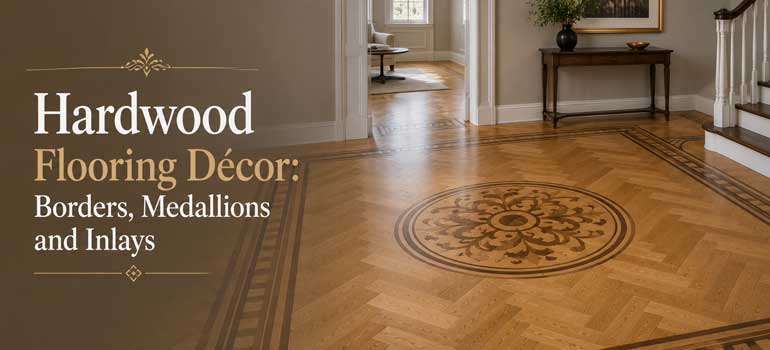
A well-chosen pattern, species and finish already does a lot for a room, but borders, medallions and inlays take a floor a step further, turning it into a genuine design feature rather than just a surface underfoot. The three terms get used fairly loosely, though, so it's worth being clear on what actually distinguishes them before deciding which, if any, suits your project.
What actually distinguishes borders, medallions and inlays
A border is a contrasting strip that frames the edge of a room or a defined area, often in a different wood species, tone or pattern than the main floor, similar in effect to a rug's edge but built permanently into the flooring itself. Borders work particularly well in formal rooms, defining the space without needing an actual rug.
A medallion is a standalone centrepiece design, typically circular or geometric, inlaid into the floor at a focal point such as the centre of a room, an entryway, or directly beneath a chandelier or dining table. Medallions range from relatively simple geometric compositions through to genuinely intricate, multi-species designs that function as real works of art underfoot.
An inlay is the broader technique behind both, small pieces of contrasting wood, and sometimes other materials, set into the main flooring to create a pattern or image. Borders and medallions are both types of inlay work, applied in different ways and different scales.
Laser-cut versus hand-cut inlays
This distinction matters more than most people realise when weighing up cost and options.
- Laser-cut inlays use precision laser or CNC cutting technology to create intricate custom shapes, letters, logos or complex medallion designs with a level of detail that would take a skilled artisan far longer to achieve by hand. This makes elaborate custom designs considerably more accessible than they once were.
- Hand-cut inlays are fitted piece by piece by a skilled craftsperson, the traditional method used for centuries of decorative parquet work. This remains the standard for the most bespoke, highest-end commissions, and it carries a corresponding price premium given the time and expertise involved.
- Both methods produce genuinely durable results once properly fitted and finished, so the choice between them tends to come down to budget, design complexity and how bespoke you want the final result to be, rather than one being inherently better than the other.
Where these features work best
Placement matters as much as the design itself. A few rooms consistently make the most sense for a genuine investment in decorative flooring:
- Entryways and foyers, where a medallion or border makes an immediate first impression as soon as someone walks in
- Formal dining rooms, often with a medallion positioned directly under the table, or a border framing the whole seating area
- Beneath a chandelier or other significant light fixture, where the floor and the fixture above it create a deliberate visual pairing
It's worth thinking through furniture placement before committing to a design. A border or medallion that ends up permanently hidden under a bed, dresser or dining table isn't delivering the visual impact you're paying the premium for, so plan the room layout around the feature rather than adding it as an afterthought once furniture's already in place.
Styling the rest of the room
A statement floor works best when everything else in the room lets it do the talking. Simple lines, calm and earthy colours, and restrained decoration elsewhere give a border or medallion room to actually stand out, rather than competing with busy wallpaper, bold furniture or heavy patterning elsewhere in the space. This doesn't mean the rest of the room has to be plain, just deliberately less visually loud than the floor itself.
A practical consideration worth knowing
If your border or medallion uses a different wood species than the main floor, it's worth factoring that into long-term maintenance. Different species can have different hardness and colour-change characteristics over time, so refinishing a floor with mixed species needs a technician who understands how to sand and finish each section appropriately rather than treating the whole floor as one uniform surface. Our guide to durable wood floors with patterns covers why multi-directional grain and mixed materials make some floors more demanding to refinish evenly.
If you're considering a border, medallion or custom inlay for your own project, our parquet floor fitting team can talk through design options, placement and budget. Get in touch for a free quote whenever you're ready.
Frequently asked questions
Are medallions only available as pre-made designs, or can they be fully custom? Both are genuinely available. Pre-made medallion designs in a range of sizes and styles are more affordable and quicker to source, while a fully custom design, particularly with laser-cut technology, can incorporate anything from a family crest to a bespoke geometric pattern.
Do borders and medallions need to match the main floor's wood species? Not necessarily, and a deliberate contrast is often exactly the point, using a different species or tone to make the feature stand out. Some designs do use a closely matched species for a more subtle, integrated effect instead, so it comes down to the look you're after.
How much more do decorative elements add to a flooring project's cost? It varies enormously depending on size, complexity and whether the work is hand-cut or laser-cut, so it's worth getting a specific quote for your design rather than assuming a fixed percentage. A simple border adds relatively little, while an elaborate multi-species medallion is a genuine investment.
Can an existing plain floor have a medallion or border added later? Sometimes, depending on the floor's construction and condition, though it's a more involved job than incorporating the design during original installation. It's worth having a professional assess whether retrofitting is practical for your specific floor before committing to the idea.
Do laser-cut inlays look less authentic than hand-cut ones? Not in any way that's visible once fitted and finished. The laser cutting process achieves precise, clean joints in the wood itself, and the finished result looks like genuine inlaid wood because that's exactly what it is, just cut using more modern tools than a traditional chisel.