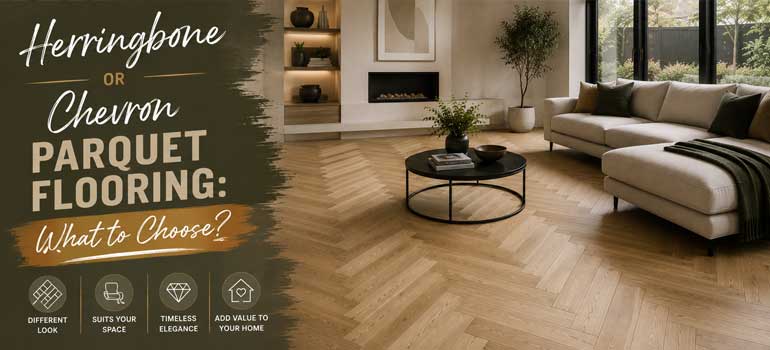
Herringbone and chevron are the two most requested parquet patterns, and it's easy to see why: both bring genuine movement and craftsmanship to a floor that a straight plank layout simply can't match. They're similar enough to get mixed up constantly, though, and a few genuine differences between them are worth understanding clearly before you choose one over the other.
What's actually different between them
The distinction comes down to how each block is cut. Herringbone uses blocks with square-cut ends, which creates a staggered zigzag where each row steps slightly out of line with the next. Chevron pieces are cut with mitred, angled ends instead, so they meet edge to edge and form one continuous, unbroken "V" line down the room. Our guide to the herringbone wood floor pattern covers that pattern's history and styling in full, and our piece on why we love chevron patterned parquetry does the same for chevron's construction and cost.
Which one costs more?
Chevron is generally the more expensive of the two, not herringbone. The mitred cuts required for chevron's continuous line produce more offcut waste during manufacturing and demand more precision during fitting than herringbone's simpler square-cut blocks. If budget is the deciding factor, herringbone is typically the more affordable route to a similar overall look.
Does one make a room look more spacious than the other?
Not really, and it's worth being sceptical of any claim that one pattern is inherently better at this than the other. Direction has far more influence over how a room reads than the choice between herringbone and chevron does. Laid pointing down the length of a room, either pattern draws the eye forward and emphasises depth. Laid at an angle across the room, either can help visually widen a narrower space instead. The zigzag itself, whether broken or continuous, does more of that work than which specific cut you've chosen.
Is one more durable or stable than the other?
No, not because of the cut angle itself. Wood movement and durability come down to the wood species and whether you're choosing solid or engineered construction, not whether the blocks are square-cut or mitred. Engineered wood in either pattern will be more dimensionally stable than solid wood in either pattern, and a harder species like oak will outlast a softer one like walnut regardless of which zigzag it's arranged in. If you're weighing this up, our guide on why wood floors expand and contract with the seasons covers what actually drives that movement.
So which should you choose?
With cost, room size and durability all coming down to factors other than the herringbone-versus-chevron choice itself, it really comes down to which look you prefer. Herringbone's staggered, broken zigzag has a slightly more traditional, textured feel, while chevron's continuous unbroken "V" reads as sharper and more graphic. Budget is a genuine factor too, given chevron's typically higher cost, and it's worth considering whether you're trying to match an existing floor elsewhere in the property, since mixing the two patterns in adjoining rooms rarely looks intentional.
Our parquet floor fitting team fits both patterns across London in solid and engineered wood, and can talk through which suits your room, budget and style before you order any material. Get in touch for a free quote whenever you're ready.
Frequently asked questions
Is chevron harder to fit than herringbone? Generally yes. The mitred angles on every piece need to line up precisely for the continuous zigzag to read cleanly, which demands more skill and time than herringbone's square-cut blocks, and this is a large part of why chevron typically costs more overall.
Can herringbone and chevron be combined in the same room? It's unusual and generally not recommended within a single continuous space, since the two patterns read quite differently and rarely blend well side by side. Using one pattern as a feature in a specific area, like an entrance hall bordered by simpler straight-laid flooring elsewhere, is a more common way to combine visual interest without the two zigzags competing.
Does the wood species matter more than the pattern choice? For durability and stability, yes. The species and whether it's solid or engineered wood determine how the floor performs over time far more than whether it's cut as herringbone or chevron.
Which pattern is more popular in the UK right now? Both remain popular, though herringbone has the longer, more established history in UK interiors specifically, while chevron has seen a stronger resurgence in more recent years. Popularity shifts over time, so it's worth choosing based on what you'll be happy with long-term rather than current trends alone.
Is one pattern better suited to a period property than the other? Herringbone has a slightly stronger historical association with traditional and period interiors, given its longer track record in European flooring. That said, both patterns have been used in grand interiors for centuries, so either works well in a period property depending on the specific style you're going for.