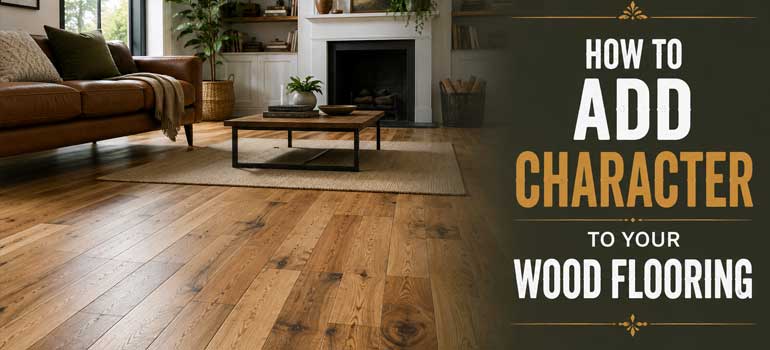
Wood flooring is popular enough now that it's easy to end up with a floor that looks much like everyone else's. The good news is that wood is genuinely one of the most flexible materials for expressing a personal style, provided you go a little further than the default species and finish. Here's how to actually make that happen.
Start with the room, not just the floor
Before choosing anything, think about the space the floor is going into rather than the flooring in isolation. Does the wood need to sit quietly alongside the room's existing features, or make a deliberate contrast? Both approaches work, but the decision should tie back to a genuine sense of what the room's overall style is aiming for, rather than being chosen on its own.
A few ways to bring real personality into the floor itself:
- A bold accent at the centre of the room gives the space a genuine focal point, something a plain, uniform floor can't offer on its own
- A border framing the room's perimeter adds a finished, considered look, and tends to suit larger rooms particularly well, where there's enough scale for the framing effect to register properly
Matching wood species to your style
Certain species naturally suit certain interior directions, though none of this is a strict rule, just a starting point worth knowing.
| Style | Species that tend to suit it | Why |
|---|---|---|
| Traditional | Oak, ash | Warm, rich natural tones with a long history in classic interiors |
| Modern and contemporary | Maple, darker-finished exotic species, high-gloss finishes | Clean lines and bold, saturated colour read as current and deliberate |
| Rustic and countryside | Hickory, cherry | Character-rich grain and warm, informal colouring |
A couple of things worth knowing before committing: genuine mahogany, sometimes suggested for a traditional look, is actually one of the softer woods available rather than a hard-wearing choice, so it suits a lower-traffic, more formal room better than a busy family space. Cherry falls into a similar category, valued for its warm colour and the way it deepens with light exposure over time, but softer underfoot than oak or maple, so it's worth pairing with a room that won't put it through heavy daily wear.
Patterns worth exploring beyond the obvious
Herringbone remains the classic, elegant starting point for anyone wanting more visual interest than a straight-laid floor, and basketweave and brick bond both bring a calmer geometric texture that suits smaller spaces particularly well. Two patterns worth knowing about specifically, since they rarely get properly explained:
Trellis arranges boards in a diamond or lattice-like repeating geometry, giving a more intricate, structured look than herringbone or chevron's simpler zigzags. It reads as genuinely distinctive precisely because it's less commonly seen than the more familiar patterns.
Marquetry is a different thing entirely from parquetry, even though the names sound related. Where parquetry arranges wood pieces into repeating geometric patterns, marquetry uses inlaid veneers of different wood species, and sometimes other materials, to create pictorial or decorative images, closer to a picture made from wood than a structural pattern. It's traditionally more associated with furniture and decorative panels than full floors, though bespoke marquetry floor features do exist for anyone after something genuinely one-of-a-kind.
Our guide to wood flooring patterns covers herringbone, chevron, basketweave, brick bond and Versailles in more depth if you'd like the fuller picture on the more established options.
Accents: borders and centrepiece medallions
If a full pattern feels like more commitment than you want, a smaller decorative feature can still deliver real personality. Our guide to hardwood flooring décor covers borders, medallions and laser inlays in full, including the practical side of where these features work best and what to consider around furniture placement.
If you'd like advice on combining species, pattern and finish for a floor that genuinely reflects your style, our parquet floor fitting team can talk it through with you. Get in touch for a free quote whenever you're ready.
Frequently asked questions
Is a trellis pattern harder to install than herringbone? Generally yes, since its more intricate, repeating lattice geometry demands even more precision than herringbone's simpler zigzag. It's a pattern worth having fitted by an experienced professional rather than attempted as a DIY project.
Can marquetry be added to an existing plain wood floor? It's possible in some cases, depending on the floor's construction, but it's a considerably more involved job than incorporating a marquetry feature during the original installation. It's worth having a professional assess whether your specific floor can accommodate it.
Is it a mistake to mix more than one wood species in the same room? Not at all, provided it's done deliberately rather than accidentally. A border or accent in a contrasting species is a common, effective way to add character precisely because the contrast is intentional.
How do I avoid my customised floor looking dated in a few years? Choosing a pattern or species with genuine longevity, herringbone and oak both have centuries of track record, is safer than chasing a very specific short-term trend. Real wood's ability to be resanded and refinished also means a floor isn't permanently locked into today's exact look.
Does adding character to a floor always mean spending significantly more? Not necessarily. A border or a thoughtfully chosen species and pattern combination can add real personality without the cost of a full custom medallion or marquetry feature, so it's worth discussing your budget upfront to find the right level of customisation for it.