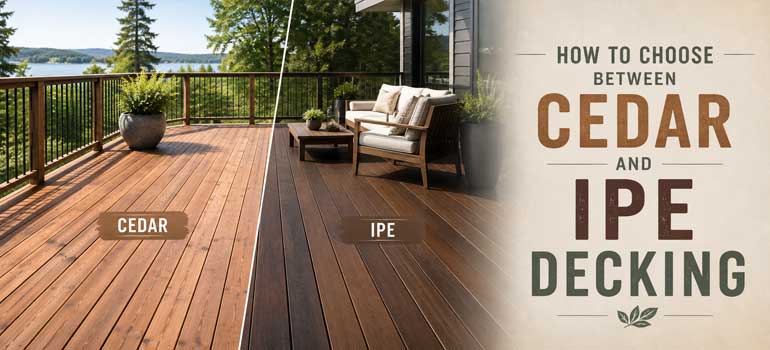
Decking faces a genuinely tougher environment than any indoor floor, constant weather exposure, UV, moisture and temperature swings all at once, so the wood you choose matters even more outdoors than it does inside. Cedar and ipe are two of the most popular options, and they sit at almost opposite ends of the spectrum in terms of hardness, maintenance and cost.
Cedar decking
Cedar is a naturally attractive softwood with genuine rot, decay and insect resistance built into the timber itself, which is part of why it's stayed such a popular decking choice. It carries a warm, reddish undertone naturally, and it's versatile enough to be stained darker or bleached lighter depending on the look you want. The trade-off is ongoing maintenance. Cedar's natural resistance fades over time without regular resealing or staining, so it needs more consistent upkeep than some harder tropical species to keep both its looks and its protective qualities intact.
Ipe decking
Ipe, sourced primarily from South America, is an exceptionally dense, tough hardwood, often nicknamed ironwood for its strength, and it shares cedar's natural resistance to rot, decay and insects, at a considerably higher level of durability. It also carries a genuine Class A fire rating, an advantage cedar and most other decking timbers simply don't offer.
One claim worth correcting directly: ipe is not resistant to the effects of UV light on its colour. Left untreated, ipe's rich brown tones gradually fade under sun exposure, developing a distinctive silvery-grey patina over time, the opposite of getting darker. This is a genuinely normal, cosmetic process that doesn't affect the wood's strength or structural integrity in any way, but it's worth knowing before assuming ipe will hold its original colour without any maintenance. If you want to preserve that original brown tone, periodic application of a UV-protective oil slows the fading considerably, though it won't stop it indefinitely without ongoing reapplication.
Comparing the two directly
| Cedar | Ipe | |
|---|---|---|
| Hardness | Softwood, considerably softer | Exceptionally hard and dense |
| Natural rot/insect resistance | Genuine, but fades without maintenance | Very high, more durable long-term |
| Colour without maintenance | Silvers and fades over time | Fades from brown to silvery-grey over time |
| Fire resistance | Standard for softwood | Class A fire rating |
| Grain | Regular, uniform, simple | Exotic, more varied and characterful |
| Typical cost | More affordable | Significant premium |
| Maintenance frequency | Regular resealing needed | Less frequent, but still needed to preserve colour |
Choosing between them
If budget is the deciding factor, or you like the idea of a simple, uniform grain that suits a minimalist look, cedar is the more accessible choice, provided you're comfortable with the ongoing maintenance it needs to stay looking good. If you want a genuinely tough, long-lasting deck and don't mind the higher upfront cost, ipe's density and durability are hard to match, though it's worth going in with realistic expectations about colour change over time rather than assuming it. Either wood can be maintained to preserve its original colour, or allowed to weather naturally into a greyer patina, which some people prefer as a look in its own right.
If you're weighing up decking options for your own outdoor space, our parquet floor fitting team can advise on species and maintenance requirements to suit your project. Get in touch for a free quote whenever you're ready.
Frequently asked questions
Can I stop ipe from fading to grey if I want to keep the brown tone? Yes, with regular application of a UV-protective oil, though it needs reapplying periodically rather than as a one-off treatment. Without that upkeep, the fade to silvery-grey will happen naturally over time regardless of how durable the wood otherwise is.
Is cedar too soft to be a practical decking choice? No, it's a well-established, genuinely practical option, just softer than exotic hardwoods like ipe. It handles typical decking use well, provided the regular maintenance it needs is kept up.
Why does ipe cost so much more than cedar? Its density, durability and more limited supply all push the price up considerably compared with a more widely available domestic softwood like cedar. Many people consider the lower long-term maintenance and much longer lifespan worth the higher upfront cost.
Does a silvery, weathered ipe deck lose any of its strength? No, the colour change is purely cosmetic, driven by UV exposure breaking down surface oils rather than anything affecting the wood's structural integrity. A weathered, silver ipe deck is just as strong as a freshly oiled brown one.
Are there other decking species worth considering besides cedar and ipe? Yes, species like teak, balau, cumaru and iroko all appear regularly in decking projects, each with their own balance of hardness, cost and maintenance needs. It's worth discussing your specific budget and maintenance appetite with a professional if none of cedar or ipe feels like quite the right fit.