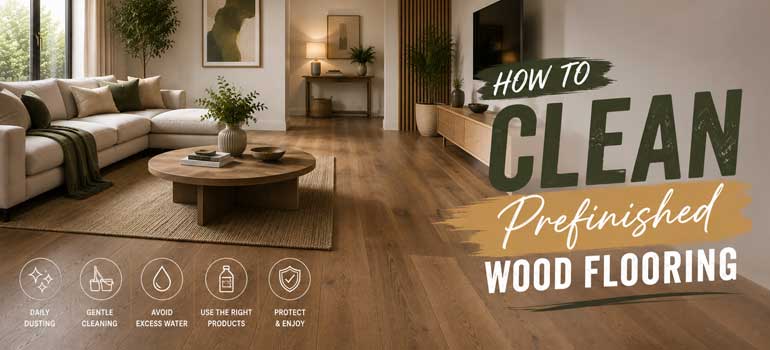
Prefinished wood flooring arrives with its protective coating already cured at the factory, usually a polyurethane finish, and that changes what "cleaning it properly" actually means compared with an older, site-finished floor. It's genuinely low-maintenance once you know the routine, but a few common habits, particularly around water and the wrong cleaning products, can dull or damage that factory finish faster than ordinary wear ever would. This first part covers the daily and weekly routine that keeps a prefinished floor looking its best, plus the products worth avoiding entirely.
Why prefinished floors need a slightly different approach
The polyurethane coating applied in the factory is harder and more consistent than most finishes applied on-site, which is part of why prefinished flooring holds up so well to daily use. That same coating is also more sensitive to certain cleaning habits than people expect. Excess water, harsh chemicals and abrasive tools can all dull or strip a polyurethane finish over time, even though the floor looks perfectly durable on the surface. Knowing what to use, and just as importantly what to avoid, is really the whole of what "proper" prefinished floor cleaning comes down to.
The daily and weekly routine
A consistent, simple routine does more for a prefinished floor than any occasional deep clean:
- Sweep daily with a soft-bristled broom to clear the grit and dust that would otherwise get ground into the finish underfoot, since this abrasive debris is what causes most of the fine surface scratches that build up over time.
- Vacuum with a hard-floor setting, not a rotating brush or beater bar attachment, which is designed for carpet and can scratch a wood surface rather than clean it.
- Don't skip corners and hard-to-reach spots. Dust and debris that accumulates along skirting boards and under furniture edges gets tracked back across the rest of the floor if it's left to build up.
- Adjust frequency to how the room's actually used. A busy kitchen or a commercial space needs daily attention, while a spare bedroom might only need a proper clean once a week.
What to clean with, and what to avoid entirely
This is the part that trips people up most, since plenty of everyday household cleaners actively damage a polyurethane finish over time even though the harm isn't obvious immediately.
| Use | Avoid |
|---|---|
| A pH-neutral cleaner made specifically for wood or polyurethane floors | Vinegar or other acidic cleaners, which etch the finish over repeated use |
| A well wrung-out, barely damp mop or microfiber cloth | Ammonia or bleach-based products, which strip and dull the coating |
| Immediate drying after any damp mopping | A soaking wet mop or standing water left on the surface |
| A soft microfiber mop for dusting and light cleaning | Wax, oil soap or "restorer" products not made for polyurethane |
| A doormat or rug system to reduce grit at entrances | Steam mops, which force moisture into the seams between boards |
Water is genuinely the biggest long-term risk to a prefinished floor. A damp mop used occasionally for a deeper clean is fine, but the mop needs to be wrung out properly beforehand, and any dampness should be dried off the surface straight after rather than left to air-dry. Water that sits on or seeps between boards can cause swelling, discolouration or a lifted finish over time, and this damage isn't easily undone the way a scuff mark is.
Handling spills and scuff marks
Spills are inevitable, and how quickly and how you deal with them matters more than the product you reach for. Blot spills immediately with a dry cloth rather than wiping or rubbing, since rubbing tends to spread the liquid and can push it into the seams between boards instead of lifting it off the surface. For anything that leaves a mark once it's dried, a cloth dampened with a mild, pH-neutral soap solution and a gentle wipe usually clears it.
Scuffs and light surface marks can often be dealt with just as simply: a soft, slightly damp cloth rubbed gently over the mark is enough for most everyday scuffs. Deeper scratches that have gone through the finish are a different matter and are better addressed with a colour-matched touch-up product, or left for a professional if the mark runs through to the bare wood underneath.
A few habits that protect the floor long-term
- Doormats inside and outside entrances catch grit before it ever reaches the floor, which does more to prevent scratching than any cleaning product can.
- Felt pads under furniture legs stop dents and drag marks from chairs, tables and anything else that regularly moves across the surface.
- Rugs in front of sinks and cooking areas in kitchens specifically help, since these spots see the most spills and standing moisture over time.
- Keep pet claws trimmed where relevant, since untrimmed claws are a common and easily avoided source of fine surface scratching.
Stay tuned for part two of this series, where we'll go further into deeper cleaning and dealing with tougher stains on a prefinished floor. If you're still deciding between a prefinished and unfinished floor for a new project, our guide to prefinished or unfinished wood flooring covers that decision in full. Our parquet floor fitting team is also happy to advise on maintenance for an existing floor, and you can get a free quote for any new fitting project.
Frequently asked questions
Can I use a steam mop on a prefinished wood floor? No, steam mops should be avoided on any sealed wood floor. The vapour forces moisture deeper into the seams between boards than a damp cloth ever would, which can permanently damage both the wood and the finish over repeated use.
Is vinegar and water a safe DIY cleaner for prefinished floors? It's best avoided despite being a popular natural cleaning tip online. Vinegar's acidity gradually etches a polyurethane finish with repeated use, dulling the shine even though the damage isn't obvious after just one clean.
How often should a prefinished floor really be cleaned? Daily sweeping or vacuuming is the baseline for any room, with a damp mop clean added weekly or as needed depending on traffic. Busy areas like kitchens and hallways generally need more frequent attention than a low-traffic spare room.