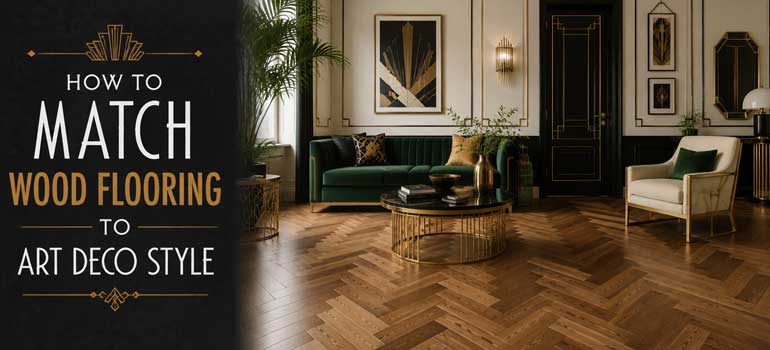
Art Deco has never really gone out of fashion, and it's easy to see why: few interior styles combine geometry, glamour and craftsmanship quite so confidently. Before matching a floor to it, though, it's worth being clear on what the style actually is, since it gets softened and misdescribed online more often than you'd expect.
What Art Deco actually looks like
Art Deco is defined by boldness, not restraint. It's characterised by rich, saturated colours, confident geometric shapes, and genuinely decadent detail work, evoking glamour and luxury rather than a calm, airy minimalism. The style takes its name from "Arts Décoratifs," originating in France and first shown publicly at the 1925 Paris Exposition Internationale des Arts Décoratifs, before flourishing through the 1920s, 30s and into the early 40s. Its signature elements, metallic finishes, high-gloss surfaces, mirrored furnishings and striking woodwork, all point in the same direction: a style built on confident, luxurious statements rather than understated simplicity.
That distinction matters directly for flooring. A wood floor chosen for Art Deco should hold its own as a genuine design feature, not simply recede into the background.
Choosing your wood tone
There's more than one legitimate route here, and it's worth knowing the options rather than assuming only one tone "does" Art Deco properly.
- Light oak tones give a crisp, graphic effect that makes a geometric pattern read with real clarity, a genuinely authentic Art Deco choice when the goal is precision and structure over drama
- Warm honey and richer tones bring depth and a sense of luxury that suits the style's more decadent side
- Dramatic contrast, dark wood paired with lighter inlays, or a genuine black-and-white scheme, gets closer to the boldest, most glamorous end of authentic 1920s and 30s Art Deco interiors
- Cooler, more contemporary platinum-toned finishes offer a modern reinterpretation of the style rather than a strictly period-accurate one
Our guide to how wood floor colour changes the mood of a room covers how different tones affect a room's atmosphere more broadly, worth reading alongside this if you're still deciding on a direction.
Board width and scale
Wide, long boards are a genuine feature of the Art Deco look, generally in the region of 6 to 10 inches wide, since the scale itself contributes to the style's confident, architectural feel. A single consistent width across the floor also suits the style better than a deliberately varied, rustic mix, keeping the geometry crisp rather than informal.
Pattern choice
Herringbone and chevron are both genuinely well suited to Art Deco, and it's easy to see why: the style is built on strong geometric shapes, symmetry and repeating forms, exactly what both patterns deliver underfoot. Herringbone's staggered zigzag and chevron's continuous "V" both work as a confident geometric backdrop for the metallic accents, mirrored surfaces and bold furnishings the rest of an Art Deco room typically carries. Our guides to the herringbone wood floor pattern and chevron patterned parquetry cover both in more depth.
If you're planning an Art Deco-inspired room, our parquet floor fitting team can talk through tone, width and pattern for a genuinely authentic result. Get in touch for a free quote whenever you're ready.
Frequently asked questions
Is dark or light flooring more authentically Art Deco? Both have a genuine place in the style, so it comes down to which specific Art Deco mood you're after. Dramatic dark and light contrast leans toward the boldest, most glamorous end of the original 1920s and 30s look, while a lighter, crisper oak tone suits a more graphic, structured interpretation.
Does Art Deco flooring need to be paired with specific furniture to work? The floor works best as part of a coordinated scheme, so metallic accents, mirrored surfaces and rich colours elsewhere in the room genuinely help a geometric floor read as authentically Art Deco rather than simply a modern patterned floor on its own.
Is herringbone more authentically Art Deco than chevron, or are they interchangeable? Both patterns are genuinely associated with the era, so it's less about historical accuracy and more about which specific look you want. Chevron's continuous line often reads as slightly more graphic and modern, while herringbone carries a marginally more traditional feel, though the difference is subtle.
Can engineered wood achieve an authentic Art Deco look, or does it need to be solid? Engineered wood works perfectly well and is generally the more practical choice today, offering the same visual pattern, tone and width with better dimensional stability than solid wood provided through the original era.
Is Art Deco flooring a safe long-term choice, or a passing trend? It's held genuine, sustained popularity since the 1920s rather than being tied to one brief moment, so it's a reasonably safe long-term choice. A well-fitted floor can also be resanded and refinished in a different tone later if your taste shifts.