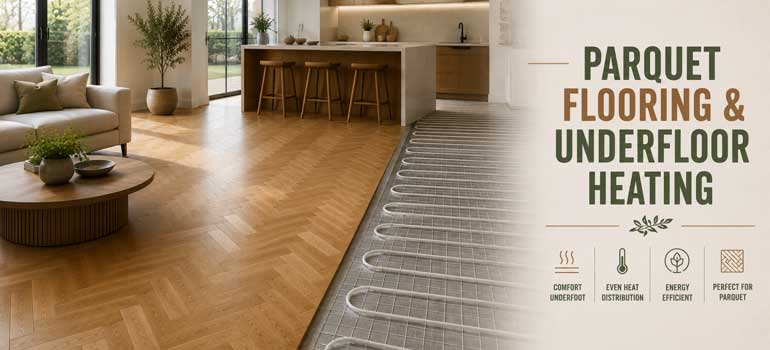
Underfloor heating and parquet flooring work well together, warm underfoot, no radiators to work the floor plan around, and a finish that suits practically any interior style. It's worth being accurate about what wood actually contributes to that pairing, though, since one common claim about it needs a direct correction.
Does wood actually give the best heat output?
This is worth addressing head-on: wood is not the most thermally efficient flooring for underfloor heating, and it's inaccurate to claim otherwise. Tile and stone are consistently the best-performing materials for underfloor heating specifically because they have high thermal conductivity, meaning heat passes through them quickly and efficiently. Wood, by comparison, is a natural insulator. Its thermal conductivity is considerably lower than stone or tile, which means a wood floor takes longer to warm up and delivers somewhat less heat output for the same input than a tiled floor would.
That doesn't make wood a bad choice, just not the most efficient one on paper. In practice:
- Wood still delivers genuine, comfortable warmth underfoot, even if it's not the fastest-responding or most efficient surface available
- A thinner, denser wood floor conducts heat somewhat better than a thick solid one, which is part of why engineered wood, with its typically slimmer profile, tends to perform better than solid parquet with underfloor heating
- The system itself can be designed around wood's properties, with appropriate pipe spacing and controlled running temperatures, to deliver comfortable results even though wood isn't the top performer on raw conductivity
If maximising heating efficiency is the priority over the look and feel of wood, tile or stone will always outperform any wood flooring on that specific measure. Most people choosing parquet with underfloor heating are prioritising the warmth-underfoot comfort and the aesthetic, which wood delivers very well, over squeezing out the last few percent of heating efficiency.
Engineered or solid parquet?
Engineered wood is the recommended choice for underfloor heating, though the reason is stability rather than superior heat output. Its layered, cross-grain construction resists the expansion and contraction that temperature cycling causes far better than solid wood does, since solid parquet blocks are cut from a single piece of timber and move more with the repeated heating and cooling a UFH system produces. Solid hardwood parquet can still be paired with underfloor heating in some cases, but it carries a higher risk of gaps, cupping or other movement-related issues over time. Our guide to why wood floors expand and contract with the seasons covers this movement in more detail, and it's worth noting the glue-down fitting method is generally recommended for underfloor heating specifically, since it limits movement between the boards and the heated subfloor.
Newly installed parquet or retrofitting an existing floor?
Underfloor heating is installed beneath the floorboards, so timing matters a great deal. Fitting the heating system before the parquet goes down is the more straightforward, cost-effective route, since retrofitting it under an existing floor means lifting the boards first, adding time, cost and a real risk of damaging boards during removal. It's entirely possible to add underfloor heating to a home with parquet already installed, but it's worth planning for the extra disruption that involves compared with including it from the start of a new installation.
If you're planning to pair parquet with underfloor heating, our parquet floor fitting team can advise on construction, fitting method and realistic expectations for how the combination will perform. Get in touch for a free quote whenever you're ready.
Frequently asked questions
Will my heating bills be higher with wood flooring than with tile over underfloor heating? Potentially somewhat, since wood's lower thermal conductivity means the system may need to run a little longer or at a slightly higher setting to achieve the same room temperature compared with tile. In practice, the difference is often manageable and many people find the comfort and look of wood worth that trade-off.
Can I use any wood species with underfloor heating, or are some better than others? Thinner, denser engineered boards generally perform better than thick solid ones, but species-specific differences matter less than construction type. It's worth discussing your specific product choice with a flooring professional to confirm it's rated for underfloor heating use.
How hot can the floor surface get with parquet over underfloor heating? Wood floors are generally recommended to stay within a lower surface temperature range than tile or stone, since excessive heat risks drying out and damaging the timber over time. Your heating installer and flooring supplier should both specify a maximum safe operating temperature for your specific setup.
Is it worth choosing tile in high-heat-loss rooms and saving parquet for elsewhere? This is a properly reasonable approach for rooms with especially high heat loss, like a conservatory or a room with a lot of glazing, where tile's superior heat output can matter more. Parquet works well in more typical rooms where the difference in efficiency is less noticeable day to day.
Does underfloor heating shorten a parquet floor's lifespan? Not if the floor is properly specified and fitted for it, with engineered construction, glue-down fitting, and heating run within recommended limits. Issues generally arise from poor product choice or aggressive heating settings rather than underfloor heating being inherently damaging to wood.