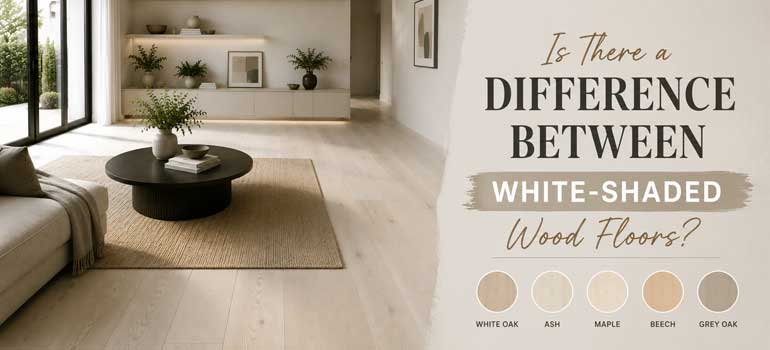
White wood flooring has stayed popular for good reason. It reads as clean and calm against almost any interior style, and lighter tones genuinely help a room feel more open, particularly when there's limited natural light to work with. The confusing part is that manufacturers give their white finishes all sorts of appealing names, and it's not always obvious what's actually different between them beyond the marketing. Here's what's really going on underneath those names.
How a white wood floor is actually achieved
There isn't one single "white finish." A few genuinely different techniques all produce a pale or white-toned floor, and which one's used affects both the look and how the floor behaves over time:
- UV-cured white oil penetrates the wood with a pigmented oil, giving a natural, matte look that still shows the grain clearly underneath the paleness. This is the most common route for a "white oiled" floor.
- Whitewashing or pickling applies a translucent white stain, sometimes over an open-grained species like oak or ash, which lets the wood's natural grain and character show through rather than fully covering it.
- Bleaching lightens the timber itself before any finish is applied, often used to neutralise the pink or red undertones naturally present in species like red oak.
- White-tinted lacquer sits on the surface rather than penetrating it, giving a more solid, opaque white with less of the grain visible through the finish, closer to a painted look than a natural one.
Each of the branded names you'll come across on a supplier's website is really just a specific product built from one of these underlying methods, dressed up with a name that's meant to catch your eye.
Making sense of the common names
Once you know the technique behind a name, the differences between products become a lot clearer:
| Common name | Technique | What it looks like |
|---|---|---|
| Sunny white, Paris white | Light oil finish on pale oak | Natural, airy, warm undertone |
| Polar white | White-tinted lacquer or heavily pigmented oil | True, bright white with a slight sheen |
| Brushed and white oiled | UV oil over a textured, open-grain surface | Natural with pronounced visible grain |
| Whitewashed | Translucent whitewash or pickling stain | Warm, honey-toned, grain still visible |
| London white | UV oil with deliberate tonal contrast | Detailed, more depth than a flat white |
Beyond the name, it's worth asking your supplier directly which technique was used and what topcoat sits over it, since that has more bearing on how the floor performs long-term than the name on the tin.
The one thing worth knowing: yellowing over time
White finishes are more prone to visibly yellowing than darker ones, and the topcoat is usually the reason why. Oil-based topcoats naturally amber slightly as they age, and that shift is far more noticeable against a white or pale base than it would be on a mid-brown or dark floor, where the same amount of yellowing barely registers. A water-based, UV-stable topcoat resists this considerably better than an oil-based one, so it's worth asking specifically about this when you're choosing a product, particularly for a room that gets a lot of direct sunlight.
Living with a white floor day to day
Colour affects maintenance as much as it affects looks. As we cover in our guide to how wood floor colour changes the mood of a room, pale floors do a better job of hiding everyday dust and light scratches than dark ones, but they show water marks, dirt trails and stains more obviously in return. A white floor near an entrance or in a kitchen will need a bit more regular attention to stay looking crisp than the same floor in a lower-traffic room.
If you're weighing up which white finish suits your space, our parquet floor fitting team can talk through the trade-offs between oil, lacquer and whitewash techniques for your specific room. Get in touch for a free quote once you've got a shortlist in mind.
Frequently asked questions
Does a white wood floor need a specific wood species? Open-grained species like oak and ash generally take a whitewash or pickling stain most naturally, since the pores accept pigment well and the grain still shows through afterwards. Tighter-grained species like maple can still be finished white, though usually with a different technique such as a white-tinted lacquer rather than a stain.
Can an existing wood floor be turned white, or does it need to be new? An existing solid wood floor can often be sanded back to bare timber and refinished with a white technique, provided there's enough wear layer left to sand. Prefinished engineered boards with a thin wear layer are more limited in how many times this can be done, so it's worth checking before committing to a full refinish.
Will a white floor show every mark straight away? Not immediately, but it will show water marks, dirt and stains more clearly than a mid-tone or dark floor over time. Regular cleaning and a doormat at entrances go a long way toward keeping a white floor looking as crisp as it did on day one.
Is whitewashing the same as painting a floor white? No, whitewashing and pickling are translucent techniques that let the wood grain show through, while a fully opaque white lacquer or paint covers it almost entirely. If keeping the natural texture of the wood visible matters to you, a translucent technique is the one to ask for specifically.
Do white floors go out of style faster than natural wood tones? It's genuinely hard to say for certain, since trends shift over time the way they do with any colour choice. What does help is that a white finish can be sanded back and refinished in a different tone later if your taste changes, the same as any other wood floor colour.