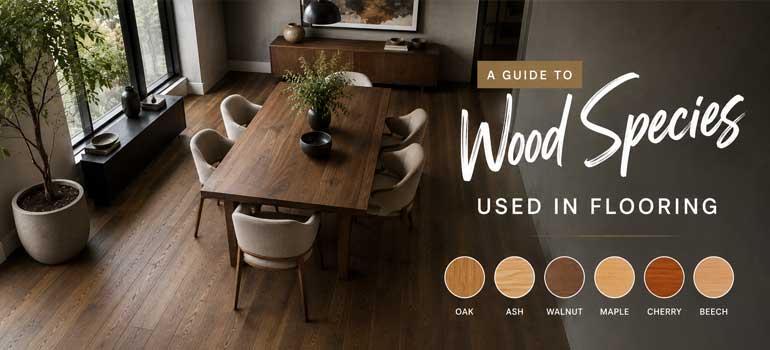
Wood flooring covers a genuinely wide range of species, from familiar UK staples to dense, exotic hardwoods more commonly associated with outdoor decking. Getting to know the basics of each one makes the eventual choice a lot less overwhelming, and it's worth going in with accurate expectations, since a few of these species get misrepresented online more often than you'd think.
Species we've covered in detail elsewhere
A handful of the most popular flooring species already have dedicated guides on our site, so we'll keep things brief here and point you toward the fuller picture. Oak remains the most widely used species for UK flooring, and our guide to ash, cherry, walnut, maple and oak flooring covers it alongside four other popular options in depth. American black walnut and how it compares specifically with oak is covered in our oak vs walnut guide. Beech and wenge each have their own dedicated pieces too, covering beech's hardness and stability and wenge's sourcing and working properties respectively.
Iroko
Also known as African teak, though it isn't a true teak species, iroko grows across West and Central Africa, including Nigeria, Ivory Coast and the Congo Basin. It's a genuinely durable, naturally weather-resistant timber, which is why it's such a common choice for decking as well as flooring, and it ages from a fresh yellowish tone to a deeper honey brown over time.
African walnut
Despite the name, African walnut isn't a true walnut species at all. It belongs to a different genus entirely, though its rich, reddish-brown colouring and grain give it a similar visual character to genuine walnut, which is likely how the name stuck. It's a flexible, long-lasting timber most commonly seen in furniture, though it does turn up in flooring too.
Bamboo
Bamboo is technically a fast-growing grass rather than a hardwood tree, and that's part of its appeal: it can be harvested roughly every three to five years, considerably faster than any hardwood species, which makes it a genuinely sustainable option. Its hardness varies a lot depending on how it's manufactured. Traditional horizontal or vertical bamboo flooring sits at a fairly moderate hardness, while strand-woven bamboo, made by compressing bamboo fibres under high pressure, can end up considerably harder than oak. It's worth checking which type you're being offered rather than assuming all bamboo flooring performs the same.
Cumaru
Cumaru is native to northern South America, harvested commercially across Brazil, Peru and Colombia, not South Africa, a mix-up that's surprisingly common online. Also called Brazilian teak despite not being a true teak, cumaru is one of the hardest timbers used in flooring anywhere, sitting well above red oak on the Janka scale. That density makes it exceptionally long-lasting, though it also means it's harder to cut and finish than more common domestic species.
Ipe
Ipe, sometimes called Brazilian walnut despite no relation to true walnut, grows across Central America and northern South America. It's often mentioned in the same breath as cumaru for good reason: the two are close rivals for the hardest timber commonly used in flooring, both dramatically outperforming oak and most other domestic hardwoods on durability.
Mahogany
Genuine mahogany is actually one of the softer woods on this list, not one of the hardest, which surprises people given its reputation as a premium material. True mahogany, native to Central and South America, sits well below oak on the Janka hardness scale, and its value comes from its rich reddish-brown colour and fine grain rather than exceptional durability underfoot. Santos mahogany, a different and unrelated species sometimes sold under a similar name, is considerably harder and closer to what people picture when they imagine "mahogany hardness." It's worth being clear on which one you're actually being offered before assuming durability that genuine mahogany doesn't have.
Teak
Teak is native to South and Southeast Asia, particularly Myanmar, Thailand and Indonesia, rather than Africa. Its natural oils give it excellent weather and insect resistance, which is exactly why it's such a longstanding choice for decking, and it carries a distinctive golden-brown colour with darker grain lines running through it.
Hardness compared
| Species | Approximate Janka rating | Native region |
|---|---|---|
| Ipe | ~3,510–3,680 | Central and northern South America |
| Cumaru | ~3,540 | Northern South America |
| Wenge | ~1,600–1,900 | Central Africa |
| Maple | ~1,450 | North America |
| Oak (white) | ~1,360 | Europe, North America |
| Beech | ~1,300 | Europe |
| Oak (red) | ~1,290 | North America |
| Iroko | ~1,260 | West and Central Africa |
| Teak | ~1,000–1,150 | South and Southeast Asia |
| Walnut | ~1,010 | North America |
| Mahogany (true) | ~800–900 | Central and South America |
Ratings vary between suppliers and specific samples, so treat this as a comparative guide rather than an exact figure for any one board.
If you'd like advice on which of these species genuinely suits your project, both practically and stylistically, our parquet floor fitting team can talk it through with you. Get in touch for a free quote once you've got a shortlist in mind.
Frequently asked questions
Are exotic hardwoods like ipe and cumaru available as engineered wood? Yes, and it's often the more practical choice given how expensive and difficult to work these species are in solid form. Engineered construction stretches an expensive, dense timber further while still giving you the genuine species as the visible wear layer.
Is it worth paying more for an extremely hard species like ipe or cumaru for indoor use? For most homes, not really, since domestic species like oak or maple already comfortably handle typical household traffic. These ultra-hard species make more practical sense in commercial settings with heavier footfall, or where their specific colour and grain are the main draw.
Why do some suppliers use different names for the same wood? Trade names vary regionally and don't always match the wood's actual botanical family, which is exactly how genuine walnut and African walnut, or true teak and iroko, can sound related when they're not. It's worth asking for the botanical name if you want certainty about what you're actually buying.
Are tropical hardwoods like these sustainably sourced? It depends entirely on the specific supplier, so look for FSC certification or another credible chain-of-custody standard before buying. This matters more for these species than for temperate hardwoods like oak, given how much international demand has pressured some tropical timber populations.
Can bamboo flooring be refinished like a hardwood floor? Yes, most bamboo flooring can be sanded and refinished, though how many times depends on the thickness of the wear layer, similar to engineered hardwood. It's worth checking this with the specific product, since it varies more between bamboo manufacturers than it does between hardwood species.