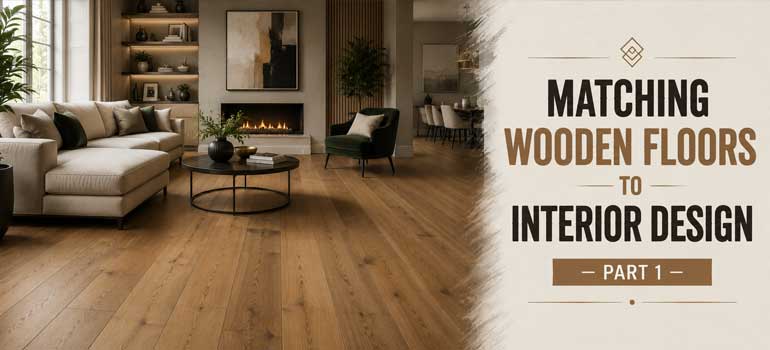
Wood flooring is one of the few materials in a home that genuinely works at any budget or grade. Rustic, knotty or a premium clear finish, real wood carries a natural character that's hard to replicate in a manufactured product. If a wood floor isn't quite landing the way you hoped, the issue is often less about the wood itself and more about how well it's been coordinated with the rest of the space around it. Here's where to start.
Keep species consistent across connected spaces
It's tempting to bring in several different beautiful species throughout a home, but this usually reads as busy rather than rich. A more reliable approach:
- Stick to one or two species with a similar colour scheme, undertone and grain, rather than mixing several distinct woods across different rooms
- Extend the same logic to furniture and worktops if you're a fan of wood elsewhere in the home, keeping the palette consistent rather than introducing yet another species
- A consistent species and tone throughout connected spaces makes a home feel larger and more considered, since there's nothing visually interrupting the flow from one room to the next
- If you want variation without abandoning consistency, play with different plank lengths and widths instead of introducing new colours, grains or species
Highlight one or two rooms rather than the whole house
Covering every room in wood isn't always the most elegant option, even for genuine wood flooring enthusiasts. Choosing one or two standout rooms, an entrance hall or a living room, for example, and keeping the rest of the home simpler often reads as more considered than wood everywhere. If you go this route, it's still worth tying the rest of the home together with a consistent colour palette, whatever material you're using elsewhere, tile, carpet or vinyl, so the transition between rooms feels intentional rather than disjointed.
Choosing a finish sheen: matt, satin or gloss
This is worth correcting directly, since matt finishes get an unfair reputation in some older advice. Matt is genuinely one of the most popular and versatile choices in current wood flooring, not a difficult option to style around.
| Sheen level | Look | Practical trade-offs |
|---|---|---|
| Matt | Natural, closest to raw wood texture | Disguises scuffs and light scratches well; currently the leading trend across most projects |
| Satin | Soft, understated shine | Balances easy maintenance with a touch more visual polish than matt |
| Gloss | Reflective, formal | Shows scratches and dust more clearly; largely reserved for traditional or formal settings now |
Satin remains a genuinely solid, low-maintenance choice, easy to keep looking good and forgiving of everyday wear. But it's worth knowing that matt, not satin, is actually the dominant direction in current wood flooring, valued for its natural texture and its ability to hide daily scuffs even better than satin does. Our guide to oiled or lacquered floor finishes covers how finish type and sheen level interact if you're deciding between oil and lacquer specifically.
Part two of this series continues with more ways to coordinate wood flooring with the rest of your interior design. If you'd like advice tailored to your own space, our parquet floor fitting team can talk through species, finish and where to use wood throughout your home. Get in touch for a free quote whenever you're ready.
Frequently asked questions
Is it ever a good idea to mix three or more wood species in one home? It's possible but genuinely harder to pull off well, since more species means more colour and grain variation to coordinate. Sticking to one or two, with variation coming from plank width or pattern instead, is the more reliable route to a cohesive result.
Does a matt finish need more maintenance than satin or gloss? Not more maintenance, just slightly different care in some cases, since certain matt oil finishes need periodic re-oiling more often than a lacquered satin or gloss surface. Day-to-day cleaning is essentially the same across all three sheen levels.
Should the wood tone match my walls, or contrast with them? Both approaches work, and it comes down to the effect you want. A close match creates a calm, cohesive look, while a deliberate contrast adds definition, so it's more about intention than a fixed rule.
If I only put wood flooring in one room, what should the connecting rooms use instead? Whatever material suits those rooms' function, tile in a kitchen, carpet in a bedroom, provided the colour palette stays coordinated with the wood floor's tone. The connection between rooms matters more than every room using the same material.
Is gloss finish ever the right choice today? It still has a place, particularly in traditional or formal settings where a polished, reflective look suits the room's character. For most contemporary projects, though, matt and satin have become the more commonly recommended choices.