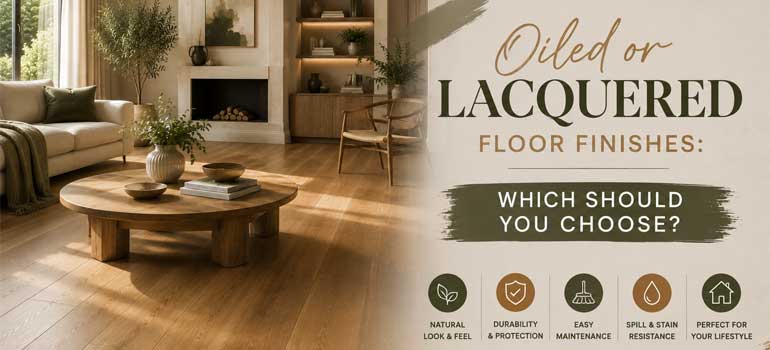
Every wood floor needs a finish on top of the bare timber, and oil and lacquer are the two most common routes. They protect the wood in genuinely different ways, though, which means the right choice depends less on which one simply "looks better" and more on how the room actually gets used day to day.
What's the real difference between the two?
Lacquer forms a hard, sealed film on top of the wood, similar to a layer of varnish, which is what gives it that glossy, uniform sheen. Oil soaks into the wood fibres themselves rather than sitting on top, protecting from within as well as on the surface, which is why oiled floors keep more of the timber's natural matte texture and depth.
That difference in how each finish sits on the wood is really the source of every other trade-off between them.
Lacquer: durable, glossy, but shows scratches
A lacquered floor gives a sleek, glossy, uniform look that reads as polished and formal, and it works well with pretty much any wood species. It's genuinely hard-wearing too: because the film sits on top of the wood, it takes the brunt of daily wear rather than the timber underneath, and a good lacquer finish can last several years before it needs recoating, considerably longer than an oiled finish typically manages between applications.
The trade-off is visibility. Precisely because lacquer is glossy and uniform, scratches and dents stand out clearly against that smooth, reflective surface, more so than the same mark would on a matte oiled floor. Busy households with kids, pets or heavy foot traffic will likely notice this sooner than a quieter, lower-traffic room. When it does eventually need attention, refinishing means sanding back the existing film and reapplying a fresh coat, a job worth leaving to an experienced fitter rather than attempting as a first DIY project.
Oil: natural-looking, easier to spot-repair, needs more frequent attention
Oiled finishes have become genuinely popular over the last several years, largely because they preserve wood's natural look and texture better than a glossy film ever could. Because oil penetrates the timber rather than sitting on it, it protects from the inside as well as the surface, and it's noticeably easier to touch up: a scuffed or worn patch can often be spot-treated with fresh oil rather than requiring the whole floor to be redone, which isn't really possible with lacquer.
The trade-off runs the other way for lacquer: oil wears thinner faster and needs more frequent maintenance, generally recommended somewhere in the range of every one to three years depending on how much traffic the room sees, considerably more often than lacquer. Our guide to the re-oiling procedure covers what that maintenance actually involves and how to judge when your floor needs it. The process itself is genuinely straightforward once you know it, and much less disruptive than a full lacquer refinish.
Oil vs lacquer at a glance
| Oil | Lacquer | |
|---|---|---|
| Look | Natural, matt, shows wood texture | Glossy, sleek, uniform sheen |
| Protection | Penetrates and protects from within | Forms a hard film on the surface |
| Scratch visibility | Less noticeable against a matte finish | More noticeable against a glossy surface |
| Typical maintenance interval | Roughly every 1 to 3 years | Several years |
| Repairability | Easy spot touch-ups | Usually needs a full recoat |
| Best suited to | Households wanting a natural look and easy spot repairs | Rooms wanting a polished, formal finish and longer intervals between maintenance |
If you're weighing up wax as a third option alongside these two, our guide to the pros and cons of hardwood floor waxing covers where it fits into this comparison, though it's worth knowing upfront that wax needs the most frequent attention of the three.
Which one should you choose?
If you want the lowest-maintenance option and don't mind scratches showing a little more clearly, lacquer's longer intervals between recoats make it the practical choice, particularly for a formal room that doesn't take the heaviest daily traffic. If you'd rather have a natural, matte look with the ability to fix small worn patches yourself without redoing the whole floor, oil is generally the better fit, provided you're comfortable with the more frequent maintenance schedule. Our parquet floor fitting team can advise on which finish suits your specific room and lifestyle, and we're happy to put together a free quote once you've settled on a direction.
Frequently asked questions
Can I switch from lacquer to oil on an existing floor? Yes, but the existing lacquer film needs to be fully sanded off down to bare wood first, since oil won't penetrate through a sealed lacquer coating. At that point, the floor is effectively being refinished from scratch rather than simply having a new product applied over the old one.
Is oil or lacquer better for a kitchen? Both can work, but it depends on your priorities. Lacquer's sealed surface handles occasional spills a little better, while oil's easier spot-repair means an isolated worn patch near the sink or hob doesn't mean redoing the whole floor.
Does oil make a floor slippery? Not typically, since a properly applied and buffed oil finish leaves a matte, low-sheen surface rather than a slick one. Over-application or excessive buffing is what occasionally causes this, rather than oil as a finish type inherently being slippery.
Which finish is better for underfloor heating? Both oil and lacquer are generally suitable, and the more important factor for underfloor heating compatibility is whether you're using solid or engineered wood, and which fitting method is used, rather than which surface finish you choose.
Is lacquer more expensive than oil overall? The upfront application cost is often similar, but the total cost over the floor's lifetime depends on how often each needs redoing. Oil's more frequent maintenance can add up over many years, though each re-oiling session tends to be simpler and less disruptive than a full lacquer recoat.