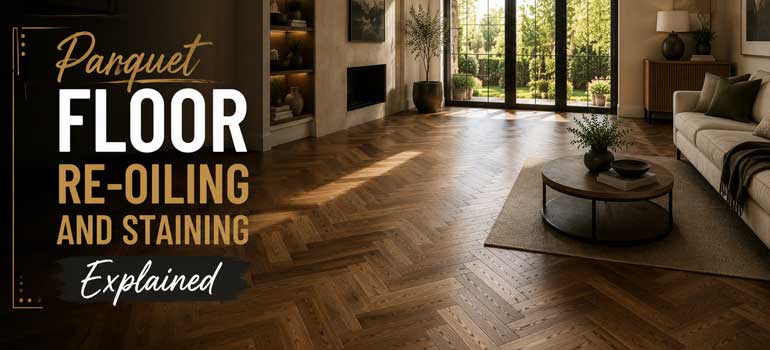
Re-oiling and staining are two genuinely different things, even though they often get mentioned in the same breath. One tops up a floor's existing protection, the other changes its colour entirely. Knowing which one you actually need makes a real difference to the result.
Re-oiling, briefly
Re-oiling maintains an existing oiled finish rather than changing the floor's look. It tops the protective layer back up as it wears from daily use, restoring water resistance and scratch protection without a full sand and refinish.
- Expect to re-oil roughly every one to three years, depending on how much traffic the room sees, not annually and not indefinitely either
- It only needs a light buff of the surface, not a full sanding down to bare wood
- The same oil product used originally generally gives the most even result, since mixing different oils can bond unevenly
Our dedicated guide to the re-oiling procedure covers the full step-by-step process if that's what you're after.
What staining actually does, and how it differs from oiling
Staining changes the colour of the wood itself, while a standard oil finish mainly protects and enhances the timber's natural tone.
- A clear or lightly tinted oil lets the wood's own colour come through, deepening it slightly without a dramatic shift
- A stain deliberately changes the colour, sometimes subtly, sometimes completely, before a protective finish is applied on top
- The two work together, not as alternatives: a floor is typically stained first, then finished with oil or lacquer to protect and seal the new colour
When can a floor actually be stained?
Only a bare, evenly sanded surface takes stain well. This is worth being clear about before getting attached to the idea.
- An existing finish must be fully sanded off before staining, since stain applied over an old finish won't absorb properly
- Any unevenness in the sanding shows up under stain, since it absorbs more heavily into rougher patches, highlighting imperfections rather than hiding them
- A test patch in an inconspicuous area is worth doing before committing to a colour and covering the whole floor, since the same stain can look different on different boards depending on grain
Staining a patterned floor specifically
Parquet brings an extra consideration that a straight-laid floor doesn't have.
- Grain runs in multiple directions across a herringbone, chevron or basketweave floor, and stain can absorb slightly differently depending on which way each block's grain runs
- This can create subtle tonal variation across the pattern, which some people like for the added texture and others prefer to avoid
- An experienced technician working section by section, with test patches across a few different block orientations, gets the most even, predictable result
Choosing a colour
Colour affects a room's whole atmosphere, not just the floor itself. Our guide to how wood floor colour changes the mood of a room covers how different tones suit different rooms if you're still deciding on a direction before committing to a stain.
If you're considering re-oiling or a full stain and refinish, our parquet floor fitting team can assess your floor's current condition and advise on what's realistic. Get in touch for a free quote whenever you're ready.
Frequently asked questions
Can I stain my floor a different colour without a full sanding? No, staining only works reliably on bare, freshly sanded wood, so an existing finish needs to come off first. Attempting to stain over an old finish typically results in patchy, uneven colour.
Is staining permanent, or can I change the colour again later? It's not permanent. A stained floor can be sanded back to bare wood and restained in a different colour later, the same as any other wood floor, provided there's enough wear layer left to sand.
Does staining weaken the wood or affect its durability? No, stain is a colour treatment, not a structural one, and it doesn't affect the wood's inherent hardness or durability. The protective finish applied afterward, whether oil or lacquer, is what actually determines day-to-day durability.
Can engineered parquet be stained the same way as solid parquet? Yes, provided there's enough hardwood wear layer to sand back to bare wood first. This is worth confirming before committing to staining, since engineered boards have a limited number of times they can be sanded compared with solid wood.
How long does a stain and refinish project typically take? It depends on the size of the floor and the finish chosen, but expect the room to be unusable for several days between sanding, staining and the finish curing. Your fitter can give a more specific timeline once they've assessed the floor.