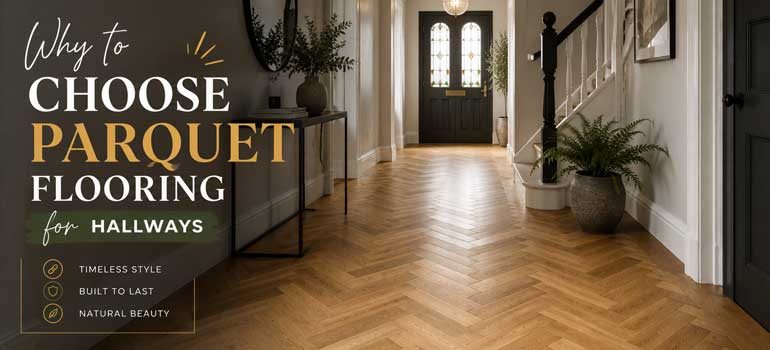
We fit parquet in hallways more than almost any other room, and it's not just because the pattern looks good. Hallways take some of the heaviest daily traffic in a home, from muddy shoes to dragged suitcases to the constant back-and-forth of a busy front door, and a well-fitted parquet floor handles that better than most flooring types while still being the first thing a visitor sees. This guide covers which patterns and colours suit narrow hallways, whether solid or engineered wood makes more sense near a front door, and how to keep the floor looking sharp once it's down.
Does a hallway suit a bold parquet pattern?
Yes, and it's actually one of the better rooms for it. Hallways are usually long and narrow rather than large, and pattern direction has a real effect on how that shape reads. Laid pointing down the length of the hallway, herringbone or fishbone draws the eye forward and emphasises depth, which is often exactly what a narrow corridor needs. Laid at 45 degrees to the walls instead, the same pattern can visually widen the space and soften an awkward or overly straight layout. Either way, the zigzag breaks up the tunnel effect that plain straight-laid boards can create in a long, narrow room.
If your hallway connects to another parquet floor, such as an open-plan hall and living area, keeping the pattern direction consistent across both spaces avoids a disjointed look where the floor seems to change its mind partway through.
Will a dark parquet floor make my hallway feel smaller?
Not necessarily, and colour matters less than most people assume once the pattern and lighting are right. Light tones such as pale oak or ash reflect more natural and artificial light, which does make a hallway feel brighter and more open, and they're a safe choice if your hallway gets limited daylight. Darker tones like walnut or smoked oak absorb more light and give a more dramatic, cosy feel, but they don't automatically shrink the room. Good hallway lighting and the pattern direction do more of that work than the wood colour alone.
Solid or engineered wood for a hallway?
We generally recommend engineered wood for hallways, especially anywhere close to a front door. The area just inside an entrance sees the sharpest swings in temperature and moisture as the door opens and closes throughout the day, and that's exactly the kind of movement that causes solid wood parquet blocks to loosen, gap or cup over time. Engineered boards are built from cross-layered plies under a real hardwood veneer, which holds its shape far better through those daily fluctuations. You can see this in more detail in our guide to engineered wood fishbone parquet flooring, which covers the construction in full.
Harder wood species also matter more in a hallway than in most other rooms, simply because of the volume of footfall. Oak and other dense hardwoods resist dents and scratches better than softer species, which is worth factoring in if the hallway is a main thoroughfare rather than an occasional-use space.
Protecting a hallway parquet floor day to day
A parquet floor in a hallway will always work harder than one in a bedroom, but a few habits make a real difference to how it looks years on:
- Use a doormat inside and outside the entrance to catch grit and moisture before they reach the floor, since grit dragged underfoot is what actually scratches wood, not the traffic itself.
- Fit felt pads under any furniture that sits in the hallway, including console tables and shoe racks.
- Choose a matte or oiled finish over a high-gloss lacquer if you're worried about scuffs, since a satin or matte sheen disguises light surface marks far better than gloss does under hallway lighting.
- Wipe up spills and standing water promptly, particularly near the front door where wet umbrellas and shoes are most likely to leave puddles.
- Have the floor professionally cleaned and re-oiled or re-lacquered periodically, rather than waiting until wear is visible, since maintaining the finish is far cheaper than a full sand and refinish later.
If you'd like advice specific to your hallway's shape, light and traffic levels before committing to a pattern or species, our parquet floor fitting team can talk it through with you, and we also handle commercial parquet floor fitting for entrance halls and reception areas that see even heavier footfall. You can get a free, no-obligation quote whenever you're ready to move ahead.
Frequently asked questions
Is parquet flooring durable enough for a busy family hallway? Yes, properly fitted parquet is one of the more durable options for a hallway. Solid hardwood and engineered wood both resist daily foot traffic well, and unlike carpet or vinyl, a worn parquet floor can be sanded and refinished rather than replaced.
What's the best parquet pattern for a narrow hallway? Herringbone or fishbone laid lengthwise down the hallway is the most common choice, since it draws the eye down the corridor and emphasises depth rather than width. A 45-degree diagonal lay is worth considering instead if the hallway feels particularly cramped side to side.
Should hallway flooring match the rest of the ground floor? It doesn't have to, but keeping the same wood species or a closely related tone creates a smoother visual flow between rooms, especially in open-plan layouts where the hallway leads directly into a kitchen or living space.
Can parquet flooring be fitted over underfloor heating in a hallway? Engineered wood parquet can, provided it's installed with the glue-down method and the boards are within the thickness range the manufacturer specifies for heated floors. Solid wood parquet isn't recommended over underfloor heating.
How often does hallway parquet need refinishing? This depends heavily on foot traffic and how well the floor is maintained day to day, but a hallway will typically need attention sooner than a low-traffic room. Regular sweeping, doormats at entrances and prompt spill cleanup all extend the time between refinishes.