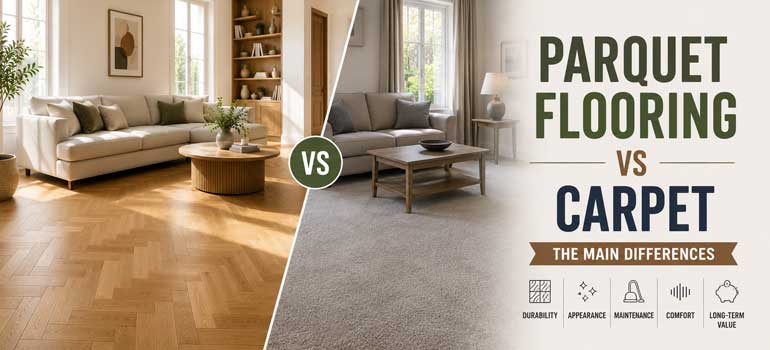
Parquet and carpet are two of the most popular flooring choices, and they sit at opposite ends of several important trade-offs. It's worth weighing up the full picture, including a couple of points that often get left out of comparisons written from a wood flooring perspective, rather than just the factors that make parquet look like the obvious winner.
Cleaning
Day to day, the two aren't as different as people sometimes assume. A quick weekly vacuum keeps both carpet and parquet looking reasonable on the surface. Where the real difference shows up is in deeper cleaning. Carpet traps dirt, dust and debris well below the surface, deep in the fibres, which eventually needs proper professional cleaning to shift properly. Parquet keeps everything on the surface, where a vacuum or a damp mop with a wood-specific, neutral-pH cleaner reaches it directly. Over the life of the floor, that difference in what deep cleaning actually involves is what makes parquet the lower-maintenance option overall, even though the daily routine looks fairly similar for both.
Allergy triggers
This is a genuine, well-established difference. Carpet fibres trap dust, pet dander and other allergens in a way that's hard to fully remove without regular professional cleaning, which can also accelerate wear on the carpet itself. Parquet doesn't have anywhere for that kind of debris to hide, since everything sits on the hard surface rather than working its way into fibres, making it a notably better choice for households managing allergies or asthma.
Durability
Real wood flooring holds up considerably better over time than carpet does. A well-maintained parquet floor can last for decades, sometimes a century or more with proper care, while carpet typically needs replacing within a decade even with good upkeep. Parquet's other advantage here is that wear doesn't mean the end of the floor: sanding and refinishing restores it rather than requiring a full replacement, something carpet simply can't do.
Restoration
This follows directly from durability. A worn or damaged carpet has one real option: lift it and replace it. A worn parquet floor can usually be repaired, re-sanded and refinished, bringing it back close to its original condition. It's rare for a parquet floor to be beyond saving this way, and even then it's usually a case of replacing specific damaged boards rather than the whole floor.
Cost: the point that favours carpet
This is worth including honestly rather than glossing over. Carpet is typically the cheaper option upfront, both in material cost and installation, which matters if budget is the primary constraint on a project. Parquet costs more to buy and fit, though it often works out better value over a longer timeframe given how much longer it lasts and its ability to be refinished rather than replaced. Which matters more depends on how long you're planning to stay in the property and how much upfront budget you have available.
Comfort and noise: carpet's other genuine advantages
Carpet is warmer and softer underfoot than wood, which matters in a cooler climate or for anyone who prefers a softer surface to walk on. It also does a noticeably better job of absorbing sound, while a hard wood floor can produce more noise and echo, particularly in a room with hard walls and minimal soft furnishings. Neither of these is necessarily a dealbreaker for parquet: underfloor heating closes much of the warmth gap, and rugs, curtains and softer furnishings reduce noise considerably, but it's worth factoring both into the decision rather than assuming wood is a straightforward upgrade in every respect.
Style
Both options offer genuine variety. Carpet comes in a wide range of materials, textures and colours, suiting almost any style preference. Parquet's variety comes through pattern, herringbone, chevron, basketweave and more, as well as wood species, colour and finish, giving it a distinctive character that carpet doesn't really replicate. Which suits your home better ultimately comes down to personal taste as much as any practical factor.
If you're weighing up parquet for your own project, our parquet floor fitting team can talk through species, pattern and finish options. Get in touch for a free quote whenever you're ready.
Frequently asked questions
Is parquet a good choice for a cold climate given carpet's warmth advantage? Yes, particularly paired with underfloor heating, which closes most of the temperature gap between the two. Without underfloor heating, a rug in key areas is a common way to get some of carpet's warmth while keeping most of the floor as wood.
Does parquet really cost more over its whole lifespan, or just upfront? It depends on how long you own the property and how the numbers work out, but parquet's much longer lifespan and ability to be refinished rather than replaced often make it the better long-term value, even with a higher initial cost. Carpet's lower upfront cost is a genuine advantage if you don't expect to stay in the property for many years.
Can parquet be made quieter to walk on? Rugs, especially in high-traffic areas, and soft furnishings elsewhere in the room both help reduce noise and echo. Some underlay options used during installation can also help, depending on the specific construction.
Is carpet ever the better hygiene choice? Not generally, since its fibres trap allergens and debris in a way that's hard to fully clean, regardless of vacuuming frequency. Parquet's hard surface is the more hygienic option for most households, particularly those managing allergies.
Does parquet lose value the way carpet does over time? No, and this is part of its long-term appeal. A parquet floor can be refinished repeatedly over decades, restoring it close to its original condition, while a worn carpet has no equivalent option and simply needs replacing.