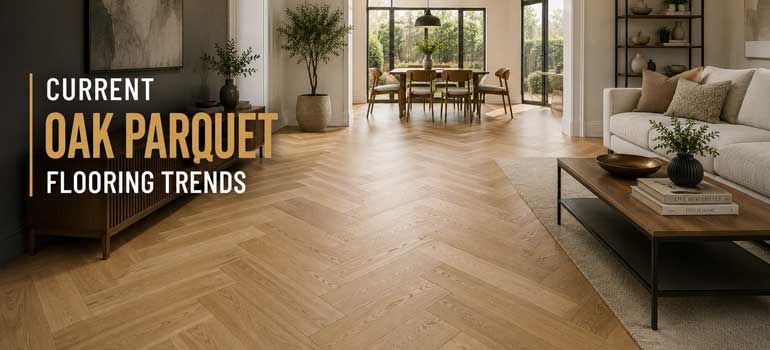
Oak has stayed the default choice for UK flooring for a reason: it's durable, widely available, and takes almost any finish or treatment well. That flexibility is exactly why it's worth revisiting what's actually current for oak right now, since the direction has genuinely shifted from where it sat a few years ago.
Wider, and increasingly variable-width, planks
Standard narrow strip flooring has fallen out of favour, replaced by considerably wider boards.
- 7 to 10 inch wide planks are now the sweet spot most designers are specifying, showing off more of the wood's natural grain per board
- Variable-width installations, mixing several plank widths in the same room, are trending specifically for the more authentic, less uniform look they create
- Fewer visual seams across a room make wide-plank oak feel more open, particularly in larger or open-plan spaces
- A flatter subfloor matters more with wider boards, since any dip in the surface shows through a long plank far more obviously than a narrow one
Warm honey and caramel tones are replacing grey and whitewash
This is the clearest shift worth flagging directly: grey and starkly whitewashed oak, which dominated for years, has genuinely fallen out of favour.
- Warm honey, caramel and mid-tone oak are now the most requested colours, striking a balance between the pale extremes and the almost-black stains of recent years
- These modern warm tones are more muted and refined than the yellow-orange oak popular decades ago, so it's a different look from older "honey oak" despite the similar description
- Warmer tones hide dust and pet hair better than stark grey ever did, which is a genuine practical upside alongside the aesthetic shift
- Darker oak stains still suit period and traditional properties well, particularly paired with herringbone in a grand entryway, where the depth of colour respects the character of an older building
Our guide to how wood floor colour changes the mood of a room covers how tone affects a room's atmosphere in more depth, including the point that lighting and pattern direction do more to affect a small room's feel than colour alone.
Wire-brushed and hand-scraped texture
Perfectly smooth, uniform oak is giving way to more tactile, textured surfaces.
- Wire-brushed finishes add a light surface texture that highlights the grain and gives a floor real dimension underfoot
- Hand-scraped or subtly distressed edges bring an authentic, lived-in character rather than a flawless, manufactured look
- Texture genuinely hides everyday wear better than a smooth surface, since scuffs and light scratches blend into an already-textured grain far more easily
Matte and oiled finishes over high gloss
High-gloss lacquer has quietly disappeared from most current oak flooring projects.
- Matte and low-sheen finishes are now the default, reading as more natural and closer to the wood's genuine texture
- Oiled surfaces are increasingly preferred over lacquer specifically for oak, complementing the wire-brushed texture trend rather than sealing over it
- Gloss is now largely reserved for traditional or formal settings, rather than being a mainstream default the way it once was
Our guide to oiled or lacquered floor finishes covers how the two compare if you're deciding between them for your own project.
Oak in oversized herringbone and chevron
Patterned oak floors are trending at a considerably bigger scale than the smaller, busier parquet of the past.
- Longer, wider planks used within the pattern itself create a bolder, more architectural statement than traditional small-block parquet
- Entryways, dining rooms and primary bedrooms are where this oversized patterning shows up most, as a deliberate feature rather than covering an entire home
- Affordable pre-cut herringbone and chevron oak has made these patterns accessible at a wider range of budgets than the fully hand-laid versions of the past
Our guides to the herringbone wood floor pattern and chevron patterned parquetry cover both in more depth, and our broader look at what's new in parquet flooring covers the wider trend picture beyond oak specifically.
If any of these directions appeal for your own project, our parquet floor fitting team can talk through plank width, tone, texture and pattern for your specific space. Get in touch for a free quote whenever you're ready.
Frequently asked questions
Is grey oak flooring now considered dated? It's genuinely fallen out of favour compared with a few years ago, replaced by warmer honey and caramel tones. That said, a well-fitted floor can always be resanded and restained if your taste or the trend shifts again, so it's not an irreversible choice.
Do wide planks work in a small room, or only large ones? Wide planks work in most room sizes, though a very small room can sometimes benefit from a slightly narrower width to avoid too few boards spanning the space. It's worth seeing samples in the actual room before deciding, since photographs don't convey scale accurately.
Is a wire-brushed finish harder to clean than a smooth one? Not significantly, though the texture can hold slightly more dust in daily use than a perfectly smooth surface. Regular sweeping or vacuuming keeps this from being a genuine maintenance burden.
Does oversized herringbone cost more than standard-sized parquet? It varies by product and supplier rather than following a fixed rule, so it's worth getting a direct quote for the specific plank size and finish you want. Pre-cut engineered options have narrowed the cost gap considerably compared with fully bespoke, hand-laid installations.
Will these trends still look current in a few years? Trends shift over time the way they always do, but oak's ability to be resanded and refinished means a floor fitted today isn't locked into today's exact tone or texture forever. That flexibility is part of why oak has stayed the dominant choice across so many different design eras.