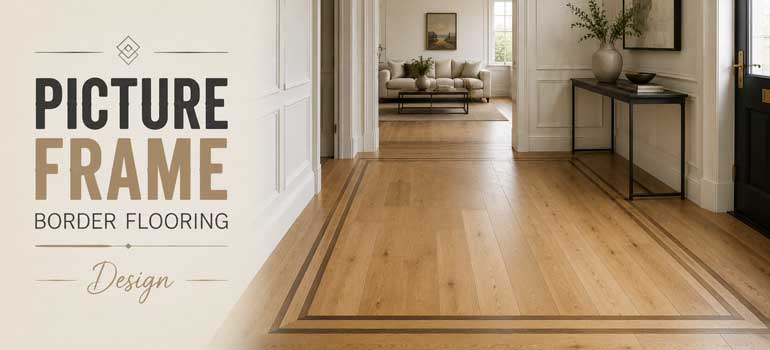
Basketweave, herringbone and chevron get most of the attention when people talk about statement flooring, but picture frame border design deserves a mention too. Rather than a repeating geometric pattern across the whole floor, it uses a contrasting frame around the room's perimeter, and the effect can be just as striking with a fraction of the pattern complexity.
What picture frame border design actually is
The technique frames the room's perimeter in a contrasting wood, using differences in colour, grain or plank width to draw a clear visual border around the main field of flooring. It's a genuinely flexible idea: the contrast can be subtle, a slightly different tone in the same species, or dramatic, a completely different dark wood framing a pale main floor. Either way, the effect reads as formal and considered, closer to a piece of furniture than a floor, which is exactly where the "picture frame" name comes from.
Practical ways to use it
A few genuinely useful applications go beyond simply framing a room for looks:
- Separating spaces visually, using the border to mark where one zone of an open-plan room ends and another begins, without needing an actual wall or change in flooring material
- Following the outline of the room's architecture, tracing bay windows, alcoves or an unusual floor plan in a way that highlights the space's actual structure rather than working against it
- Framing a specific feature, such as a dining table, a fireplace hearth, or a seating area, giving that part of the room a defined boundary the way a rug might, but built permanently into the floor
Do you actually need unfinished materials?
The original advice here is worth being more precise about. For a fully custom picture frame border, mixing species, widths or contrasting mitred corners, unfinished materials genuinely do give the more reliable result, since sanding and finishing the whole floor on-site after fitting blends the transition between field and border far more seamlessly than trying to align separately prefinished pieces with slightly different sheens or micro-bevels.
That's not the only route, though. Simpler, pre-made border panel products are also available prefinished, particularly for more standard, less bespoke border designs, and they're worth considering if speed and cost matter more than an entirely custom look. It comes down to how bespoke the specific design is:
- A fully custom, multi-species border with complex mitred joints benefits from unfinished materials and on-site finishing
- A simpler, more standardised border pattern can often be sourced prefinished, cutting installation time and cost
Choosing contrasting species
The species pairing does most of the visual work in this design. A pale oak field with a walnut border gives a classic, high-contrast result, while two different tones of the same species create a subtler, more understated frame. Our guide to oak vs walnut covers that specific pairing in depth if it's the direction you're drawn to, and our piece on how to add character to your wood flooring covers species and style pairing more broadly.
If a picture frame border sounds right for your project, our parquet floor fitting team can advise on species, width and finish for your specific room. Get in touch for a free quote whenever you're ready.
Frequently asked questions
Does a picture frame border suit every room shape, or only rectangular ones? It genuinely works better with irregular room shapes than a repeating pattern would, since the border can follow bay windows, alcoves or an unusual layout in a way that highlights the room's actual architecture. A simple rectangular room works well too, just with a more predictable, symmetrical result.
Is a picture frame border more expensive than a full herringbone or chevron floor? Usually less, since the contrasting material only covers the perimeter rather than the whole floor area. It's a genuine way to use a pricier accent species without the cost of covering an entire room in it.
Can an existing plain floor have a picture frame border added later? Sometimes, depending on the floor's construction and condition, though it's more involved than including the border during original installation. It's worth having a professional assess whether retrofitting suits your specific floor before assuming it's possible.
How wide should the border typically be? There's no fixed rule, and it varies by room size and the effect you want. A narrower border reads as a subtle accent, while a wider one becomes a more dominant design feature in its own right, so it's worth seeing samples at scale before deciding.
Does the border need to match the room's skirting boards or trim? Not necessarily, though a deliberate relationship between the two, whether matching or a considered contrast, tends to look more intentional than an unrelated combination. It's worth thinking about the border alongside the room's other finishes rather than in isolation.