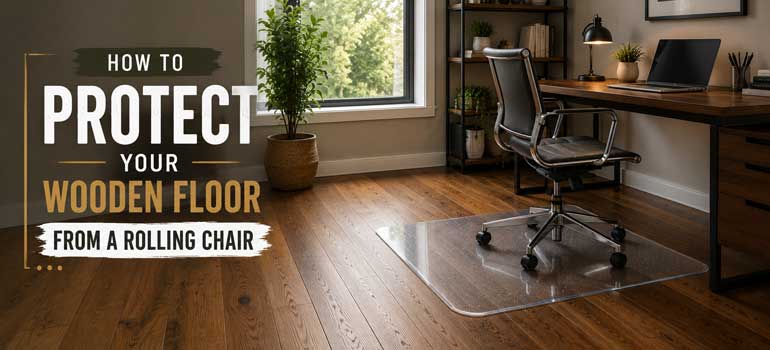
Wood flooring suits an office well: it looks professional, holds up to daily use, and is easy to keep clean. A rolling chair is one of the few things that genuinely tests it, though, and it's worth understanding why before jumping to fixes. It's not really the weight of the chair itself that causes the damage. It's the constant back-and-forth motion, combined with grit and debris getting caught under the wheels, that gradually wears through the finish and leaves scuff marks and fine scratches over time. Left unaddressed, that worn finish exposes the bare wood underneath to the same problems.
Matching your casters to the floor
The single most effective fix is often the simplest: check what your chair's wheels are actually made of. Most standard office chairs ship with hard plastic or hard nylon casters, which are designed for carpeted floors, not wood. On a hard surface like parquet, those hard wheels are exactly what causes the scuffing.
Swapping them for softer casters solves the mismatch at the source:
- Rubber, urethane or neoprene casters are made specifically for hard floors and are widely available as a direct replacement for standard office chair wheels
- Replacement is usually straightforward, following the manufacturer's fitting instructions, and doesn't require any tools beyond what came with the chair
- Check the caster's load rating if the chair or its user is on the heavier side, since a soft caster rated for the wrong weight will still wear unevenly
A quick DIY fix sometimes suggested is wrapping tape around the existing hard casters, but this isn't a genuine long-term solution. It wears through quickly, looks unprofessional in a workplace, and doesn't actually address the mismatch the way a proper caster swap does. If you're protecting an office floor for the long term, replacing the wheels outright is worth the small upfront cost.
Chair mats and rugs
A chair mat placed under the chair keeps the wheels off the wood entirely, which is the most reliable protection short of replacing the casters. If the chair tends to roam beyond a single mat's coverage, a larger area rug can protect a wider zone, particularly useful in an open desk layout where movement isn't confined to one spot.
Stick to rugs and woven materials rather than plastic mats. Plastic traps small pieces of grit and debris between itself and the floor, and that trapped debris ends up grinding into the finish with every roll of the chair, which somewhat defeats the purpose of using a mat in the first place.
A few other things worth considering
The finish itself plays a role too. A matte or textured finish, like a wire-brushed or oiled surface, tends to disguise the light scuffing that chair traffic causes far better than a high-gloss lacquer does, where the same marks show up more obviously against the reflective surface. If you're specifying flooring for a new office fit-out, this is worth factoring in alongside caster choice.
It's also worth keeping an eye on the finish's general condition in a busy office, since heavy chair traffic wears through protective coatings faster than in a typical home. Our guide to oiled or lacquered floor finishes covers how the two compare on durability and maintenance, which is worth knowing before specifying a finish for a commercial space.
If you're planning wood flooring for an office or other commercial space, our commercial parquet floor fitting service can advise on species, finish and layout that hold up well to daily chair traffic. Get in touch for a free quote whenever you're ready.
Frequently asked questions
Do I need to replace every chair's casters, or just the ones that roll the most? It's worth doing every chair that regularly moves across the wood floor, since even occasional use with hard casters will eventually leave marks. Chairs confined to a carpeted area don't need the swap.
Are chair mats enough on their own, without changing the casters? A good chair mat is genuinely effective on its own, provided the chair stays within its coverage area. Combining both a mat and softer casters gives the best protection if the chair tends to move beyond the mat's edges.
Will scuff marks from a rolling chair go away with cleaning? Light surface scuffs often buff out with a soft cloth and a cleaner suited to the floor's finish. Deeper scratches that have gone through the finish need a more involved repair, such as spot sanding and refinishing the affected area.
Is wood flooring a bad choice for an office because of this issue? Not at all, this is a genuinely manageable problem with straightforward fixes. Wood flooring remains a durable, professional-looking choice for office spaces once the caster and mat considerations are addressed.
Does the wood species matter for resisting chair scuffs? Harder species like oak or maple resist the underlying wear a little better than softer species like walnut, though the caster and finish choices matter more for this specific issue than species hardness alone.