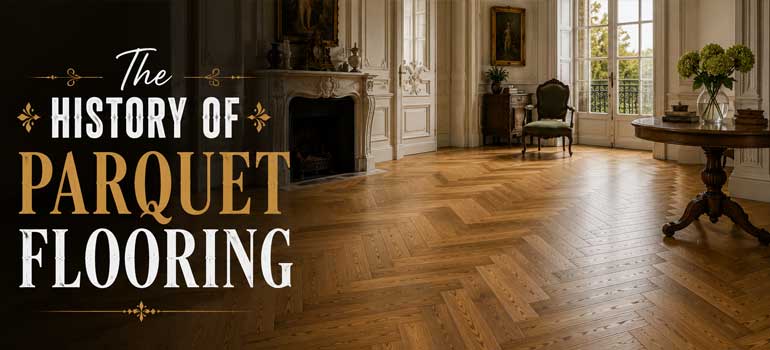
Parquet has a genuine history behind it, not just a look borrowed from the past. Understanding where it actually came from, and correcting a common mix-up about exactly when, makes the pattern feel even more considered underfoot. Here's the real story.
Where parquet actually began
Parquet's origins trace back to 16th-century France, not the late 1600s as it's sometimes described. One of the earliest documented examples was laid at the Château de Fontainebleau in 1539, considerably earlier than the palace most people associate with the pattern's beginnings.
The reason parquet caught on in the first place had nothing to do with fashion. Marble floors were the standard in grand French homes at the time, but marble came with a genuine practical problem: keeping it clean required regular washing, and all that water gradually damaged the wooden joists supporting the floor underneath. Parquet offered a lighter, warmer alternative that solved this exact issue, made from small pieces of hardwood cut and arranged into geometric patterns, triangles, squares and rhombuses among them, then fitted, sanded and polished by hand.
The Parquet de Versailles pattern
This is where the common mix-up comes from. The specific pattern known as Parquet de Versailles dates to 1684, when it was installed at the Palace of Versailles, roughly a century and a half after parquet as a general flooring technique had already been established elsewhere in France. Versailles gave its name to one particular, highly elaborate design, large square panels combining diagonal and interwoven elements within a decorative border, but it wasn't the birthplace of parquet flooring itself. That distinction belongs to the earlier French interiors that used the technique first.
Why parquet was such a serious luxury
Parquet's exclusivity in its early centuries wasn't just about appearances. A few genuine factors kept it out of reach for most people:
- Every piece was cut and fitted by hand, requiring genuinely skilled artisans rather than general labourers, which made the work slow and expensive
- Maintenance was a real ongoing cost, since inappropriate care of the period frequently damaged the finish, requiring frequent, costly restoration
- Only the wealthy and the aristocracy could sustain that expense, which is exactly why parquet became so strongly associated with grand, formal interiors rather than ordinary homes
The decline, and the mid-century comeback
Parquet's popularity held for centuries, but it faced real competition once carpet manufacturing became mass-produced and genuinely affordable in the early to mid-20th century. Fitted, wall-to-wall carpet offered a cheaper, faster alternative that didn't require skilled hand-fitting, and it drew homeowners away from wood flooring through the middle decades of the 1900s.
The comeback arrived in the 1980s and 90s, as interior tastes shifted back toward natural materials and genuine craftsmanship over synthetic, mass-produced finishes. Advances in engineered wood construction around this period also helped, making parquet considerably more accessible than the fully hand-laid solid wood installations of centuries past.
A quick timeline
| Period | What happened |
|---|---|
| 1539 | One of the earliest documented parquet floors laid at Château de Fontainebleau |
| Late 1600s | Parquet de Versailles pattern created, giving the style its most famous name |
| 1930s–1950s | Mass-produced fitted carpet becomes affordable, and parquet's popularity declines in ordinary homes |
| 1980s–1990s | Parquet makes a strong comeback, aided by more accessible engineered wood construction |
| Today | Herringbone and other traditional patterns are seeing a renewed resurgence, alongside contemporary takes on scale, tone and finish |
Parquet today
Parquet is arguably more accessible now than at any point in its history, thanks to engineered construction and pre-cut panels that remove much of the hand-fitting cost that once made it a luxury reserved for the wealthy. Our guides to what's new in parquet flooring and current oak parquet flooring trends cover where the pattern is heading right now, four and a half centuries after it first appeared on a French floor.
If parquet's history has you considering it for your own home, our parquet floor fitting team can talk through pattern, species and construction options, whichever era of style you're drawn to. Get in touch for a free quote whenever you're ready.
Frequently asked questions
Is all parquet flooring today made the same way it was originally? No, most modern parquet is engineered rather than solid, built from a real hardwood veneer over a stable, cross-layered core. It looks identical to traditional solid parquet once fitted, but it's fitted far more efficiently and holds up better to humidity changes.
Why is herringbone specifically so associated with parquet's history? Herringbone was one of the earliest and most widely used parquet patterns, largely because its relatively simple square-cut blocks were more practical to produce by hand than more elaborate designs like Versailles panels. That practicality is part of why it remained the most enduring pattern through parquet's history.
Did parquet exist outside France historically? Parquet techniques spread across Europe over the centuries following its French origins, appearing in grand interiors from Russia to Central Europe, though France remains the style's historical home and the source of its most recognised patterns.
Is Versailles pattern parquet still available today? Yes, and it's now produced in engineered wood as well as traditional solid panels, which makes the pattern considerably more accessible than the fully hand-cut versions installed at the palace itself.
Why did carpet overtake parquet in popularity for a period? Cost and speed were the main drivers. Fitted carpet could be manufactured and installed far more cheaply and quickly than hand-laid parquet, which made it the practical choice for most households once mass production made it widely available.