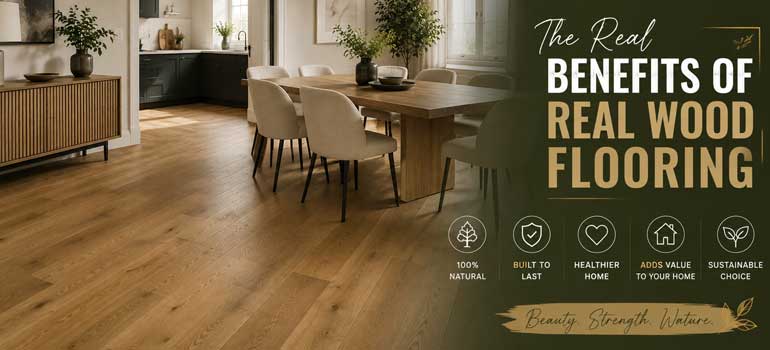
Real wood flooring costs more upfront than most alternatives, so it's worth being clear about what that extra cost actually buys you beyond good looks. The honest answer is a floor that can be restored rather than replaced, holds its value over decades rather than years, and genuinely performs better in a few practical ways that aren't always obvious until you've lived with it.
It can be restored, not just replaced
The single biggest practical advantage of real wood over most other flooring is that wear doesn't mean the end of the floor. Scratches, dents and a dulled finish that would mean ripping out carpet or vinyl can usually be sanded back and refinished on real wood instead, bringing it back close to how it looked on day one. That also means you're not locked into one look forever: refinishing with a different stain or sheen is a genuine way to change a room's character years down the line without replacing the floor underneath it.
It's easier to keep clean and allergen-free
A hard, sealed wood surface doesn't trap dust, pet dander and other allergens the way carpet fibres do, which makes it a genuinely better choice for anyone managing allergies or asthma in the household. Day-to-day maintenance is also simpler: a regular vacuum or damp mop keeps it looking good, without the periodic deep cleans or professional washing that carpets and rugs need to stay hygienic.
It doesn't date the way other finishes can
Trends in flooring come and go, but wood has stayed a consistent, safe choice across decades of interior design shifts in a way that patterned carpet or bold laminate rarely manages. A well-maintained wood floor tends to look appropriate whether the rest of the room is styled traditionally or contemporarily, which matters if you'd rather not redo the floor every time your taste or the market's changes.
It tends to add resale value
Wood flooring is consistently one of the features buyers respond well to when viewing a property, and estate agents commonly cite it as a factor that helps a home show better and move faster than one with worn carpet or dated flooring. It's not a guaranteed fixed uplift, since the effect varies by property type and local market, but it's rarely seen as a downside the way an ageing carpet often is.
It's a more sustainable long-term choice
Because it can be sanded and refinished multiple times rather than torn out and replaced, a real wood floor generally has a much longer useful life than synthetic alternatives before anything ends up in landfill. Choosing timber from a responsibly managed source adds to that picture further, since wood is a renewable material in a way that most manufactured flooring options simply aren't.
If you're deciding between solid and engineered wood for your own project, our guide to prefinished or unfinished wood flooring covers another key decision worth making early on. Our parquet floor fitting team can talk through species, pattern and finish options for your specific room, and we're happy to put together a free quote once you've got a sense of direction.
Frequently asked questions
Is real wood flooring worth the extra cost compared with laminate? It depends on how long you plan to stay in the property and how much you value being able to refinish rather than replace. Laminate is cheaper upfront but can't be sanded back the way real wood can, so it typically needs full replacement once it's worn, while a wood floor can often be restored multiple times over its life.
How many times can a real wood floor be refinished? It depends on the thickness of the wear layer. Solid wood generally allows for several refinishes over its lifetime, while engineered wood is limited by how thick its top hardwood veneer is, often allowing for one or two refinishes depending on the specific product.
Does real wood flooring help with allergies? It can, since it doesn't trap dust, pollen and pet dander in fibres the way carpet does. It's not a substitute for other allergy management, but many people with allergies or asthma find a hardwood surface easier to keep genuinely clean than carpet.
Is real wood flooring a good investment if I'm planning to sell in a few years? Generally yes, since it's a feature most buyers respond positively to and rarely a point against a property, unlike ageing or heavily worn carpet. The exact value it adds varies by area and property type, so it's worth getting a local view if resale is your main motivation.
Is engineered wood still considered "real" wood flooring? Yes, the visible surface layer on engineered wood is genuine hardwood, identical in look and species to solid wood. What differs is the construction underneath it, not whether it counts as real wood.