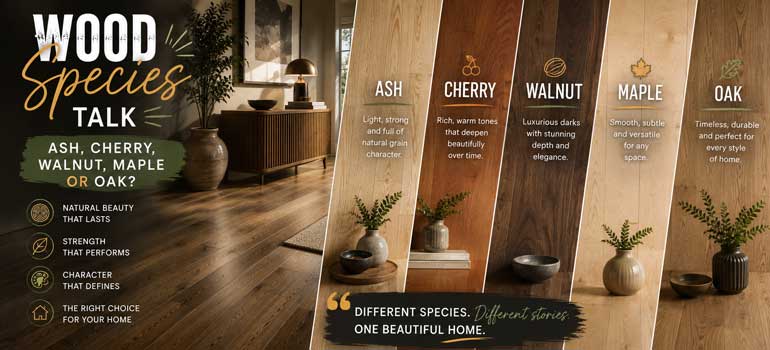
Choosing a wood species is one of the biggest decisions in any flooring project, and it comes down to more than just colour. Hardness, grain and how a floor copes with daily traffic all vary significantly between species, and getting this right matters more in a busy hallway than it does in a spare room. Here's a practical look at five of the most popular options for London homes: ash, cherry, walnut, maple and oak.
Ash wood floors
Ash is a light, pale timber running from near-white through to soft yellow and light grey tones, which makes it easy to work into almost any interior style and useful for making a smaller room feel more open. It's also one of the harder domestic species, sitting above oak on the Janka hardness scale, which makes it a genuinely solid choice for busy rooms rather than just a good-looking one.
Cherry wood floors
Cherry has long been valued for its warm, reddish-brown tone, which deepens further with exposure to natural light over the first year or so after fitting, a distinctive trait of the species worth knowing about before you commit to it. Where cherry falls down compared with the others here is hardness. It's one of the softer domestic species, similar to walnut, so it dents and marks more readily under heavy traffic than oak, ash or maple. That makes it a better fit for a formal living room or dining room than a busy hallway or a home with large dogs.
Walnut wood floors
Walnut's deep, chocolate-brown tone with a hint of purple gives a room a strong, deliberate character, and it works equally well in traditional and contemporary settings. Like cherry, walnut sits toward the softer end of the domestic hardwoods, so it's worth choosing it for its looks and accepting it needs a little more care underfoot than oak or maple, particularly in high-traffic spots.
Maple wood floors
Maple ranges from near-white to a light honey brown, with a fine, subtle grain that takes a smooth finish well. It's also the hardest of the five species covered here, which makes it a strong practical choice for busy family rooms as well as a popular option for sports and dance floors, where durability under repeated impact matters even more than in a typical home.
Oak wood floors
Oak remains the most popular choice for UK flooring, and for good reason. White oak has a light, slightly silvery tone that suits contemporary spaces, while red oak leans warmer. Both take stain well if you want to shift the colour without changing species, and oak's combination of strength and relatively stable movement with humidity makes it a dependable choice for commercial parquet flooring as well as busy family homes.
Hardness compared: the Janka scale
The Janka scale measures how much force it takes to press a steel ball halfway into a piece of wood, and it's the standard way to compare how well different species resist dents and wear. Higher numbers mean a harder, more traffic-resistant floor.
| Species | Approximate Janka rating | Relative hardness |
|---|---|---|
| Maple | ~1,450 | Hardest of the five |
| Ash | ~1,320 | Very hard |
| Oak (white) | ~1,360 | Very hard |
| Oak (red) | ~1,290 | Hard |
| Walnut | ~1,010 | Softer |
| Cherry | ~995 | Softest of the five |
Ratings vary slightly between suppliers and specific sub-species, so treat these as a guide for comparison rather than an exact figure for any one board.
Which species suits which room?
- Hallways, kitchens and family rooms: oak, ash or maple, given their higher hardness and better resistance to daily wear
- Formal living rooms or dining rooms with lighter use: cherry or walnut, where their softer wood is less of a practical concern and their colour can take centre stage
- Homes with pets or children: oak or maple are the safer bet for resisting dents and scratches over time
- Spaces you want to feel bigger or brighter: ash or white oak, given their lighter natural tones
If you're still weighing up species for a specific room, our parquet floor fitting team can talk through what suits your traffic levels and style before you order anything, and a free quote is a good starting point once you've narrowed things down.
Frequently asked questions
Is oak really the best all-round choice? For most homes, yes. It combines good hardness, relative stability with humidity changes, and wide availability, which is why it remains the most common choice for UK wood flooring even though ash and maple technically rank harder on the Janka scale.
Why does cherry wood darken after it's fitted? Cherry is naturally photoreactive, meaning it changes colour with exposure to light, typically deepening from a paler pinkish tone to a richer red-brown over its first year or so. This is normal and expected rather than a fault.
Can I get the look of walnut with better durability? Yes, engineered walnut boards give you the same colour and grain as solid walnut while being more dimensionally stable, though the visible wear layer is still the same softer walnut timber, so it doesn't change the hardness itself. Choosing a harder species and staining it darker is another route if durability matters more than having genuine walnut.
Does a harder wood species mean less maintenance? Generally yes, since a harder floor resists the dents and surface scratches that eventually call for sanding and refinishing. It's not the only factor, though. How the floor is finished and maintained day to day matters just as much as the species itself.
Are these species available as engineered wood as well as solid? Yes, all five are commonly available as engineered wood, which pairs the same species and finish with a more stable, cross-layered core. This is worth considering for rooms with underfloor heating or bigger humidity swings, regardless of which species you choose.