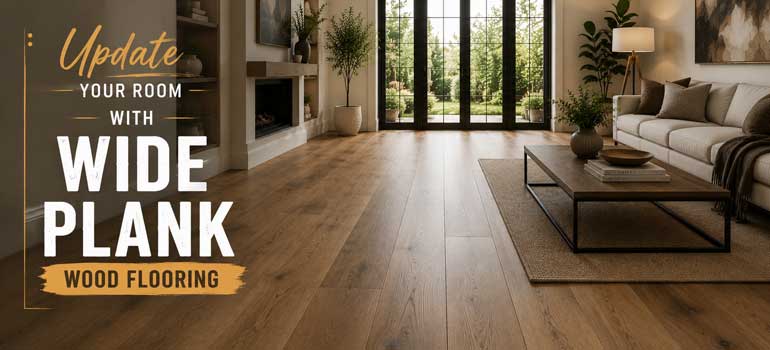
Wide plank flooring has become one of the most requested looks in current wood flooring projects, and it's easy to see the appeal: fewer seams, more visible grain per board, and a genuinely open, contemporary feel. It's worth going in with accurate expectations, though, since a few claims about wide plank flooring get oversold more than they should.
Does it really suit every room, regardless of size?
Wide plank generally means boards five inches or wider, with current projects increasingly favouring something closer to 7 to 10 inches for the boldest version of the look. Wide planks indeed make most rooms feel more open, with fewer visual seams breaking up the floor. That said, it's not accurate to say it makes literally any room, however small, look more spacious. A very small room can sometimes benefit from a slightly narrower plank instead, since too few boards spanning a tight space can actually look disproportionate rather than expansive. Our guide to current oak parquet flooring trends covers this width consideration in more detail.
Genuine design variety
This part holds up well. Wide plank flooring comes in a genuinely wide range of species, colours and finishes, from gloss through to matte, with textures spanning smooth and refined to hand-scraped and rustic. Oak remains the most common choice given its wide availability, but walnut, ash and a range of more exotic species are all produced in wide plank format too, so the width itself doesn't box you into one look. Colour is just as flexible: current projects lean toward warm honey and caramel tones, but wide plank boards are stained, oiled or lacquered across the full spectrum from pale, near-white finishes through to the darkest walnut or wenge tones, depending on what suits your room. Whether you're after something contemporary, traditional or somewhere in between, there's a wide plank option that fits, and the width itself doesn't limit your styling choices the way some other flooring decisions can. It's worth seeing a few physical samples in the room itself before deciding, since the effect of a wide board's grain and colour reads quite differently in person than it does in a small product photo.
Is it actually more affordable?
This is worth correcting directly. Wide plank flooring typically costs more than standard-width boards, not less, since wider planks use more material per board and demand a flatter, more carefully prepared subfloor to install well. It's not the budget-friendly route to a luxury look the way it's sometimes marketed.
That said, there are genuine ways to manage the cost if wide plank is the look you want:
- Engineered wide plank gives you the same visual width and real wood surface over a more efficient, stable core, generally at a lower cost than solid wide plank
- Choosing a more widely available species like oak, rather than a rarer or exotic timber, keeps material costs down while still getting the width you want
- A character grade with visible knots and natural variation often costs less than a premium, uniform-looking grade
What installation actually involves
Wide plank flooring isn't the same quick weekend job that narrower boards can sometimes be. Because any dip or unevenness in the subfloor shows through a long plank far more obviously than a narrow one, subfloor preparation matters more here than with standard flooring, and that preparation takes real time to get right. Prefinished, engineered wide plank does speed up the process considerably compared with solid wood finished on-site, since there's no sanding and finishing to wait on, but it's still worth planning for a proper installation timeline rather than assuming a single weekend covers it. Our guide to what to look for in a flooring contractor covers why proper subfloor preparation matters so much to the final result.
If wide plank flooring sounds right for your project, our parquet floor fitting team can assess your subfloor and advise on a realistic timeline and budget. Get in touch for a free quote whenever you're ready.
Frequently asked questions
Is engineered wide plank as good-looking as solid wide plank? Yes, since the visible wear layer is genuine hardwood either way, the appearance is identical once fitted and finished. The difference is in the construction underneath, not what you see and feel underfoot.
How much wider is "wide plank" compared with standard flooring? Standard strip flooring is typically under 3 inches wide, while wide plank generally starts around 5 inches and can go up to 10 inches or more in current projects. The wider end of that range is where the fewer-seams, more-open look is most pronounced.
Does wide plank flooring need a different fitting method than narrower boards? Not necessarily a different method, but it does demand a flatter subfloor and more careful preparation regardless of whether it's nailed, glued or floated. Skipping this step is more noticeable with wide plank than with narrower boards.
Can wide plank flooring be used with a patterned layout like herringbone? Yes, and oversized herringbone or chevron using longer, wider planks within the pattern is a genuinely current look, distinct from the smaller-block parquet of the past. It creates a bolder, more architectural version of the pattern.
Is wide plank flooring more prone to gapping than narrower boards? It can show slightly more visible movement per board during humidity changes, simply because each board covers more surface area. Engineered construction manages this better than solid wood, which is worth factoring in if your room sees noticeable seasonal humidity swings.