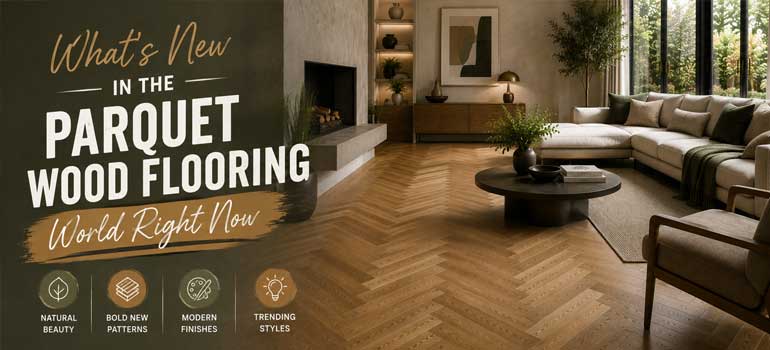
Parquet has properly returned to the spotlight after years of interior design leaning toward minimal, uniform flooring, and this time it's arriving with some real shifts in how people are choosing to use it. Here's what's genuinely shaping parquet and wood flooring choices right now, rather than a vague nod to "trends" without much behind it.
Herringbone is leading the pattern comeback
Herringbone and traditional parquet layouts are seeing a genuine resurgence, in some cases overtaking the chevron layouts that dominated in recent years. Part of the appeal is that it doesn't feel like a passing trend the way some bolder interior choices do: the pattern has centuries of history behind it, so it reads as intentional and considered rather than of-the-moment.
What's driving the current look specifically:
- Narrower plank widths, roughly 3 to 5 inches, are what most designers point to for clean, crisp lines, since wider individual pieces can make the geometry look heavier and less precise
- Experienced installation matters more than ever, since the appeal of the pattern relies on genuinely even, well-aligned lines
- Long hallways and open-plan living areas are where the pattern is showing up most, since it guides the eye through the space rather than sitting still in one room
Our guides to the herringbone wood floor pattern and chevron patterned parquetry cover both in more depth if you're deciding between the two.
Warmer, richer tones are replacing the pale, grey-washed look
After several years where pale and grey-toned floors dominated, mid-tone and darker woods are having a real moment. Honey, chestnut, walnut and deeper espresso shades are all showing up far more in current projects than they were even a couple of years ago.
Why the shift is happening:
- Warmth over starkness — a lot of people feel the ultra-light interiors of recent years lost some cosiness, and richer tones bring that atmosphere back
- Best suited to living rooms and bedrooms, where a grounded, intimate feel matters more than an open, airy one
- Pairs naturally with warm neutrals, rather than the cooler greys that pale floors tend to sit alongside
If you're weighing up tone for your own project, our guide to how wood floor colour changes the mood of a room covers how different shades affect a space's atmosphere.
Matte finishes are taking over from high gloss
Glossy, heavily lacquered floors are giving way to matte and low-sheen finishes across most current projects. The look reads as more natural and closer to the wood's genuine texture, and it comes with a real practical upside too:
- Matte surfaces disguise everyday scuffs and light scratches far better than a high-gloss finish, which shows the same marks much more obviously
- The look leans into the wood's texture rather than smoothing it over with a reflective sheen
- Oil finishes naturally lean matte, while lacquer can be specified across a range of sheen levels, so the finish type and the sheen level are two separate decisions worth discussing together
Our guide to oiled or lacquered floor finishes covers how the two main finish types compare if you're deciding between them.
Natural grain variation is replacing perfectly matched boards
There's a genuine shift away from floors made of uniform, closely matched boards toward ones that deliberately mix lighter and darker tones within the same floor.
A few things worth knowing about this look:
- White oak and hickory suit it particularly well, given how much natural colour variation already exists within a single plank of either species
- It hides everyday wear more effectively, since scratches, dust and light marks blend into a varied floor far more easily than into a perfectly uniform one
- It reads as more natural rather than manufactured, which is part of why it's replacing the closely matched, uniform boards that dominated for years
Patterns as an accent, not the whole floor
Rather than covering an entire home in one bold pattern, a growing number of projects are using parquet as a feature within a space rather than a whole-house commitment.
A few ways this is showing up:
- A patterned entrance hall bordered by simpler, straight-laid flooring elsewhere in the home
- A bordered panel or feature area within an otherwise plain room, rather than pattern wall to wall
- Lower cost and commitment than covering every room, while still delivering the visual impact a pattern is chosen for
- A more deliberate, considered read than a busy layout repeated throughout the whole house
If any of these directions appeal for your own project, our parquet floor fitting team can talk through pattern, tone and finish options for your specific space. Get in touch for a free quote whenever you're ready.
Frequently asked questions
Is herringbone actually more popular than chevron right now, or are they equally trendy? Current design coverage leans toward herringbone specifically regaining ground on chevron, though both remain popular choices. It's worth choosing based on which look you genuinely prefer rather than chasing whichever is marginally more fashionable this year, since both have long track records and aren't going anywhere.
Do matte finishes need more maintenance than glossy ones? Not more maintenance exactly, though the two do wear differently. A matte finish tends to disguise light scratches and dust better day to day, while a glossy finish shows marks more clearly but can look more dramatically refreshed right after cleaning.
Is dark flooring a safe long-term choice, or will it feel dated again soon? Dark and mid-tone woods have cycled in and out of fashion for decades without ever truly disappearing, so it's a reasonably safe long-term choice compared with a more unusual or highly specific trend colour. If tone ever falls out of favour, a solid or thick-veneer engineered floor can be resanded and restained rather than replaced.
Does using parquet as an accent rather than throughout cost less? Generally yes, since you're covering less area with the more labour-intensive patterned installation and using simpler, more affordable flooring elsewhere. It's a practical way to get a striking feature without the full cost of a pattern across every room.
Are these trends specific to homes, or do they apply to commercial spaces too? Most of them apply to both. Matte finishes and natural grain variation in particular are increasingly common in offices, restaurants and retail spaces, partly because they hide daily wear well in high-footfall commercial environments.