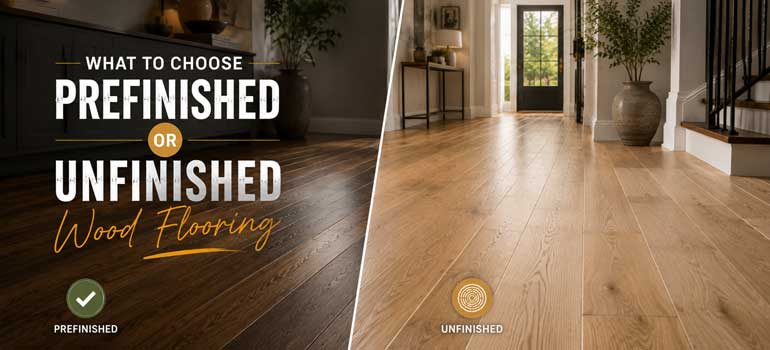
Every wood floor needs a protective finish on top of the bare timber, and the question is really just when and where that finish gets applied. Prefinished boards arrive with it already done at the factory, while unfinished boards are sanded, stained and sealed on-site once they're down. Both are genuine, long-lasting options, and the right one depends more on your priorities around cost, timeline and customisation than on which is objectively "better."
What is prefinished wood flooring?
Prefinished boards are sanded, stained and sealed at the factory under controlled conditions before they ever reach your home. That controlled environment produces a consistently even finish that's harder to replicate on-site, and many prefinished products use aluminium oxide or similar hardeners that give the finish strong resistance to scratches and UV fading, with some manufacturers offering warranties well into the double digits. Because the finish is already cured, you can walk on a prefinished floor almost as soon as it's installed rather than waiting days for coats to dry.
The trade-off is flexibility. Once a prefinished board is made, that's the colour and sheen you're getting, and boards typically have a slight bevelled edge at each join, which some people like for the definition it gives each plank and others find less seamless than a site-finished floor.
What is unfinished wood flooring?
Unfinished boards go down bare and are sanded, stained and finished as one continuous job once they're fitted. This gives you full control over stain colour, sheen and finish type, and because sanding happens after installation, the whole floor ends up perfectly flat and seamless across every board, without the bevelled edges you get with prefinished planks. Some wood species and custom board sizes are also only available unfinished.
The trade-off here is time and disruption. Sanding, staining and sealing on-site takes days, sometimes longer between coats, and the room is off-limits while it's happening. Site-applied finishes can also carry a noticeable odour while curing, which is worth planning around if you're living in the property during the work.
Which one actually costs less?
This is where the original comparison usually goes wrong, since neither option is simply "cheaper." Unfinished boards have a lower cost per square metre as raw material, but installing them adds the cost of sanding, staining, sealing and the extra labour time all of that takes. Prefinished boards cost more upfront but skip most of that labour and material, since the finish is already done. Once you compare the total installed cost rather than just the price of the boards, the two options often land much closer together than the sticker price suggests, and which one comes out ahead can depend on the size of the job and the specific products involved.
Can both be sanded and refinished later?
Yes, both prefinished and unfinished floors can be sanded and refinished down the line, though it's a little more involved with prefinished boards. Refinishing a prefinished floor sands away the bevelled edges along with the factory finish, so it ends up looking like a site-finished floor from that point on. Unfinished floors are generally considered easier to spot-repair too, since a scuffed or damaged patch can often be sanded and blended in without it being obvious, which is trickier to do invisibly on a factory finish.
Quick comparison
| Prefinished | Unfinished | |
|---|---|---|
| Where it's finished | Factory, before delivery | On-site, after fitting |
| Ready to use | Almost immediately | Days after finishing, once fully cured |
| Customisation | Fixed colour and sheen, chosen before purchase | Full control over stain and finish on-site |
| Board edges | Slight bevel at each join | Flat, seamless surface |
| Total installed cost | Higher material cost, lower labour cost | Lower material cost, higher labour cost |
| Refinishing later | Sands away the bevel, becomes flat like site-finished | Straightforward, matches original look |
Whichever route suits your project, our parquet floor fitting team works with both prefinished and unfinished materials across London, and we can talk through which makes more sense for your timeline and budget. We also handle commercial parquet floor fitting, where minimising downtime often tips the decision toward prefinished. Get in touch for a free quote whenever you're ready to move forward.
Frequently asked questions
Is prefinished flooring lower quality than unfinished? No, quality comes down to the specific product and installation rather than which category it falls into. Good prefinished flooring uses factory-cured finishes that are often more durable than what's achievable on-site, while good unfinished flooring, properly sanded and sealed, holds up just as well over time.
How long do I need to stay out of the room with unfinished flooring? It varies by product, but expect the room to be unusable for several days while sanding, staining and sealing happen and each coat cures. Prefinished flooring, by contrast, is typically walkable almost immediately after fitting.
Does prefinished flooring smell during installation? Not in the way site-finishing does, since the finish is already cured before the boards arrive. Unfinished flooring can carry a noticeable smell from stains and sealants while they cure on-site, which is worth factoring in if you're living in the space.
Which option is better for matching an existing floor? Unfinished flooring generally gives a closer match, since the stain and finish are mixed and applied on-site specifically to match what's already there. Prefinished boards come in a fixed range of factory colours, which may not line up exactly with an older existing floor.
Can I mix prefinished and unfinished flooring in the same home? It's possible, but it's worth planning carefully so transitions between rooms look intentional rather than mismatched, particularly where a prefinished floor's bevelled edges meet a seamless unfinished one at a doorway.