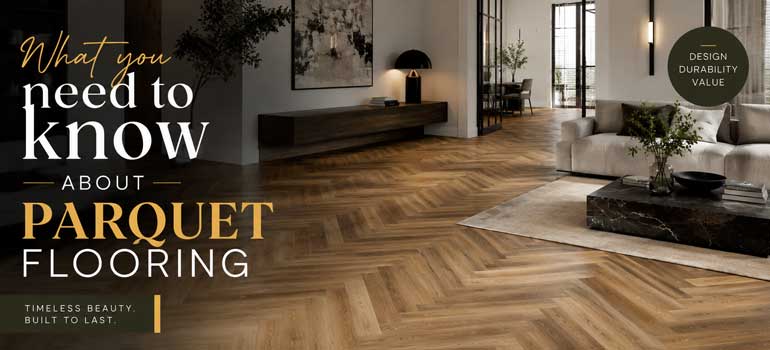
Parquet flooring is real wood cut into small blocks and laid in geometric patterns instead of long planks. That's the core difference from standard wood flooring: rather than one continuous board running the length of a room, parquet is assembled piece by piece into designs like herringbone, chevron, or basket weave. It's one of the few flooring types where the installation pattern is as much a part of the design as the wood itself.
Where parquet flooring comes from
Parquet originated in 16th-century France, where it was developed as a practical alternative to marble and stone floors in grand houses and châteaux. Marble was cold, heavy, and expensive to maintain, and it damaged the timber joists beneath it over time. Wood solved all three problems at once. The style reached its most famous form under Louis XIV, who commissioned the "Parquet de Versailles" pattern for the Palace of Versailles in 1684, still one of the most recognisable parquet designs today. It arrived in England not long after; Queen Henrietta Maria had it installed at Somerset House in London in the 1620s. From there it spread through European aristocratic homes and, eventually, into ordinary households as manufacturing made it more affordable.
Solid vs engineered parquet
Parquet blocks are cut from either solid timber or engineered wood. Solid parquet is timber through and through, usually around 3/4 inch thick, and can be sanded and refinished multiple times over its life. Engineered parquet has a real hardwood veneer bonded to a plywood or HDF core, giving better stability against humidity changes at the cost of fewer refinishing cycles. Once laid and finished, the two look identical.
Oak is by far the most common species, prized for its hardness and the way its grain shows off geometric patterns. Walnut, cherry, and maple are also used, mainly for a darker tone or a finer grain.
Popular parquet patterns
- Herringbone — rectangular blocks laid in a zigzag, each block's end meeting the next block's side. The most popular pattern today for its balance of visual impact and reasonable installation cost.
- Chevron — similar zigzag effect, but the block ends are cut at an angle so they meet in a continuous point rather than a step. More expensive to install than herringbone because of the precise angle cuts.
- Basket weave — blocks set in alternating pairs to resemble a woven basket. A traditional pattern that suits period properties well.
- Brick (or running bond) — blocks laid in straight, offset rows like a brick wall. The simplest and most affordable pattern to install.
- Versailles — large square panels combining diagonal and perpendicular pieces, the most elaborate and labour-intensive of the classic patterns.
How parquet flooring is installed
Parquet is more demanding to install than plank flooring, mainly because of the sheer number of individual pieces and the precision needed to keep a pattern aligned across a whole room. A few things matter more here than with standard flooring:
- Subfloor moisture testing is essential. Concrete subfloors need to be tested before any parquet goes down — a slab that hasn't fully cured, or one with elevated moisture, can cause blocks to lift or gap later. This isn't something to eyeball; it needs a proper moisture meter reading.
- A vapour barrier is required over concrete. A polyethylene membrane sits between the slab and the flooring adhesive to stop residual moisture reaching the wood.
- Blocks are glued, not nailed, in almost all modern installations. A flexible wood flooring adhesive spread across the subfloor holds each block in place; nailing individual parquet blocks is largely a thing of the past and isn't recommended.
- Acclimatisation matters. Parquet should sit in the room it's being fitted in for a couple of days beforehand so it adjusts to the room's temperature and humidity before installation.
Given how much precision the pattern work demands, this is genuinely one of the flooring types where a professional fitter earns their keep — a misaligned herringbone or chevron run is very hard to correct after the adhesive has set.
Caring for a parquet floor
Parquet doesn't need much beyond regular upkeep. A vacuum or soft-broom sweep two to three times a week keeps grit from scratching the surface, and a once-weekly mop with a barely-damp cloth (never a wet one) handles the rest. Because it's real wood, avoid standing water and excessive moisture altogether — that applies whether the blocks are solid or engineered.
Frequently asked questions
Is parquet flooring hard to maintain?
No. Beyond routine sweeping and the occasional light mop, parquet needs no more upkeep than any other wood floor. Solid parquet also has the advantage of being sandable and refinishable if it wears over time.
Can parquet flooring be installed over concrete?
Yes, provided the slab is tested for moisture and fitted with a vapour barrier first. Skipping this step is the most common cause of parquet failures on concrete subfloors.
What's the difference between herringbone and chevron?
Herringbone uses rectangular blocks that meet end-to-side in a zigzag. Chevron blocks are cut at an angle so they meet in a continuous point. Chevron generally costs more to install due to the precision cutting involved.
Can I fit parquet flooring myself?
It's possible for a confident DIYer, but the pattern work leaves little room for error, and mistakes are difficult to fix once the adhesive sets. Most people get better, faster results hiring an experienced fitter.
For advice on the right pattern, wood species, or installation approach for your space, call Parquet Floor Fitters on 020 7036 0624 for a free quote.