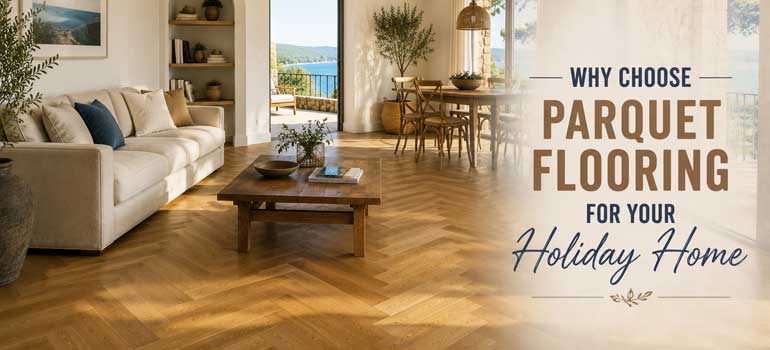
A holiday home brings its own set of flooring priorities, somewhere between the everyday practicality of a main residence and the durability a rental property needs to handle different guests. Parquet suits both sides of that well, but it's worth going beyond the usual "it's beautiful and durable" pitch to the one consideration that actually matters most for this specific kind of property.
Parquet flooring is beautiful
Parquet has centuries of history behind it as one of the more distinctive flooring choices available, and its range of patterns - herringbone, chevron, basketweave and more - gives a holiday home genuine character rather than a generic finish. The right pattern can make a room feel more open too, particularly when laid to draw the eye along a room's longest dimension. Parquet is also available across a wide range of colours, textures and finishes, so it's genuinely flexible enough to suit a coastal cottage, a period countryside property or a contemporary city apartment equally well.
Parquet flooring is durable
Few flooring types match real wood's durability, and a well-maintained parquet floor can last for decades, sometimes a century or more, with proper care. It handles high traffic and heavy footfall well, which matters if your holiday home sees a steady stream of visitors, whether that's your own family or paying guests. When wear does eventually show, sanding and refinishing brings the floor back close to its original condition rather than requiring a full replacement.
The consideration most guides miss: what happens when nobody's there
This is worth addressing directly, since it's specific to holiday homes in a way that doesn't come up with a main residence. Wood flooring reacts to humidity and temperature, and a property that sits unoccupied for weeks or months at a time, without anyone regulating heating between visits, can put a floor through bigger swings than a normally lived-in home would.
- Engineered wood is the more sensible choice for a holiday property specifically, since its layered construction resists the gapping, cupping and loose blocks that solid wood is more prone to when conditions swing more widely between visits
- Coastal properties add another factor worth considering, since salt air and higher ambient humidity are both easier for engineered wood to cope with than solid parquet
- If the property does sit empty for extended periods, even basic measures like leaving heating on a low, consistent setting rather than switched off entirely help keep humidity swings more manageable
- Our guide to why wood floors expand and contract with the seasons covers the mechanics behind this if you'd like the fuller picture before choosing
If you're letting the property out
A holiday home that gets rented to different guests puts a floor through more varied use than a typical family home: different people, different habits, different levels of care. A hard-wearing species like oak, paired with a durable, easy-to-maintain finish, holds up better to this kind of turnover than a softer species would. Our guide to the best floors for busy areas covers species and finish choices for exactly this kind of demand.
Parquet flooring is functional and easy to maintain
Wood floors have a warmer feel underfoot than stone or tile, and as a natural material, they don't trap dust, allergens and bacteria the way carpet does, since everything sits on the surface where a vacuum or damp mop can reach it. Routine cleaning is genuinely simple: regular vacuuming handles most day-to-day upkeep, and an occasional damp mop with a cleaner designed for wood floors deals with anything more stubborn.
If you're planning flooring for a holiday home and want advice on species, construction and finish suited to how the property will actually be used and occupied, our parquet floor fitting team can help. Get in touch for a free quote whenever you're ready.
Frequently asked questions
Should I always choose engineered wood for a holiday home, or is solid ever appropriate? Solid wood can still work well if the property is regularly occupied and has consistent heating, but engineered wood is the safer choice given the unpredictable occupancy most holiday homes actually see. It's worth discussing your specific usage pattern with a flooring professional before deciding.
Is prefinished parquet a better choice than unfinished for a holiday let? Generally yes, since prefinished flooring is ready to use immediately without the downtime an on-site finish requires, which matters more for a property you want back in service quickly between fitting and letting it out. Our guide to prefinished or unfinished wood flooring covers the trade-offs in full.
How often does a rental holiday home's floor need professional attention? It varies with occupancy levels, but a property that changes guests frequently generally needs its finish checked and maintained more often than a typical family home. Building this into a regular property maintenance schedule avoids surprises between bookings.
Does parquet add value to a holiday home, or is it just a nice-to-have? Real wood flooring is generally well received by both buyers and renters, and it's a feature that tends to photograph and show well in listings, which matters for a property marketed to guests. It's not a guaranteed fixed return, but it's rarely seen as a downside.
Can parquet cope with sandy feet and coastal grit if the property is near a beach? With a durable finish and reasonable doormat habits at the entrance, yes, though grit is exactly the kind of thing that causes scratching if it's not managed. A hard-wearing species and finish, plus a simple doormat routine, go a long way toward protecting the floor in this kind of setting.