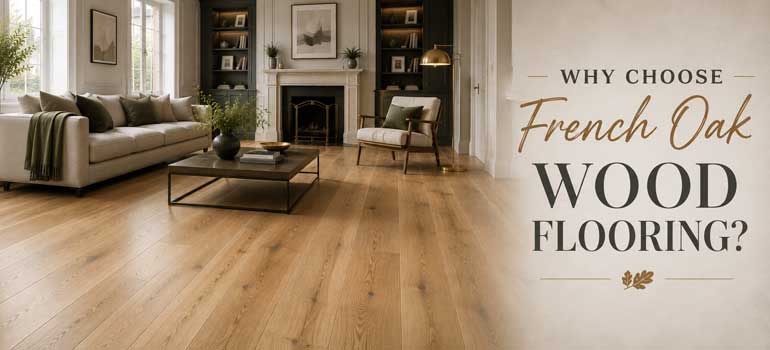
French oak has a reputation as one of the most sought-after flooring choices available, but it's worth knowing exactly what earns it that reputation rather than taking the faith claim. Here's what genuinely sets it apart from other oak, both other European sources and American oak specifically.
What French oak actually is
French oak flooring comes from Quercus robur and Quercus petraea, the same two species used across European oak more broadly, sourced specifically from managed forests in France, particularly regions like Burgundy and Normandy. It's technically a type of European oak, not a distinct species, but the specific growing conditions in French forests give it real, identifiable characteristics.
What genuinely distinguishes it
A few real differences separate French oak from American oak and, to a lesser extent, from other European sources:
- Slower growth produces tighter grain. French forests are managed for slow, steady growth, often with trees well over a century old, which packs denser growth rings into the timber than faster-grown American oak typically shows
- A warmer, more amber colour, distinct from American white oak's cooler, light tan tone and American red oak's pinkish undertones
- Higher tannin content, which affects how the wood ages and how it takes stains, oils and fumed finishes, often producing a more even, consistent result than oak with lower tannin levels
- A subtler, tighter "cathedral" grain pattern compared with American oak's bolder, more open and expressive grain and more pronounced ray fleck, particularly in quarter-sawn boards
- Live-sawn cutting is common with French oak, cutting straight through the log to show the full range of grain, from straight through to rift and quarter-sawn character, within individual boards
A material with real history
French oak's association with quality isn't purely a marketing story. It's the same timber traditionally used for Bordeaux and Burgundy wine barrels, and it has a documented history in French architecture stretching back centuries, associated with everything from medieval castles to the Palace of Versailles. That history is part of why it carries the prestige it does, alongside the genuine physical characteristics that set it apart.
Is it actually better than other oak, or just different?
This is worth answering honestly rather than repeating the marketing line. Oak trees themselves aren't inherently superior in France compared with anywhere else, but the combination of slow growth, forest management, and centuries of established selection and grading standards genuinely does produce a more consistent, tightly grained product. Countries with similarly rigorous, slow-growth forestry, Germany and parts of the UK among them, produce comparably high-quality oak for the same underlying reasons. It's less that French oak is magically better wood and more that the specific growing and selection conditions consistently produce a particular, desirable result.
Where French oak genuinely suits a room
Its tight grain and even colour make it a versatile choice across most interior styles, though it particularly suits:
- Traditional and classic interiors, where its warm, amber tone and subtle grain complement period features naturally
- Rooms wanting a refined, less busy look than American oak's bolder, more open grain would give
- Wide plank installations, since the tighter, more consistent grain holds up visually well even at greater widths, where a less consistent grain can look patchy across a larger board
If you're considering French oak for your own project, our parquet floor fitting team can talk through sourcing, grade and finish options. Our guide to ash, cherry, walnut, maple and oak flooring is worth a read too if you're still weighing oak up against other species. Get in touch for a free quote whenever you're ready.
Frequently asked questions
Is French oak harder or more durable than American oak? Hardness between the two is broadly comparable, since both come from closely related oak species. The real differences are in grain tightness, colour and how evenly the wood takes stain, rather than a significant gap in durability.
Is French oak always more expensive than American oak? Generally yes, reflecting its sourcing, the slower growth involved, and its established reputation, though pricing varies by grade, supplier and whether you choose solid or engineered construction. Engineered French oak is a genuine way to access the look at a more accessible cost.
Can French oak be stained a different colour, or does it need to stay natural? It takes stain very evenly thanks to its tight grain and tannin content, so it's a genuinely flexible choice if you want a specific colour rather than its natural amber tone. This even stain uptake is actually one of its more practical advantages over more open-grained oak.
Is "French oak" always genuinely sourced from France? Not always, and it's worth asking a supplier directly, since "French oak" sometimes gets used loosely as a style descriptor for European oak more broadly rather than a guarantee of French origin. A reputable supplier should be able to confirm the actual source.
Does French oak work well with underfloor heating? Engineered French oak does, provided it's fitted with the glue-down method, following the same general guidance that applies to underfloor heating with any engineered wood. Solid French oak isn't recommended over underfloor heating, the same as solid wood generally.