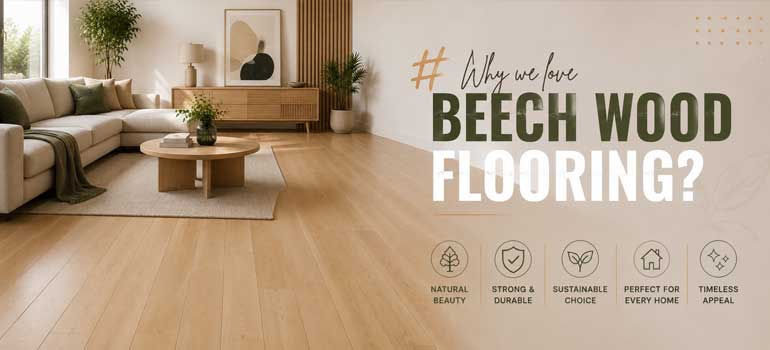
Beech doesn't get talked about as often as oak or walnut, but it's genuinely one of the more practical hardwoods available for flooring, combining real durability with a light, versatile colour that suits almost any room. Here's what makes it worth considering, and the one thing worth knowing before you commit to it in solid form.
How hard-wearing is beech?
Beech scores 1,300 on the Janka hardness scale, which measures resistance to dents and surface wear. That puts it just ahead of red oak and makes it a genuinely solid choice for busy rooms, not just a good-looking budget alternative to more popular species.
| Species | Approximate Janka rating |
|---|---|
| Beech | ~1,300 |
| Oak (red) | ~1,290 |
| Oak (white) | ~1,360 |
| Walnut | ~1,010 |
Because of this hardness, beech holds up well in high-traffic rooms and commercial spaces, and it's actually a common choice for sports flooring, where repeated impact and heavy footfall are a daily reality rather than an occasional concern.
Colour and style
Beech runs from pale cream through to light tan and soft mid-brown tones, which makes it easy to work into most interior styles and a good option for smaller rooms where a lighter floor helps the space feel more open. If you'd rather have a deeper tone, beech takes staining well, so you're not locked into its natural pale shade if your interior calls for something richer.
The one thing to know: beech moves more than oak
This is the part worth being upfront about, since it's easy to overlook when a wood scores this well on hardness. Beech expands and contracts with humidity more than oak or maple does, even though it's just as hard on the surface. Hardness and dimensional stability are two different properties, and beech is strong on one but only average on the other.
In practice, this means:
- Solid beech suits most standard rooms fine, but isn't the safest choice for spaces with big humidity or temperature swings.
- Engineered beech, built from a cross-layered core under a real beech veneer, is the better option for kitchens, basements and anywhere with underfloor heating, since its construction resists the movement that solid beech is more prone to.
- If you'd like to understand why humidity affects wood flooring generally, our guide on why wood floors expand and contract with the seasons covers the mechanics in more detail.
Solid or engineered beech: which should you choose?
| Solid beech | Engineered beech | |
|---|---|---|
| Hardness | Same, ~1,300 Janka | Same wear layer, same hardness |
| Stability with humidity | More prone to movement | Considerably more stable |
| Underfloor heating | Not recommended | Suitable, with glue-down fitting |
| Best suited to | Standard living rooms, bedrooms | Kitchens, basements, humidity-variable rooms |
Keeping a beech floor in good condition
Beech doesn't need special treatment, but a few habits keep it looking its best for longer:
- Sweep or vacuum regularly to clear grit before it gets ground into the surface underfoot
- Wipe up spills promptly, since standing water is what causes problems, not occasional light moisture
- Use felt pads under furniture to prevent dents from feet and legs over time
- Stick to a cleaner made for wood floors rather than general household products, which can dull the finish
If you're weighing up beech against other species for your project, our guide to ash, cherry, walnut, maple and oak flooring covers five more popular options alongside it. Our parquet floor fitting team can advise on whether solid or engineered beech suits your specific room, and we're happy to put together a free quote once you've settled on a direction.
Frequently asked questions
Is beech a good choice for a kitchen floor? Engineered beech is a better fit than solid beech for a kitchen, given the humidity and temperature swings kitchens typically see. Its hardness makes it well suited to the traffic a kitchen gets; it's specifically the movement with humidity that favours the engineered version there.
How does beech compare with oak in terms of hardness? They're very close. Beech, at roughly 1,300 on the Janka scale, is marginally harder than red oak and just slightly softer than white oak, so hardness alone isn't a strong reason to pick one over the other.
Can beech flooring be sanded and refinished? Yes, solid beech can be sanded and refinished multiple times over its life, the same as most other solid hardwoods. Engineered beech can also be refinished, though how many times depends on the thickness of its hardwood wear layer.
Why isn't beech as popular as oak for flooring? It largely comes down to familiarity and supply rather than any real shortfall in quality. Oak has simply been the dominant choice in the UK market for longer, but beech offers comparable hardness and a genuinely attractive light colour at what's often a more accessible price point.
Does beech flooring darken or change colour over time? Some natural colour shift from light exposure is normal with most wood species, beech included, though it's generally a subtle change rather than a dramatic one. A UV-protective finish slows this process if you want to keep the floor's original pale tone as close to its day-one look as possible.