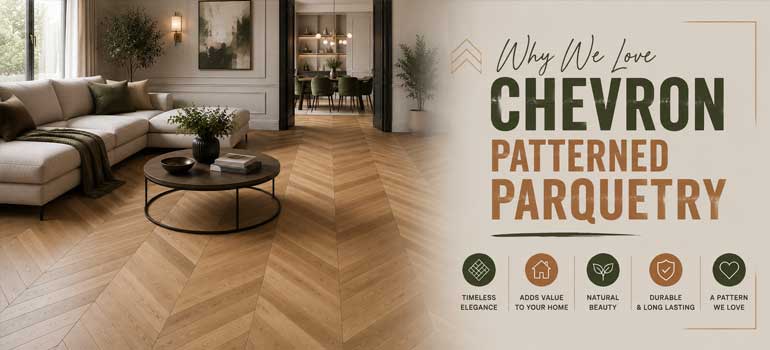
Chevron has had a real resurgence over the past few years, showing up everywhere from fashion to soft furnishings, but it's in flooring where the pattern has always felt most at home. Its clean, continuous "V" shapes give a room a strong sense of movement and direction that few other patterns match, and it's worth understanding exactly what sets it apart before deciding whether it's the right choice for your space.
What actually is chevron, and how is it different from herringbone?
This is the question most people asking about chevron actually want answered, since the two patterns get confused constantly. Both use rectangular wood pieces arranged in a repeating zigzag, but the difference comes down to how each piece is cut. Herringbone blocks have square-cut ends, which creates a staggered, broken zigzag where each row steps slightly out of line with the next. Chevron pieces have mitred, angled ends, so they meet edge to edge and form one continuous, unbroken line down the room. If you're weighing the two up directly, our guide to engineered wood fishbone parquet flooring covers herringbone's construction in more depth, and our broader wood flooring patterns piece runs through how chevron compares with basketweave, brick bond and Versailles as well.
The pattern has genuine history behind it too, having been a fixture of grand French interiors for centuries, which is part of why it still reads as elegant and considered rather than simply trendy.
Why does chevron cost more than herringbone?
The mitred cuts are the reason. Each piece needs to be angled precisely so the joints line up cleanly, which produces more offcut waste during manufacturing and demands more precision during fitting than herringbone's simpler square-cut blocks. The result is a floor that typically costs somewhat more than an equivalent herringbone installation in the same wood species, even though the raw materials involved are similar.
Solid or engineered chevron?
Both are genuine options, and the choice comes down to the usual trade-offs between the two constructions. Solid wood is cut from a single piece of timber and gives you the classic, traditional feel many people specifically want from chevron. Engineered wood is built from cross-layered plies under a real hardwood veneer, which makes it noticeably more stable through humidity and temperature changes and looks identical once fitted. Given how much precision chevron's mitred joints already demand, the added dimensional stability of engineered wood is worth serious consideration, particularly in rooms that see bigger swings in temperature or moisture.
Does chevron really make a room look bigger?
It can, but not automatically just because it's chevron. Direction matters more than the pattern itself. Laid pointing down the length of a room, chevron draws the eye forward and emphasises depth. Laid at an angle across the room, it can visually widen a narrower space instead. Our guide to how wood floor colour changes the mood of a room covers how tone plays into this too, since a pale chevron floor in a light wood does more to open up a small room than a dark one will, regardless of which way the pattern runs.
If you're considering chevron for your own project, our parquet floor fitting team can talk through pattern direction, wood species and solid versus engineered construction for your specific room, and we're happy to put together a free quote once you've settled on a direction.
Frequently asked questions
Is chevron harder to install than herringbone? Generally yes, since the mitred angles on every piece need to line up precisely for the continuous zigzag to read cleanly. It's not a job most people should attempt as a first DIY project, regardless of which pattern they choose.
Can chevron be laid with any wood species? Yes, chevron works with most hardwood species available for flooring, though harder woods like oak hold their crisp mitred edges better over time than softer species, which can round off slightly at the joints under heavy traffic.
Does chevron suit a modern or a traditional home better? Both, genuinely. Its long history gives it a natural fit in traditional interiors, while its clean, continuous lines read as sharp and contemporary in a modern space, which is part of why it's stayed popular across such different styles.
Is chevron more expensive than basketweave or brick bond too? Usually yes, compared with brick bond, which is one of the simplest and least wasteful patterns to produce. Basketweave sits closer to chevron in cost, since it also involves a more complex, labour-intensive layout than a straight or brick-bond floor.
Will chevron flooring go out of style? It's one of the more enduring patterns in wood flooring, having stayed popular in various forms for centuries rather than being tied to a single decade's trend. Even if personal taste shifts, a well-fitted chevron floor can be resanded and refinished in a different tone rather than replaced.