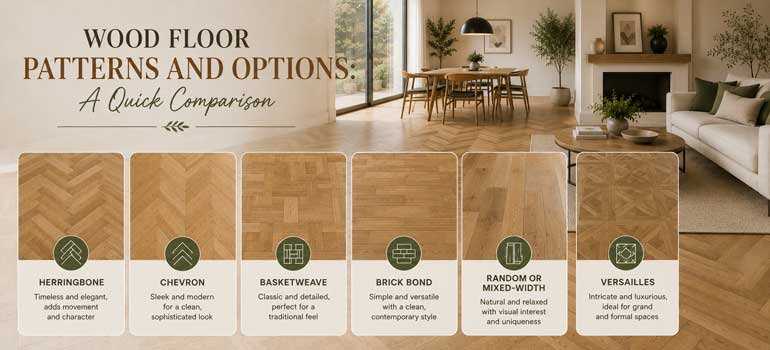
Patterned wood flooring, known as parquetry, brings a level of visual interest a straight-laid floor simply can't match. With several genuinely different patterns on the market, though, it helps to see them side by side rather than one at a time. Here's a quick comparison of the main options, plus a common mix-up worth clearing up first.
Chevron is not "a type of" herringbone
This is worth correcting directly, since the two get lumped together more than they should. Herringbone and chevron are related but genuinely distinct patterns, not one a variant of the other.
- Herringbone uses square-cut block ends, creating a staggered zigzag where each row steps slightly out of line with the next
- Chevron uses mitred, angled ends instead, so the pieces meet edge to edge and form one continuous, unbroken "V" line
- The cut is what defines each pattern, and it's also why chevron typically costs more to fit, given the extra precision and material waste the angled cuts involve
Our guides to the herringbone wood floor pattern and chevron patterned parquetry cover each one individually in full.
The main patterns compared
| Pattern | Look | Relative cost | Best suited to |
|---|---|---|---|
| Herringbone | Staggered zigzag | Moderate | Most rooms, especially hallways laid lengthwise |
| Chevron | Continuous unbroken "V" | Higher | Rooms wanting a sharp, graphic statement |
| Basketweave | Woven, interlocking blocks | Higher | Smaller spaces, calmer geometric texture |
| Brick bond | Staggered straight rows | Lower | Compact rooms, rustic or industrial styles |
| Random or mixed-width | Varied plank lengths, no repeat | Varies | Relaxed, organic interiors wanting less uniformity |
| Versailles | Large bordered panels | Highest | Formal, larger rooms with scale to spare |
Random and mixed-width patterns
This is one option worth its own mention, since it's easy to overlook next to the more geometric patterns above.
- No fixed repeat, since boards of varying lengths are laid in a deliberately irregular sequence rather than a repeating unit
- A more relaxed, organic feel than the precise geometry of herringbone or chevron, suiting interiors that lean rustic or eclectic
- Genuine room for creativity, since there's no strict formula to follow the way there is with a structured pattern
It's a good option for anyone who likes the idea of a customised, one-of-a-kind floor without committing to a specific repeating geometric design.
Does room size actually limit your pattern choice?
Not in the straightforward way it's often described. Pattern direction and block scale affect how a room reads far more than the room's actual size does.
- Herringbone and chevron laid lengthwise emphasise depth, which suits narrow spaces like hallways well rather than working against them
- A smaller block or plank scale tends to suit compact rooms better than a large, bold one, regardless of which pattern you choose
- Brick bond and basketweave are naturally calmer, less directional patterns, which is part of why they're often suggested for smaller spaces specifically
Our guide to wood flooring patterns goes further into matching pattern and scale to room size if you'd like the fuller picture.
If you'd like advice on which pattern suits your specific room, budget and style, our parquet floor fitting team can talk it through with you. Get in touch for a free quote whenever you're ready.
Frequently asked questions
Which pattern is easiest to fit yourself? None of the patterns covered here are genuinely beginner-friendly DIY projects, since all of them demand more precision than a straight-laid floor. Brick bond is the simplest of the group, but it's still worth having a professional handle it if you want a clean, even result.
Can I mix two different patterns in the same home? Yes, this works best when there's a clear boundary between them, such as a doorway or a change in room use, rather than two patterns meeting in the middle of one open space. Keeping the wood species or tone consistent between them helps the transition feel intentional.
Is random-width flooring more expensive than a fixed pattern? It varies depending on the specific product and species, so it's not automatically more or less expensive than herringbone or chevron. It's worth getting a direct quote for the specific look you want rather than assuming based on pattern type alone.
Do all these patterns work with both solid and engineered wood? Yes, every pattern covered here is available in both constructions. Engineered wood is generally the more practical choice for complex patterns like herringbone and chevron, given its added stability against humidity and temperature changes.
Is Versailles pattern worth the extra cost for a smaller renovation? It depends on the room. Versailles is genuinely striking but needs scale to work well, so it's usually better reserved for a larger, more formal room rather than a compact space where its detail can feel overwhelming rather than impressive.