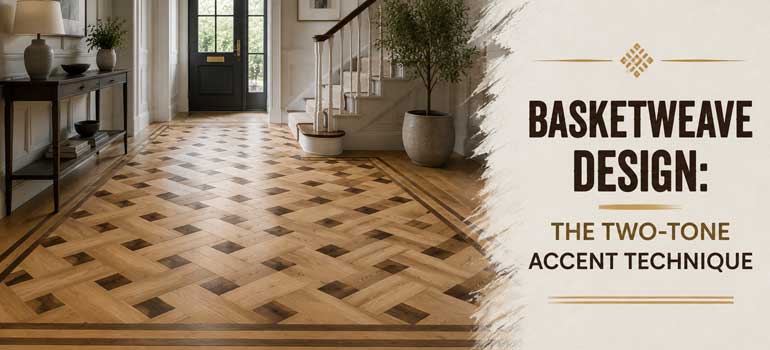
Basketweave sits alongside herringbone and chevron as one of the established parquet patterns, though it takes a genuinely different visual approach: an interlocking, woven look rather than a directional zigzag. Our dedicated guide to the basketweave parquet pattern covers the construction and room-size guidance in full. This piece focuses on a specific styling technique worth knowing if you're considering it: pairing a lighter main field with a darker accent square.
The two-tone accent technique
The classic basketweave look pairs a lighter wood species across most of the floor with a darker accent square woven into the pattern, giving the weave genuine visual depth rather than a single flat colour throughout. This isn't just an aesthetic choice, it's also a practical one:
- A striking, more expensive species can be used sparingly, limited to the accent squares rather than covering the whole floor, which keeps the overall material cost down while still delivering a genuinely luxurious detail
- The contrast makes the weave itself more visible, since the eye reads the pattern more clearly against two distinct tones than it would against one uniform colour
- It's a technique that scales, working just as well in a small hallway accent as it does across an entire formal room
Choosing your species
Maple and oak are the traditional choices for the main field, both bringing warmth without competing with the darker accent, and both offering genuine hardness for the areas of the floor that take the most consistent foot traffic. Black walnut is a common accent choice, prized for its deep, rich brown tone against a paler field.
Mahogany is also suggested for accents fairly often, and it's worth knowing the trade-off before choosing it specifically. Genuine mahogany is actually one of the softer woods commonly used in flooring, considerably softer than oak or maple, so an accent square in mahogany will show wear a little more readily than the harder field around it, even though it only covers a small area. It's not a reason to avoid it, since the accent squares generally see less concentrated wear than the main field, but it's worth going in with that expectation rather than assuming it matches the field's durability. If durability across every part of the pattern matters more than the specific colour, a darker-stained oak or walnut gives a similar visual contrast without mahogany's comparative softness.
Using basketweave in smaller spaces
Basketweave's calmer, less directional geometry genuinely suits compact areas well, which makes it a practical option even without committing to a full room.
- A hallway or entryway is a common place to use basketweave as a self-contained accent, delivering real visual interest without the cost of covering a much larger area
- The pattern doesn't need a large room to read clearly, unlike some more elaborate options like Versailles, which genuinely benefit from more scale
- Using it in a smaller, contained area is also a practical way to try the two-tone accent technique on a smaller budget before deciding whether you want it across a larger space
If you'd like to see how basketweave compares with other patterns before deciding, our wood flooring patterns cover herringbone, chevron, brick bond and Versailles alongside it. Our parquet floor fitting team can advise on species pairing and where the technique works best in your specific space. Get in touch for a free quote whenever you're ready.
Frequently asked questions
Does the accent square need to be a completely different species, or can it just be a darker stain? Either works, and it comes down to budget and how much natural contrast you want. A stained accent in the same species as the main field is more affordable and easier to match for future refinishing, while a genuinely different species gives more pronounced colour and grain contrast.
Is basketweave with a two-tone accent harder to install than a single-colour version? Yes, since fitting two different species or tones together demands more precise cutting and layout than a uniform floor. It's worth having an experienced fitter handle this specifically, given how visible any misalignment becomes against the colour contrast.
Can the accent squares be replaced individually if they get damaged? Often yes, since they're distinct pieces within the pattern rather than part of a continuous run. It's worth keeping a note of the exact species and finish used so a replacement can be matched accurately if needed later.
Is basketweave with mahogany accents a bad idea for a family home? Not necessarily, since the accent squares typically see less concentrated wear than the main walking areas of a floor. It's worth choosing a harder species for the field itself regardless, and treating the mahogany accent as a decorative detail rather than the floor's main durability layer.
How much of the floor should be accent squares versus the main field? There's no fixed rule, but a common approach uses accents sparingly, as a repeating detail within the weave rather than an even split with the main field. This keeps the cost of a pricier accent species manageable while still delivering real visual impact.