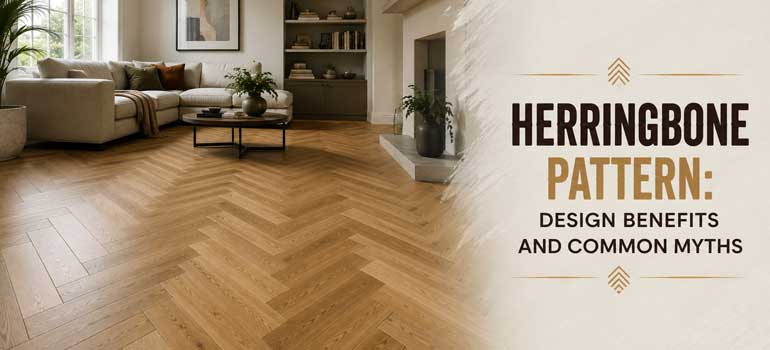
Herringbone has stayed one of the most requested wood flooring patterns for good reason: its zigzag brings genuine movement and craft to a floor that a straight-laid plank simply can't offer. It's also a pattern that picks up a fair amount of misinformation online, so it's worth separating what's actually true from what's just commonly repeated.
Where herringbone actually comes from
The Roman connection is real, but it's often stated in a slightly misleading way. Herringbone brickwork does trace back to Roman road and masonry construction, arranged in the same alternating zigzag still recognisable today. But that's a different thing from herringbone as a wood flooring pattern specifically, which has a much more recent origin: 16th-century France, with one of the earliest documented examples laid at the Château de Fontainebleau in 1539. The Romans gave the world the geometric pattern; French interiors gave the world herringbone parquet as we know it today.
Herringbone also gets confused constantly with chevron, its close relative. The distinction comes down to the cut: herringbone uses square-cut ends, creating the classic staggered zigzag, while chevron pieces are mitred, classically at 45 degrees, so they form one continuous, unbroken line instead.
Does herringbone actually make a floor more durable?
This is worth addressing directly, since it's a claim that circulates fairly often. The pattern itself doesn't make a wood floor more resistant to humidity, moisture or general wear. Durability and moisture resistance come down to the wood species and whether it's solid or engineered construction, not the geometric arrangement of the boards. A herringbone floor in a soft, humidity-sensitive species will behave the same way a straight-laid floor in that species would, pattern aside.
What the pattern does affect is how forgiving the installation is of small errors, and how demanding refinishing becomes later, since herringbone's blocks run in multiple grain directions across the same surface. Our guide to durable wood floors with patterns covers this distinction properly, including which factors genuinely do affect a floor's long-term performance.
Styling herringbone across different design directions
One of herringbone's real strengths is how adaptable it is, provided you choose colour and scale deliberately rather than assuming the pattern does all the work on its own.
- Modern and minimalist interiors suit herringbone in a pale, uniform tone, with a smaller block scale that reads as texture rather than a dominant feature
- Traditional interiors lean naturally into herringbone's long history, particularly with a warmer oak or walnut tone and a larger, more classic block size
- Shabby chic and cottage styles work well with a lighter, slightly distressed or wire-brushed finish, softening the pattern's geometric precision into something more relaxed
Subtle or commanding: letting the room decide
Herringbone's impact genuinely changes depending on how it's finished and where it's placed, which is part of why it works in such different settings.
- A pale, matte finish in a smaller block tends to recede into the background, adding texture without demanding attention, well suited to a room where the floor shouldn't compete with other design elements
- A darker tone, larger block size, or high-gloss finish pushes the pattern toward the commanding end, making it the room's genuine focal point
- Placement matters too. The same pattern reads as a quiet backdrop in a bedroom and as a genuine statement in an entrance hall, simply because of what each room is asking the floor to do
If you're deciding on herringbone for your own project, our guide to the herringbone wood floor pattern covers construction, block sizing and room suitability in full. Our parquet floor fitting team can advise on species, finish and scale for your specific space. Get in touch for a free quote whenever you're ready.
Frequently asked questions
Is herringbone tile as durable as herringbone wood flooring? The pattern itself doesn't determine durability in either material, so a herringbone tile floor's durability comes down to the tile type and installation quality, while a wood herringbone floor's durability comes down to species and construction. Neither gets extra durability from the pattern alone.
Does a bigger herringbone block size look more commanding than a smaller one? Generally yes, since a larger block creates a bolder, more visible zigzag that draws more attention than a finer, tighter pattern. Scale is one of the more effective ways to dial the pattern's visual impact up or down.
Can herringbone work in a genuinely minimalist home, or does it clash with that style? It works well, provided the colour palette stays restrained and the block size leans smaller rather than dramatic. The geometry itself reads as clean and considered, which suits minimalist interiors more naturally than people often expect.
Is it true that herringbone was invented specifically for flooring? Not quite. The geometric zigzag pattern predates its use in wood flooring by many centuries, originating in Roman construction, while its specific use as a flooring pattern dates to 16th-century France. Both facts are true, they just describe different points in the pattern's history.
Does the finish (matte versus glossy) change how commanding herringbone looks? Yes, considerably. A glossy finish amplifies the pattern's visual presence by reflecting more light off each angled surface, while a matte finish softens it, which is worth factoring in alongside colour and block size when deciding how bold you want the final look to be.