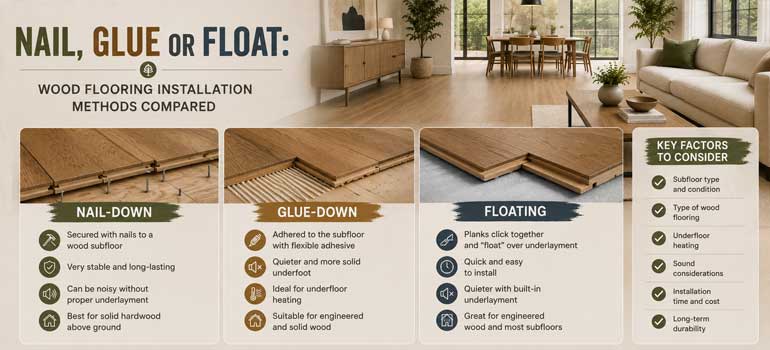
Nailing and gluing get talked about most when it comes to wood flooring installation, but they're not actually the only two options. There's no single "best" method overall, since the right choice depends on your subfloor, the type of flooring you've chosen and the room it's going in. Here's how the main methods compare, including one worth adding to the conversation that often gets left out.
Nail-down installation
Nailing works for both solid and engineered wood, but only over a wooden or plywood subfloor.
- Boards are typically blind-nailed through the tongue, so the fixings are hidden once the floor is finished
- Board direction doesn't matter when nailing over a wood or plywood subfloor
- Fitting over an existing wood floor requires laying the new boards at a 90-degree angle to the old ones, for stability
- Not suitable for concrete subfloors, since there's nothing solid enough for the nails to bite into
- An expansion gap around the room's perimeter is still essential, to allow the wood room to move with the seasons
Glue-down installation
Gluing suits both solid and engineered wood, and works over concrete as well as wooden subfloors, which is part of why it's such a versatile default choice.
- The subfloor must be clean, dry and level, especially over concrete, which tends to hold onto moisture more than people expect
- A damp-proof membrane underlay is worth adding if there's any doubt about future dampness, to protect the floor from moisture reaching it from below
- Adhesive should be applied in small sections, working through the room efficiently rather than spreading it across the whole floor at once
- A crisscross application pattern, starting from the corner furthest from the door, is the standard technique for even coverage
- Parquet and patterned floors like herringbone are almost always glued, given the precision the pattern demands
Floating installation
This is the method the "nail or glue" framing usually leaves out, and it's become genuinely common, particularly for engineered wood.
- Boards aren't fixed to the subfloor at all. Instead, they lock together via a tongue-and-groove or click system and simply sit above a thin underlayment
- It works over almost any subfloor, including concrete, tile and existing flooring, without the prep that gluing or nailing demands
- It's the quickest method to install, and often more DIY-friendly than the alternatives, though a professional fit still gives the most reliable result
- It's a strong option over underfloor heating, since it doesn't fix the boards rigidly to a heat source the way nailing or gluing can
- It can feel less solid underfoot than a glued or nailed floor, and isn't generally recommended for very large open rooms or the heaviest traffic areas
Which method actually suits your project?
| Method | Works on | Best suited to |
|---|---|---|
| Nail-down | Wood or plywood subfloors only | Solid wood, traditional installations, rooms above ground level |
| Glue-down | Concrete, wood, most solid subfloors | Parquet and patterned floors, high-traffic and commercial spaces |
| Floating | Almost any subfloor, including concrete and existing flooring | Engineered wood, underfloor heating, quicker or lower-budget projects |
If you're not sure which method suits your subfloor and chosen flooring, our parquet floor fitting team can assess your space and advise before any work begins. We also handle commercial parquet floor fitting where the right installation method matters even more, given the traffic these spaces see. Get in touch for a free quote whenever you're ready.
Frequently asked questions
Can I switch installation methods if I change my mind partway through a project? Not easily once boards have been ordered, since the fitting method affects the product itself, particularly whether it has a click-lock system for floating or is designed to be nailed or glued. It's worth deciding on the method before finalising which flooring product to buy.
Is floating installation as durable as glue-down? For most household use, yes, provided it's a quality product properly installed. Glue-down tends to feel more solid underfoot and is generally preferred for the heaviest traffic or largest open areas, where a floating floor is more likely to feel less stable over time.
Does the installation method affect whether a floor can be refinished later? Not directly, since refinishing depends on the wood's wear layer thickness rather than how it was originally fitted. It's worth checking this with whichever product you choose regardless of installation method.
Why can't solid wood be nailed over a concrete subfloor? Nails need something to bite into, and concrete doesn't offer that in the way a wood or plywood subfloor does. Gluing or floating are the two realistic options over concrete instead.
Is one method noticeably noisier underfoot than the others? Floating floors can sometimes produce a slightly hollow sound compared with a glued or nailed floor, particularly with a thinner underlayment. A good-quality underlayment reduces this considerably, so it's worth not skimping on that layer if a floating installation is your chosen method.