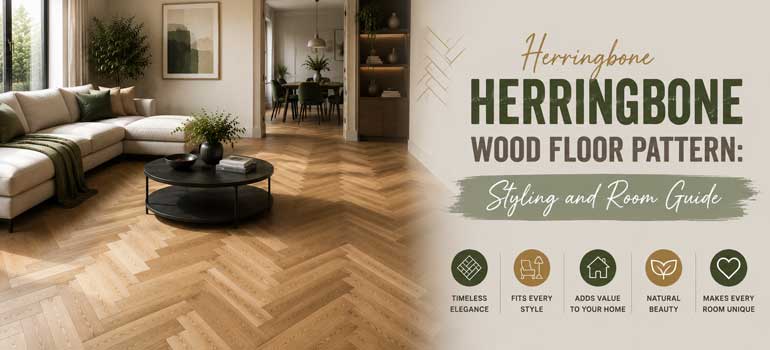
Herringbone has been a fixture of European interiors for centuries, and it's easy to see why it's stayed popular for so long. The zigzag arrangement, named for its resemblance to a fish skeleton, brings a sense of movement and craftsmanship to a floor that a straight plank layout simply can't match. If you're after the full detail on how the pattern is constructed and the solid-versus-engineered decision, our guide to engineered wood fishbone parquet flooring covers that in depth, since fishbone and herringbone are simply two names for the same pattern. This piece focuses on the history, how it compares with chevron, and which rooms genuinely suit it.
Getting the history right
Herringbone's story as a flooring pattern actually goes back to 16th-century France, with one of the earliest documented examples laid at the Château de Fontainebleau in 1539, predating its association with the following century's grand French interiors. The pattern itself is older still. Herringbone brickwork appears in Roman road construction long before it ever reached a wood floor. It's a small correction, but worth getting right: the pattern was already well established as a flooring choice before the 17th century, not newly arrived during it.
Herringbone or chevron: what's the actual difference?
The two get confused constantly, and the difference comes down to how each piece is cut. Herringbone uses square-cut ends, which creates a staggered, broken zigzag where each row steps slightly out of line with the next. Chevron uses mitred, angled ends instead, so the pieces meet edge to edge and form one continuous, unbroken line. Our piece on why we love chevron patterned parquetry goes further into that comparison if you're deciding between the two.
Does herringbone only suit large, spacious rooms?
Not really, and it's worth pushing back on the idea that herringbone needs a big room to work. Direction matters more than the size of the space it's going into. Laid pointing down the length of a room, herringbone draws the eye forward and emphasises depth, which is exactly what a narrow hallway or a compact room often benefits from rather than something to avoid. We cover this in more detail in our guide to parquet flooring for hallways, where herringbone laid lengthwise is actually one of the better pattern choices for a long, narrow space specifically.
Where room size genuinely matters more is scale: a very large herringbone block size can feel busy in a small room, while a smaller, tighter block size reads as calmer and works well in more compact spaces. It's the size of the individual pieces, not the size of the room, that's the real variable to think about.
Solid or engineered herringbone, briefly
Engineered wood has become the more common choice for herringbone specifically, since the pattern's precision is already demanding enough without also managing solid wood's greater sensitivity to humidity and temperature changes. Engineered boards arrive pre-finished and dimensionally consistent, which makes fitting more manageable, and the construction holds its shape better over time than solid parquet blocks. The fishbone guide linked above covers this trade-off, along with underfloor heating suitability, in full.
Choosing a wood tone for herringbone
Colour affects how the pattern reads just as much as the zigzag itself does. A pale oak or ash herringbone floor feels light and contemporary, letting the geometry read as subtle texture rather than a bold statement, while a dark walnut or smoked oak version turns the same pattern into a genuinely dramatic focal point. Our guide to how wood floor colour changes the mood of a room goes further into matching tone to the atmosphere you're after.
If you're planning a herringbone floor and want advice specific to your room's size and light, our parquet floor fitting team can talk through block size, wood species and construction before you order material. Get in touch for a free quote whenever you're ready.
Frequently asked questions
Is herringbone a good choice for a small bedroom? Yes, particularly with a smaller block size and a paler wood tone, both of which help the pattern feel calm rather than busy in a compact space. A large-scale, dark herringbone floor is the combination more likely to overwhelm a small room, not the pattern itself.
Does herringbone cost more to fit than a straight-laid floor? Generally yes, since the pattern demands more precision and produces more offcut waste than simply laying boards in one direction. Engineered herringbone in ready-made panels narrows that cost gap considerably compared with a fully bespoke, hand-laid solid wood installation.
Can herringbone be mixed with a straight-laid floor in the same home? Yes, this is a common way to use herringbone as a feature in one room, an entrance hall or a living room, for example, while keeping simpler straight-laid flooring elsewhere. A clear boundary like a doorway or threshold strip usually works best where the two meet.
How do I know what block size is right for my room? As a general guide, smaller rooms tend to suit a more modest block size, while larger, more open rooms can carry a bigger, bolder block without feeling busy. It's worth seeing samples in the room itself before deciding, since photographs don't always convey scale accurately.
Is herringbone practical for a family home with children and pets? Yes, as long as the wood species and finish are chosen with durability in mind, the pattern itself doesn't affect how well the floor stands up to daily use. Engineered construction and a harder wood species matter more for durability than which pattern the boards are laid in.