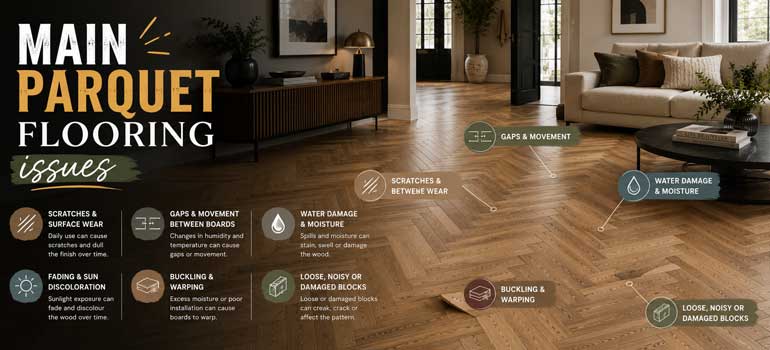
Parquet is one of the more durable wood flooring styles going, which is why it's still doing its job in plenty of London buildings that are well over a century old. That durability doesn't mean it's immune to problems, though, and knowing what's actually causing an issue makes a real difference to how it should be fixed. Sanding over a floor that's still damp, for example, can turn a minor problem into a worse one. This guide runs through the most common parquet flooring issues, what usually causes each one, and when it's safe to sort it yourself versus when it needs a professional.
Loose or lifting blocks
Loose blocks are one of the most frequent issues on older parquet floors, and they're generally caused by the wood adhesive under the blocks losing its grip over time, often sped up by humidity swings, heavy traffic, or the blocks contracting and expanding repeatedly with the seasons.
Fixing an individual loose block is usually straightforward:
- Lift the affected block carefully and, if more than one needs attention, photograph or mark each position so nothing gets mixed up
- Clean out old adhesive, dirt and debris from underneath before doing anything else
- Apply a suitable primer, let it dry fully, then apply a quality wood adhesive
- Refit the block and don't worry if a small gap remains around it at first, since this is normal after a repair like this
If loose blocks are widespread across the floor rather than a handful of isolated spots, that's usually a sign of a bigger moisture or subfloor issue rather than an ageing adhesive problem, and it's worth having a technician look at the cause before repairing individual blocks one by one.
Gaps between blocks
Some gaps are structural and left deliberately during installation to allow the wood room to move with the seasons. Others appear over time as blocks shift due to humidity changes, and these are usually the ones people notice and want addressed. Small seasonal gaps can typically be filled with a wood filler mixed with dust from sanding the same floor, which blends the repair into the existing colour far better than a generic filler would. Larger or widening gaps are worth having assessed, since they can point to the same underlying moisture problem that causes loose blocks.
Scratches and worn finish
Not all scratches are equal. Light surface scratches usually only affect the top finish layer and can often be buffed or spot-treated without a full refinish. Deeper scratches that cut through the finish and into the bare wood underneath are a different matter, since they leave the timber exposed and vulnerable to moisture and staining until it's addressed. Sanding removes both types, but it's not something to attempt without experience: sand unevenly and you can create dips, or take off more of the wear layer than necessary on engineered boards. It's worth hiring an experienced technician for any sanding and refinishing work, since getting it wrong can shorten the life of the floor rather than extend it.
Cupping, crowning and buckling
These three issues look similar but point to different causes, and mixing up the fix can make things worse.
| Issue | What it looks like | Usual cause |
|---|---|---|
| Cupping | Board edges sit higher than the centre | Moisture reaching the underside of the boards faster than the top |
| Crowning | Centre of the board sits higher than the edges | Often caused by sanding a cupped floor before it had fully dried out |
| Buckling | Boards visibly lift or pull away from the subfloor | Serious water exposure, such as flooding or a long-term leak, or occasionally a poor original installation |
Cupping and crowning can often be left to dry out and settle before any sanding is attempted, since sanding boards that are still damp is exactly what causes crowning further down the line. Buckling is more serious and shouldn't be treated as a cosmetic fix, since it usually points to a moisture source that needs to be traced and resolved before the floor itself can be repaired.
Fading and discolouration
Parquet exposed to direct sunlight for long periods, particularly near large windows or glazed doors, will gradually change colour, with some wood species darkening and others lightening depending on the timber. This isn't a fault as such, but it can leave uneven patches where rugs or furniture have shielded part of the floor from light. Rotating rugs and furniture occasionally helps even out the effect, and a UV-resistant lacquer finish slows the process considerably compared with an untreated or oiled surface.
When to call a professional
Simple block repairs and small gap fills are reasonable to attempt yourself if you're comfortable with basic DIY. Sanding, refinishing, diagnosing widespread moisture issues and anything involving cupping, crowning or buckling are better left to an experienced technician, since the wrong approach at that stage can turn a repairable floor into one that needs replacing. Our parquet floor fitting team handles repairs as well as new installations across London, and we also work on commercial parquet flooring in offices, restaurants and retail spaces where a damaged floor can't be left for long. Get in touch for a free quote if you'd like an assessment of what your floor actually needs.
Frequently asked questions
Can a cupped parquet floor go back to normal on its own? Often yes, if the moisture source is identified and removed, since the boards can flatten out again as they dry. Sanding before that happens is the mistake to avoid, as it usually causes crowning once the wood fully dries.
How do I know if my parquet floor has a moisture problem? Widespread loose blocks, gaps that keep reappearing after filling, or a musty smell from the floor area are all signs worth investigating. A moisture meter reading on the subfloor is the most reliable way to confirm it.
Is it normal for parquet to change colour over time? Yes, most wood species shift in tone with UV exposure over the years. It's only a problem when the change is uneven, which usually comes down to furniture or rugs blocking light from part of the floor.
Do gaps between parquet blocks mean the floor was installed badly? Not necessarily. A degree of seasonal gapping is normal in wood flooring, since the wood needs room to expand and contract. It only points to an installation issue if the gaps are unusually large or appear very soon after fitting.
Can engineered wood parquet still cup or buckle? It can, though it's less prone to this than solid wood because of its layered construction. Moisture exposure severe enough to cause solid wood problems can still affect engineered boards, just usually to a lesser degree.