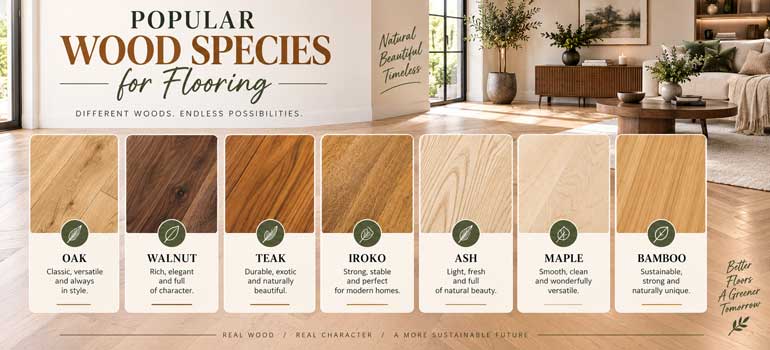
Choosing a wood species is one of the biggest decisions in any flooring project, and it's worth comparing the popular options side by side rather than reading about each one in isolation. Here's a quick comparison of seven commonly used species, including a couple of claims worth correcting before you go on general assumptions about them.
Two things worth correcting first
A couple of claims about these species get repeated online more than they should:
- Maple is a hardwood, not "both a hardwood and softwood." The confusion likely comes from mixing up wood classification with the tree itself. Maple trees, like oak and walnut, are classified as hardwoods, and maple flooring is genuinely one of the harder domestic species available.
- Bamboo is not simply "resistant to moisture." It's a grass rather than a tree, and it's actually sensitive to humidity swings, prone to swelling, warping or gapping in the same way solid wood is, sometimes more so. It needs the same careful humidity management as any other natural flooring material, not less.
Quick species comparison
| Species | Approximate Janka rating | Colour | Moisture behaviour |
|---|---|---|---|
| Maple | ~1,450 | Near-white to light honey | Moderate, benefits from stable humidity |
| Ash | ~1,320 | Pale, near-white to light grey | Good stability, one of the harder domestic species |
| Oak | ~1,290–1,360 | Honey to caramel tones | Reasonably stable, especially white oak |
| Teak | ~1,000–1,150 | Golden brown with darker lines | Naturally moisture- and insect-resistant, thanks to natural oils |
| Walnut | ~1,010 | Deep, dark brown | Moderate stability, softer than oak |
| Iroko | ~1,260 | Yellowish, deepening to honey brown | Naturally durable and weather-resistant |
| Bamboo (strand-woven) | Varies, often exceeds oak | Pale to medium, manufacturer-dependent | Sensitive to humidity swings despite its hardness |
What each species is genuinely known for
- Oak remains the most widely used species for UK flooring, combining good hardness with wide availability and a natural tone that suits almost any interior.
- Walnut brings a deep, dramatic colour that few other species match, though it's noticeably softer than oak and shows wear a little more readily.
- Teak carries a real cost premium, but its natural oils give it genuine weather and moisture resistance, which is exactly why it's such a longstanding choice for decking as well as flooring.
- Iroko, sometimes called African teak despite not being a true teak, offers similar natural durability at a different price point, ageing from yellowish to a deeper honey brown over time.
- Ash is one of the harder domestic species available, with a pale tone that works well in smaller or darker rooms wanting a lighter feel.
- Maple, despite being a genuine hardwood, can be trickier to work with during manufacturing precisely because of how hard it is, which sometimes pushes its price below other popular species.
- Bamboo remains a genuinely fast-growing, sustainable option, and strand-woven bamboo specifically can be very hard, but its moisture sensitivity means it needs the same care as solid hardwood in humid rooms.
Where to go for the full picture
Several of these species already have dedicated guides on our site covering construction, hardness comparisons and room suitability in more depth. Our guide to ash, cherry, walnut, maple and oak flooring covers five of the species above alongside cherry, and our broader wood species glossary goes further into teak, iroko and bamboo specifically, along with a few more exotic options.
If you'd like advice on which species suits your specific room and budget, our parquet floor fitting team can talk it through with you. Get in touch for a free quote whenever you're ready.
Frequently asked questions
Is bamboo a good choice for a kitchen or bathroom? Given its sensitivity to humidity swings, it's worth the same caution as solid hardwood in these rooms rather than assuming it's automatically fine. Engineered bamboo or strand-woven products tend to perform better than standard horizontal or vertical bamboo in these conditions, but none of them are truly moisture-proof.
Why is teak so much more expensive than oak? Its natural oil content, which gives it genuine weather and insect resistance without additional treatment, along with more limited global supply, both push its price well above oak. It's the same natural property that makes it such a popular decking material.
Is maple a good choice for a busy family home? Yes, its hardness makes it a genuinely practical choice for heavy foot traffic, comparable to or slightly harder than oak on the Janka scale. The main trade-off is that it can be pricier to source well-manufactured maple flooring, given how demanding the wood is to work with.
Does iroko need any special maintenance compared with oak? Not particularly, though its natural oils mean it can sometimes resist stain and finish absorption slightly differently than oak, so it's worth using products specifically suited to it. Day-to-day cleaning and care are otherwise the same as any hardwood floor.
Which of these species is the most budget-friendly? Oak and maple are generally the more accessible choices among this group, while teak and iroko typically sit at a higher price point due to their natural durability and more limited supply. Bamboo can be budget-friendly too, though quality varies significantly between manufacturers.