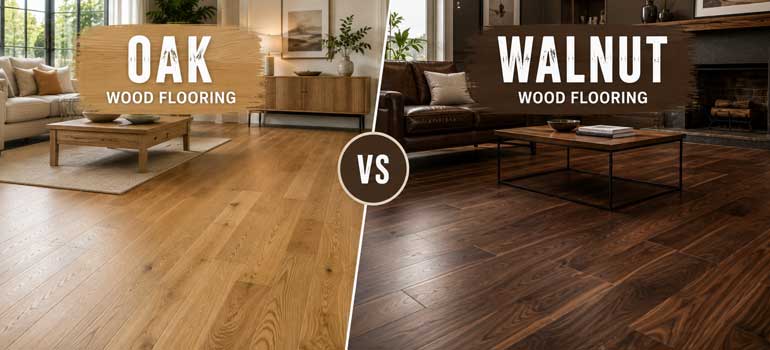
Oak and walnut are two of the most popular choices for real wood and parquet flooring, and it's easy to see why. Both bring a simple, understated elegance that suits the geometric patterns of parquetry without competing with them, and both are genuinely durable, long-lasting materials. They're quite different from each other in colour, cost and hardness, though, so it's worth knowing exactly how before choosing between them.
Oak wood flooring
Oak remains the most popular wood species for flooring of any kind, and its honey and caramel tones give a room a warmth that's hard to match. It suits almost any interior style, from traditional European rooms to more contemporary spaces, and its relatively light, casual look tends to make a room feel open rather than closed in.
There are two main types you'll come across: red oak and white oak. Red oak has a warmer, slightly pinkish heart with visible grain character, while white oak runs paler and has a tighter, closed-pore grain structure that also makes it somewhat more resistant to moisture than red oak. Both are widely available, and oak can be bought unfinished if you'd rather choose your own stain and finish once it's fitted and sanded on-site, rather than take the factory-applied colour of a prefinished board.
Walnut wood flooring
Walnut brings a deep, rich brown tone that reads as elegant and deliberate in almost any setting, and its colour naturally varies from plank to plank in a way that manufactured, uniform-looking products simply can't replicate. That variation is part of the appeal for anyone after a genuinely unique floor rather than a perfectly consistent one, and walnut's grain patterns hold up particularly well when laid out in parquetry designs.
How oak and walnut actually compare on hardness
Oak is the harder of the two, not walnut, which is worth being clear about since it's easy to assume otherwise given walnut's premium image. On the Janka hardness scale, which measures resistance to dents and surface wear, white oak sits at roughly 1,360 and red oak at around 1,290, while walnut comes in at approximately 1,010. That makes oak the more practical choice for consistently heavy foot traffic, while walnut, though still a genuinely durable hardwood, will show dents and wear a little more readily over the same use.
| Oak | Walnut | |
|---|---|---|
| Colour | Honey to caramel tones, red or white variants | Deep, rich chocolate brown |
| Hardness | Harder, better resists dents and scratches | Softer, more prone to marking under heavy use |
| Typical cost | Generally more affordable | Usually sits at a higher price point |
| Best suited to | Hallways, kitchens, high-traffic family rooms | Living rooms, studies, lower-traffic statement spaces |
Which one should you choose?
If your priority is a floor that shrugs off daily wear in a hallway, kitchen or busy family room, oak is the more practical pick and generally the more affordable one too. If you're after a darker, more dramatic look for a living room, study or dining room that doesn't see the same relentless footfall, walnut's colour and character are hard to beat, and its slightly softer nature matters less in a room used more occasionally. Neither is a wrong choice; it really comes down to matching the wood to how the room actually gets used. Our guide to ash, cherry, walnut, maple and oak flooring covers how these two stack up against three other popular species if you're weighing up more than just these two.
Whichever you lean toward, our parquet floor fitting team can advise on what suits your specific room and traffic levels before you order any material, and we're happy to put together a free quote once you've settled on a direction.
Frequently asked questions
Is walnut a bad choice if I have kids or pets? Not necessarily, but it's worth going in with realistic expectations. Walnut will show dents and scuffs a little more readily than oak under the same daily wear, so it suits a lower-traffic room better than a main family living space if durability is a real concern.
Why is walnut usually more expensive than oak? It comes down to supply and demand more than anything else. Walnut trees grow more slowly and produce less usable timber per tree than oak, and its rich colouring and grain variation make it a sought-after premium choice, which keeps the price higher.
Can I get the look of walnut with the durability of oak? Staining oak to a darker, walnut-like tone is one option if hardness matters more to you than having genuine walnut. It won't have walnut's natural colour variation between planks, but it gives you a similar dark, dramatic look with oak's better resistance to wear.
Does engineered wood change the hardness comparison between oak and walnut? Not really, since the visible wear layer on engineered boards is still the same species and hardness as solid wood. What engineered construction changes is dimensional stability against humidity and temperature, not surface hardness.
Is red oak or white oak the better choice? It's mostly a matter of taste, though white oak's tighter, closed grain gives it a slight edge in moisture resistance and it's marginally harder on the Janka scale. Red oak's warmer tone and more prominent grain pattern is simply a different look rather than a lesser one.