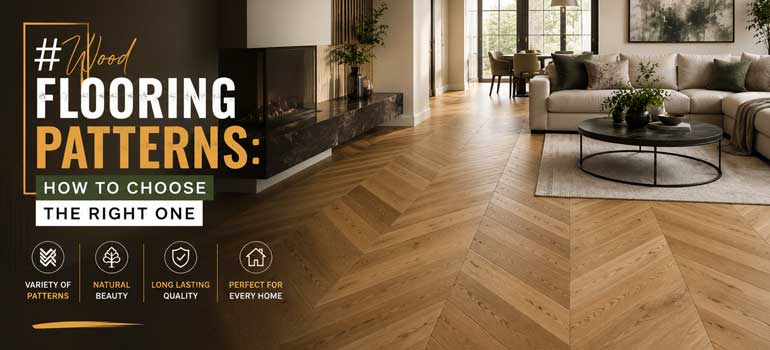
Patterned wood flooring, known as parquetry, turns a floor into part of the room's design rather than just something underfoot. It dates back centuries in France, originally used as a lighter, warmer alternative to the marble floors common in grand houses, and its most famous pattern gets its name from a specific 1684 installation at the Palace of Versailles, though the practice of laying wood in geometric patterns was already established there well before that. Today it covers everything from the classic herringbone zigzag to elaborate panelled designs, and choosing between them comes down to your room's size, style and how bold you want the floor itself to be.
Herringbone and chevron
Herringbone, also called fishbone, is the pattern most people picture when they think of parquet: rectangular blocks laid at right angles to each other in a staggered zigzag. Chevron is closely related but uses mitred, angled cuts so the rows form one continuous straight line instead of a broken zigzag. Both are strong, versatile choices that work in traditional and contemporary interiors alike, and we've covered the construction and species options for this pattern in more detail in our guide to engineered wood fishbone parquet flooring.
Basketweave
Basketweave arranges groups of parallel blocks at alternating right angles, creating a woven, over-under effect similar to a wicker basket. It's a calmer, more subtle pattern than herringbone or chevron, since it doesn't have a strong directional pull across the room, which makes it a good fit for smaller spaces or anywhere you want geometric interest without a dominant visual line.
Brick bond
Brick bond, sometimes called running bond, lays rectangular blocks in staggered rows much like bricks in a wall. It's the simplest of the common parquet patterns to install and gives a room a bit of geometric texture without the complexity or cost of herringbone or a panelled design, which makes it a practical option for rustic or industrial-leaning interiors as well as smaller rooms.
Versailles
Versailles is the most elaborate pattern in general use, built from large, pre-assembled square panels combining diagonal and woven elements within a bordered frame. It's historically associated with grand, formal rooms, and that association still holds today: it makes the strongest statement of any pattern here, but it needs a room with enough scale to let it breathe rather than overwhelm the space.
Which pattern suits your room size?
Pattern complexity matters more for smaller rooms than people often expect. Simpler, calmer patterns like brick bond and basketweave tend to suit compact spaces and entryways well, since they add texture without competing with the room for attention. Herringbone and chevron are versatile enough to work in most room sizes, particularly when laid to draw the eye down a room's longest dimension. Versailles and other elaborate panelled patterns generally need a larger, more formal room to really land, since their scale and detail can feel busy in a tight space.
Matching a pattern to your interior style
- Shabby chic and cottage-style rooms suit herringbone or basketweave laid in pale, muted wood tones, which complements the soft colour palette and rustic furniture typical of the style.
- Traditional interiors pair naturally with any classic pattern, herringbone, chevron or Versailles, especially alongside period furniture and antique pieces.
- Modern and minimalist spaces benefit from a pattern's clean geometric lines as a contrast to simple furniture, with herringbone or brick bond usually striking the right balance without overwhelming a pared-back room.
Whatever pattern you're drawn to, our parquet floor fitting team fits all of the patterns covered here across London homes and businesses, and can advise on what suits your room's size and style before you commit to one. If you're also weighing up wood species alongside the pattern, our guide to ash, cherry, walnut, maple and oak flooring is worth a look too. Get in touch for a free quote whenever you're ready to move forward.
Frequently asked questions
Is herringbone or chevron more expensive to fit? Chevron generally costs a little more, since its mitred, angled cuts produce more offcut waste than herringbone's simpler square-cut blocks. The difference isn't usually dramatic, but it's worth factoring in if budget is tight.
Can I mix two different parquet patterns in the same home? Yes, though it works best when there's a clear boundary between them, such as a doorway or a change in room use, rather than two patterns meeting in the middle of an open-plan space. Keeping the wood species or tone consistent between the two helps them feel intentional rather than mismatched.
Is Versailles pattern parquet only available as solid wood? No, Versailles panels are also produced on an engineered wood backing, which makes the pattern considerably more accessible than traditional hand-cut solid wood panels while keeping the same look.
Does a busy pattern make a small room feel cluttered? It can, particularly with detailed patterns like Versailles or a large-scale herringbone. Simpler patterns like brick bond or basketweave are generally the safer choice for a small room if you want the geometric interest without it dominating the space.
How do I know which pattern will suit my specific room? It comes down to the room's size, how much natural light it gets, and the overall style you're working with, so it's worth getting a professional opinion before ordering material for a pattern you're not entirely sure about. A quick site visit can save a costly mismatch later on.