Monday - Friday 07:30 - 17:30, Saturday 07:30 - 16:00
Restaurant Parquet Floor Fitting in London
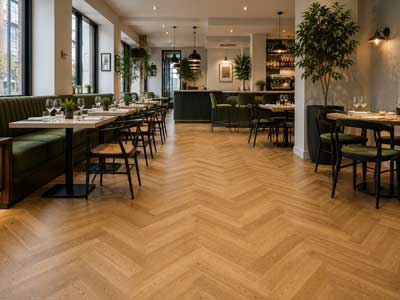
Our team fits and restores parquet flooring for restaurants and leisure venues across London, from full installations to smaller repair jobs, working closely with project managers, business owners, and architects along the way.
Parquetry is a mosaic-style installation of hardwood or engineered wood cut into small blocks and set in geometric patterns — herringbone, chevron, basket weave, and more — unlike any standard plank flooring. Because it's real wood, it carries genuine durability and longevity, but it's a more demanding installation than laying engineered planks, and it benefits from a fitting team with real pattern experience.
Choosing wood for spill-prone dining areas
- Solid wood is more sensitive to humidity and temperature swings. In a restaurant, that means it needs a genuinely dry environment — moisture causes the wood to swell ("ballooning") and, in the worst cases, crack. It's best suited to dining rooms rather than anywhere near a bar or kitchen.
- Engineered wood handles environmental changes far better, is more resistant to scratches, and copes with high foot traffic well — making it the more practical choice for most restaurant floors.
- Kitchens and bar areas are usually better served by a different flooring type altogether, since standing water and constant spills are a routine part of those spaces rather than an occasional risk.
Choosing the right finish
The finish matters as much as the wood choice in a busy dining room. A lacquered finish sits on top of the wood as a protective seal, holding up well against dropped cutlery, chair movement, and the general punishment of a working restaurant floor — when it does wear, it can be sanded and recoated rather than replaced. An oiled finish soaks into the wood instead of sitting on the surface, giving a more natural look and making small scuffs easier to spot-repair, though it needs more frequent reapplication in a high-traffic dining room than it would in a quieter setting. For most restaurants, lacquer is the more practical everyday choice; oil tends to suit lower-traffic areas where the natural finish matters more than maximum durability.
Installation considerations
Preparing the subfloor is essential regardless of which wood you choose. Concrete subfloors are tested for moisture, cleanliness, and evenness before anything is laid, and a moisture barrier underlayment may be recommended depending on the site. Once the subfloor passes, blocks are glued directly down with a high-quality wood adhesive — this remains the standard, reliable method for parquet.
Restaurant fitting comes with its own pressures: limited downtime, tight budgets, and a business that can't afford lengthy disruption. We plan installations around that reality rather than around ours, and can also advise on restaurant-specific commercial fitting more broadly if you're weighing parquet against other flooring for different zones of the venue.
Keeping a restaurant parquet floor looking good
A dining room floor takes more punishment in a week than most home floors see in a year, so a bit of routine care goes a long way. Sweeping or vacuuming daily keeps grit from being ground into the finish underfoot, and any spill — wine, sauce, or otherwise — is best wiped up straight away rather than left to sit, since standing liquid is what actually damages a wood floor, not brief contact. Entrance matting helps too, catching grit and moisture before it ever reaches the dining floor. None of this is complicated, but skipping it is usually what shortens the time between refinishing jobs.