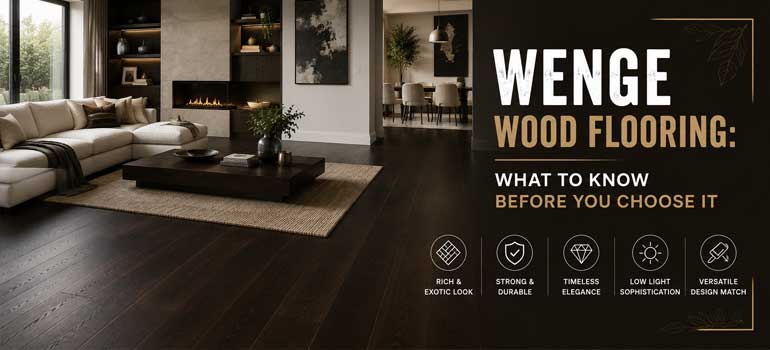
Wenge isn't a wood you see in every home, and that's largely the point of choosing it. Its deep, almost black tone with fine, lighter streaks running through the grain gives a room a striking, dramatic character that lighter, more common species like oak or ash simply don't offer. It's a serious commitment of a wood, though, both in cost and in a couple of practical considerations worth understanding before you order any.
What is wenge?
Wenge comes from Millettia laurentii, a tree native to Central Africa, found across the Congo Basin region including Cameroon, Gabon and the Republic of Congo. The timber is prized for its near-black heartwood and distinctive straight grain, marked with narrow, lighter streaks that give it a subtle pinstripe effect once finished.
How hard-wearing is wenge?
Wenge is a genuinely dense, tough hardwood, generally rated somewhere in the region of 1,600 to 1,900 on the Janka hardness scale depending on the specific source and sample, which puts it comfortably above oak, maple and walnut.
| Species | Approximate Janka rating |
|---|---|
| Wenge | ~1,600–1,900 |
| Maple | ~1,450 |
| Oak (white) | ~1,360 |
| Oak (red) | ~1,290 |
| Walnut | ~1,010 |
That hardness makes it well suited to high-traffic flooring, resisting dents and scratches better than most of the species covered in our guide to ash, cherry, walnut, maple and oak flooring.
Sourcing wenge responsibly
This is worth taking seriously rather than treating as a footnote. Wenge is listed as Vulnerable by conservation bodies due to overharvesting, and demand for its distinctive dark colour has put real pressure on wild populations over recent decades. If wenge is the look you want, buying from a supplier who can demonstrate FSC certification or another credible chain-of-custody standard matters, both ethically and because it's increasingly the only way to guarantee the timber was harvested legally in the first place.
What working with wenge actually involves
A few practical points are worth knowing before committing to it, particularly if you're weighing up solid versus engineered:
- It's genuinely difficult to work with. Wenge's density blunts cutting tools quickly and it's prone to splintering, so installation and any future repairs benefit from an experienced fitter using the right equipment.
- Its open, coarse grain needs filling before finishing for a smooth result, and oil-based finishes tend to suit it better than a straightforward lacquer.
- The dust is a known irritant. Sanding or machining wenge can trigger skin or respiratory irritation in some people, so proper dust extraction and protective equipment matter more here than with most domestic species.
- Engineered wenge is a practical alternative to solid, giving you the same striking veneer over a more stable, cost-effective core, which also stretches a scarce and increasingly expensive timber further.
Does wenge suit every room?
Its very dark tone is worth thinking through before committing to a full room. A large expanse of near-black flooring can make a smaller or naturally darker room feel more closed in, though as we cover in our guide to how wood floor colour changes the mood of a room, lighting and pattern do as much of that work as colour alone. Wenge laid in long, straight planks tends to feel calmer and more spacious than the same colour arranged in a busy herringbone or chevron pattern, so the layout is worth considering alongside the wood itself if you're working with a compact space.
If you're deciding whether wenge is the right fit for your project, our parquet floor fitting team can talk through sourcing, pattern and finish options for your specific room, and put together a free quote once you've got a direction in mind.
Frequently asked questions
Is wenge more expensive than oak or walnut? Yes, generally significantly so. Its scarcity, difficulty to work, and conservation status all push the price well above more common species like oak, which is part of why engineered wenge is a popular way to get the look at a more accessible cost.
Can wenge flooring be sanded and refinished? Yes, though its hardness and open grain make the process more demanding than with softer, more common species, so it's worth having an experienced technician handle it rather than treating it as a straightforward DIY job.
Does wenge flooring fade or change colour over time? Some colour shift from light exposure is normal with most dark woods, wenge included, typically a gradual softening of the near-black tone rather than a dramatic change. A UV-protective finish slows this if you want to preserve its original depth of colour.
Is engineered wenge as durable as solid wenge? The visible wear layer is the same wood either way, so the surface hardness is identical. What changes with engineered construction is stability against humidity and temperature, which is generally an improvement over solid wenge rather than a compromise.
What pairs well with a wenge floor? Lighter walls and furnishings tend to balance wenge's intensity well, letting the floor act as a dramatic anchor rather than making the whole room feel heavy. It also pairs naturally with brushed metal and pale stone accents if you're going for a more contemporary look.