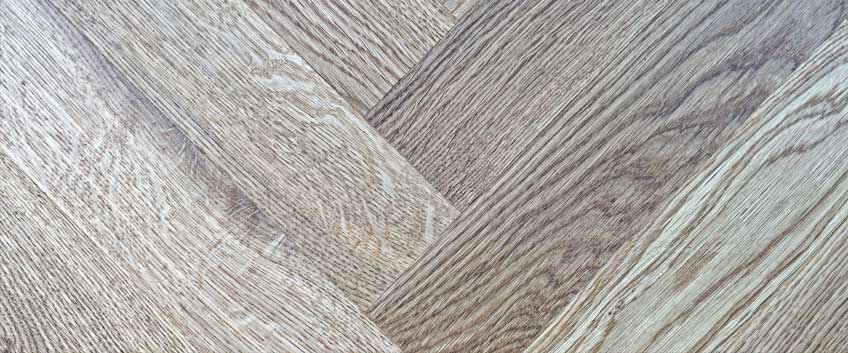
Patterned wood flooring gets chosen for its looks first, but durability is usually close behind on the list of reasons people commit to it over something simpler. It's worth separating fact from assumption here, since the pattern itself has less to do with how long a floor lasts than most people expect.
Does the pattern actually affect durability?
Not directly, and this is worth being clear about. A floor's durability comes down to the wood species and whether it's solid or engineered construction, not whether it's laid in herringbone, chevron, basketweave or a simple straight run. A hard species like oak will outlast a softer one like walnut regardless of the pattern it's arranged in, and engineered wood will resist humidity-driven movement better than solid wood in any layout. Our guide to wood flooring patterns covers the main pattern options if you're weighing them up, but the pattern choice itself is really a styling decision rather than a durability one.
Where pattern does matter is indirectly, through installation quality. A complex pattern demands more precision to fit correctly, and a poorly executed installation, regardless of pattern, is more likely to develop gaps, loose blocks or uneven wear over time than a well-fitted one. The pattern raises the bar for getting the fitting right, rather than changing what the wood itself is capable of.
Which patterns hold up best to heavy traffic?
Since the pattern doesn't change the wood's inherent durability, this comes down more to practical fitting considerations. Herringbone and chevron are both well suited to busy rooms when paired with a hard-wearing species and a durable finish, and we cover the construction differences between the two in our dedicated guides to the herringbone wood floor pattern and chevron patterned parquetry. Basketweave, being a calmer, less directional pattern, tends to suit smaller or lower-traffic spaces better, which we go into in our guide to the basketweave parquet pattern.
Engineered wood is generally the safer choice for a patterned floor in a busy room, since the added dimensional stability reduces the risk of individual blocks shifting out of alignment with their neighbours as humidity changes through the year, which is more visually obvious in a precise pattern than it would be in a simple straight-laid floor.
What does refinishing a patterned floor actually involve?
This is worth knowing before you commit to a pattern, since it's a genuine practical difference from straight-laid flooring. Patterned floors have wood grain running in several different directions across the same surface, which makes sanding more demanding than a straight-laid floor, where every board runs the same way. Getting an even finish across a herringbone or chevron floor takes real experience, and it's a job worth leaving to a professional rather than treating as a first DIY refinishing project. Our guide to the main parquet flooring issues covers more on when a floor needs this kind of attention.
Can you paint a patterned floor instead of refinishing it?
It's technically possible, using a floor paint specifically formulated for the traffic the room will see, but it's worth going into with realistic expectations. Painting covers the wood's surface rather than restoring it, which means you lose the natural grain and colour variation that's usually a big part of why someone chose a patterned wood floor in the first place. It also needs proper preparation, a clean, sanded, primed surface, to bond and wear well, so it's not simply a case of applying paint over an existing finish. If what draws you to real wood is being able to sand and refinish it repeatedly over its life, as we cover in our guide to the benefits of having a real wood floor, painting is worth weighing against that specifically, since it changes the floor's character in a way that's harder to reverse than a standard refinish.
If you're planning a patterned floor and want advice on which species, construction and pattern combination suits your room's traffic levels, our parquet floor fitting team can talk it through with you. Get in touch for a free quote whenever you're ready.
Frequently asked questions
Is a patterned floor more expensive to maintain than a straight-laid one? Not really for day-to-day cleaning, which is the same regardless of pattern. Refinishing costs a little more for a patterned floor, since the multi-directional grain takes more skill and time to sand evenly than a straight-laid floor does.
Does a complex pattern wear out faster than a simple one? No, wear comes down to the wood species, construction and finish, not the pattern's complexity. A well-fitted herringbone floor in a hard species will outlast a poorly fitted straight-laid floor in a soft one.
Is solid or engineered wood better for a patterned floor specifically? Engineered wood is generally recommended for patterned floors, since its dimensional stability helps keep the precise alignment of a complex pattern looking sharp through seasonal humidity changes, more so than it matters for a simple straight-laid floor.
Can an old, damaged patterned floor be restored rather than replaced? Often yes, provided there's enough wood left in the wear layer to sand back. It's worth having a professional assess the floor's condition before assuming a full replacement is necessary, since patterned parquet is frequently restorable even when it looks quite worn.
Do patterned floors go out of style? Patterns like herringbone and chevron have stayed popular for centuries rather than being tied to a single decade's trend, so it's a safer long-term choice than many other flooring styles. Even if a specific colour or finish falls out of favour, the underlying pattern and wood can usually be refinished rather than replaced entirely.